
Baking Area Spiral Doors are the ultimate operational upgrade for food processing facilities struggling with immense energy waste and temperature fluctuations. In thermal processing, cooking, or baking zones, the doorway is your biggest vulnerability. Every time a standard door opens slowly, massive amounts of expensive heat escape, forcing your ovens to work harder and driving up your energy bills.
If you are managing a food plant, you know that the boundary between the baking zone and the cooling/packaging zone requires a strict thermal barrier. Let’s dive into why upgrading to specific, scenario-focused rigid rapid doors is critical for your bottom line.
Contents
1. Eliminating Extreme Heat Loss (Energy-Saving)
The most significant pain point at any oven entrance is heat escaping into cooler zones. Energy-saving Baking Area Spiral Doors feature thick, double-walled aluminum slats filled with high-density PU foam. This specific construction breaks the thermal bridge. Unlike standard PVC fabric doors that warp or melt near industrial ovens, these rigid slats withstand high radiant temperatures, trapping the heat exactly where it belongs—inside the baking area.
2. Lightning-Fast Speeds to Maintain Baking Quality
When bakery trolleys or forklifts enter the thermal processing zones, exposure time must be minimized. A high-quality rigid door opens at speeds up to 2.5 m/s. This rapid action drastically reduces the air exchange time. By utilizing high-speed Baking Area Spiral Doors for food processing, you prevent sudden temperature drops in the oven room, ensuring your pastries, breads, or meats bake evenly without quality defects.
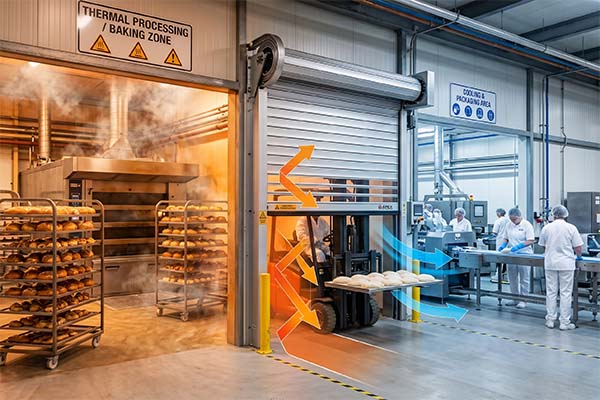
Why Baking Area Spiral Doors Outperform Standard Solutions
3. Non-Contact Track Design for Zero Contamination
Food safety is non-negotiable. Traditional roller doors have physical friction, which can generate microscopic metal dust that risks falling into food batches. Baking Area Spiral Doors utilize a specialized non-contact spiral track. The door slats roll up into the spiral guide without touching each other. This friction-free operation means no metal wear, no dust, and absolute compliance with HACCP and FDA hygiene standards.
4. Stopping “Heat Pollution” to Adjacent Cold Zones
It is a nightmare for your HVAC system when 80°C (176°F) ambient heat from the cooking zone rushes into an 18°C (64°F) packaging area. Insulated Baking Area Spiral Doors act as a heavy-duty shield. By keeping the intense heat isolated, you drastically reduce the cooling load on your refrigeration units in adjacent rooms, essentially saving money on both heating and cooling simultaneously.
5. Resisting High-Temperature Deformation
The baking environment is harsh. Continuous exposure to dry heat and steam can warp ordinary doors. Aluminum Baking Area Spiral Doors are engineered specifically for this extreme thermal environment. The robust aluminum shell resists corrosion from humidity and won’t warp under high thermal stress, providing a long lifecycle in a punishing environment.
6. Seamless Integration with Automated Conveyors
Many modern bakeries use automated guided vehicles (AGVs) or continuous conveyor belts. Custom Baking Area Spiral Doors for ovens can be integrated with radar, magnetic loops, or smart factory PLC systems. They open perfectly in sync with approaching automated trolleys, ensuring a continuous, bottleneck-free food processing line.
Conclusion
Stop letting your profits evaporate through inefficient doorways. By investing in specialized Baking Area Spiral Doors, you are not just buying a fast door; you are installing a highly effective thermal shield that protects your product quality, meets strict food safety regulations, and slashes your energy bills.
FAQ
Q1: Can Baking Area Spiral Doors withstand the extreme radiant heat next to industrial ovens?
A: Absolutely. Unlike standard fabric roll-up doors that can soften, melt, or deform when exposed to radiant oven heat, Baking Area Spiral Doors are constructed with heavy-duty aluminum slats and a high-density PU foam core. This design not only resists physical deformation under high temperatures but also effectively blocks thermal transfer, ensuring the door remains fully operational and structurally sound in extreme environments.
Q2: How do these doors help our facility comply with HACCP food safety standards?
A: In a food processing or baking zone, preventing cross-contamination is critical. HACCP compliant spiral doors feature a unique non-contact track system. Because the metal slats never rub against each other or the track as they roll up, they do not produce metallic dust or shed particles. Additionally, their smooth, crevice-free surfaces prevent flour, oil, and bacteria from accumulating, making them exceptionally easy to sanitize during your routine wash-downs.
Q3: Will installing Baking Area Spiral Doors actually reduce my overall energy bills?
A: Yes, the return on investment is highly noticeable. In a thermal processing zone, you pay a premium to generate heat for the ovens and to generate cold air for the adjacent packaging rooms. Standard slow doors allow these two atmospheres to mix, creating massive energy waste. The ultra-fast opening/closing speeds (up to 2.5 m/s) combined with thick thermal insulation drastically minimize the time the doorway is open and stop heat transfer when closed, directly lowering both your heating and HVAC cooling costs.


