
Implementing heavy-duty stainless steel fabric doors is the single most critical infrastructure decision for the hot processing and deep frying sectors of a modern food processing plant. In these high-temperature environments, the combination of boiling oil vapor and continuous moisture creates a destructive atmosphere that wrecks conventional industrial doors. Standard commercial doors quickly degrade, lock up, or harbor dangerous bacterial growth under these conditions. Conversely, specialized stainless steel fabric doors are engineered to isolate intense thermal zones, withstand aggressive sanitization, and streamline traffic flow without sacrificing hygiene.
Contents
- 1 Why Frying Areas Demand Specialized Stainless Steel Fabric Doors
- 2 The Science of Clean: Why Our Doors Resist Grease and Simplify Maintenance
- 3 Overcoming Severe Washdown and Thermal Insulation Challenges
- 4 Direct from the Factory: Custom Stainless Steel Fabric Doors for Your Plant
- 5 Conclusion
- 6 FAQ
- 6.1 Q1: Will the high heat radiating directly from industrial fryers distort or damage the fabric curtain?
- 6.2 Q2: Why is an open-profile track better than a sealed track for a heavy grease environment?
- 6.3 Q3: Can these doors withstand the highly caustic chlorinated cleaners used in food processing plants?
Why Frying Areas Demand Specialized Stainless Steel Fabric Doors
The atmospheric conditions surrounding industrial frying lines are highly hostile. When large volumes of product pass through industrial fryers, massive quantities of airborne grease and oil vapor are released into the surrounding air. As this grease vapor cools, it deposits a sticky, resilient layer over every vertical and horizontal surface, including door assemblies.
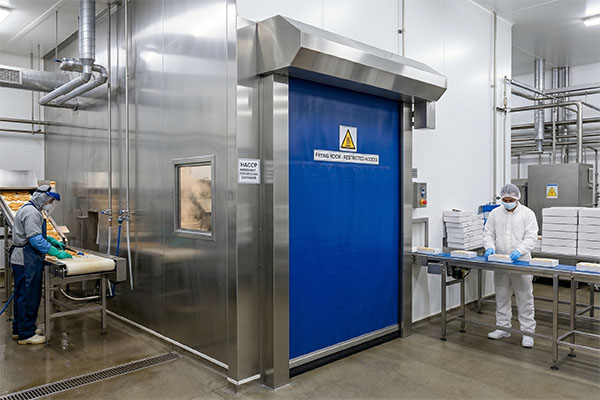
If a facility relies on painted carbon steel or standard aluminum doors, this airborne grease chemically attacks the coatings, leading to peeling paint and metal oxidation. More importantly, grease accumulation inside enclosed structural tracks creates severe friction, causing motors to overheat and doors to jam. Choosing specialized stainless steel fabric doors designed specifically for hot processing zone doors is the only reliable way to maintain continuous uptime and ensure strict HACCP compliance.
The Science of Clean: Why Our Doors Resist Grease and Simplify Maintenance
The exceptional performance of these doors in greasy environments comes down to advanced material science and sanitary engineering. They don’t just endure the grease; they are actively designed to repel it, explaining why they deliver unparalleled grease resistance and ease of cleaning.
Non-Porous, Low-Friction Door Curtains: The curtain material utilizes a high-density, double-sided polyurethane (PU) or specially treated premium PVC block-copolymer. Unlike cheap, porous fabrics that absorb fats and swell, this surface is chemically inert. Grease molecules cannot penetrate the substrate or bond tightly to it, allowing heavy oil films to slide off naturally or be wiped away with minimal effort during a washdown environment.
Ultra-Smooth 304/316L Stainless Steel Finishes: All structural components—including the side frames, hood enclosures, and bottom bars—are constructed from precision-polished 304 or 316L stainless steel. The metal surface is treated to a high-grade mechanical polish to achieve an incredibly low surface roughness (R_a value). Without microscopic crevices, organic fats and food particulates have no place to anchor, preventing the formation of stubborn biofilms.
Sloped, Self-Draining Geometries: Traditional industrial doors feature flat horizontal headers where grease aerosols naturally pool and liquefy over time. Our advanced stainless steel fabric doors utilize a 45-degree sloped canopy and rounded structural profiles. Liquid grease and condensed oil droplets drain naturally downward rather than accumulating into a fire or hygiene hazard.
Open-Profile, Washdown-Ready Tracks: Standard enclosed door tracks act as traps for grease and stagnant water, making them a breeding ground for Listeria. Our food grade stainless steel fabric doors feature an open-profile side guide or easily removable covers. This gives sanitation crews direct, unobstructed access to the interior tracks, allowing them to blast out grease without dismantling the frame.
Overcoming Severe Washdown and Thermal Insulation Challenges
High-volume frying zones not only battle severe airborne grease buildup but also must endure extremely rigorous nightly washdown procedures. After daily production concludes, sanitation crews aggressively disinfect the entire area using high-temperature, high-pressure water jets combined with caustic chemical cleaners.
Our washdown stainless steel fabric doors handle this abuse easily. The mechanical frame remains completely immune to chemical pitting and rusting. Crucially, the engineering focus extends to the electronic components. Instead of a general “waterproof” claim, our systems feature fully enclosed, IP65 or IP66-rated drive motors and corrosion-proof stainless steel control boxes. This means your sanitation team can spray the entire door assembly with high-pressure water guns without risking electronic short-circuits or costly motor burnouts.
Furthermore, the frying area represents a massive thermal load. The rapid seal of these grease resistant fabric roll up doors prevents hot, oily air from escaping into adjacent packaging or blast-freezing zones. This tight thermal separation maximizes your facility’s HVAC efficiency and completely eliminates the risk of cross-contamination from airborne grease migration.
Direct from the Factory: Custom Stainless Steel Fabric Doors for Your Plant
As a direct source manufacturer with dedicated in-house technical teams and full production lines, we know that no two food processing facilities share the exact same floor plan or ventilation dynamic. Standard, off-the-shelf doors simply cannot handle the nuances of a high-volume frying line.
We specialize in engineering custom stainless steel fabric doors tailored precisely to your specific clearance heights, wall compositions, and washdown protocols. From adjusting the curtain material thickness for extreme heat zones to integrating advanced interlocking hardware that syncs with your ventilation system, our engineers deliver optimized solutions directly from our factory floor to your facility.
Conclusion
Investing in specialized stainless steel fabric doors for your frying area is a direct investment in your facility’s operational reliability and food safety compliance. By eliminating grease-induced mechanical failures, slashing daily sanitation turnaround times, and preventing structural corrosion, these high-speed doors provide an undeniable return on investment for any high-output food processing plant.
FAQ
Q1: Will the high heat radiating directly from industrial fryers distort or damage the fabric curtain?
A1: No. Our grease resistant fabric roll up doors utilize heavy-duty, temperature-stabilized curtains specifically designed for hot processing zones. They maintain their structural integrity and flexibility in ambient temperatures up to 70°C (158°F) and resist localized radiant heat, ensuring they will not warp, stretch, or become brittle like standard warehouse door curtains.
Q2: Why is an open-profile track better than a sealed track for a heavy grease environment?
A2: In a frying zone, grease vapor penetrates even the tightest seals over time. Once inside a traditional sealed track, it mixes with water to form a toxic, sticky sludge that is impossible to clean without dismantling the door. Our washdown stainless steel fabric doors feature an open-profile or quick-release track design, allowing high-pressure water and sanitizers to easily flush out all oil and grease accumulations during daily cleaning routines, leaving zero sanitary dead zones.
Q3: Can these doors withstand the highly caustic chlorinated cleaners used in food processing plants?
A3: Yes, provided you select the appropriate stainless steel grade. We manufacture our food grade stainless steel fabric doors using premium 304 stainless steel as standard, which offers excellent resistance to common food plant sanitizers. For environments using highly aggressive, concentrated chlorine or acid-based cleaners, we offer custom upgrades to 316L stainless steel, providing maximum protection against chemical pitting and corrosion.


