
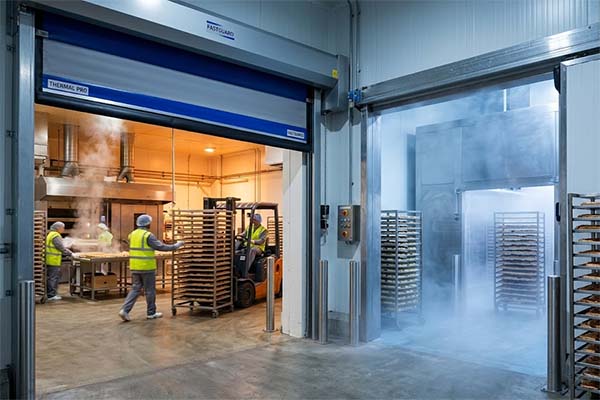
When managing a modern, high-volume food manufacturing facility, Thermal Insulation Speed Doors are not just secondary physical barriers; they are the most critical lines of defense protecting your operational efficiency, energy consumption, and hygiene standards. In industrial food processing plants, the transition corridor between the thermal processing area (such as commercial ovens, deep fryers, and steam cooking zones) and the cooling zone (including blast chillers, freezing tunnels, and pre-cooling rooms) represents the most extreme and volatile environmental clash in the entire factory.
On one side of the threshold, you are dealing with intense heat, heavy moisture, and airborne grease. Just a few feet away lies a sub-zero, highly sanitized environment meticulously designed to rapidly drop product temperatures to preserve safety and shelf life. Managing the relentless, high-speed traffic flow of forklifts, automated guided vehicles (AGVs), and production personnel between these two thermodynamic extremes without compromising internal climate control is a monumental engineering challenge.
This is precisely where standard industrial doors fail catastrophically, and where Thermal Insulation Speed Doors become absolute necessities for global food enterprises. In this comprehensive technical guide, we will explore exactly how these specialized high-speed doors solve the unique, costly, and hazardous pain points associated specifically with the thermal-to-cooling transition zone.
Contents
- 1 1. Conquering the Extreme Thermal Gradient with Thermal Insulation Speed Doors
- 2 2. Eliminating Condensation and Dangerous Frost Build-up
- 3 3. Halting Energy Hemorrhage: The Financial Impact
- 4 4. Preventing Cross-Contamination and Ensuring HACCP Compliance
- 5 5. Uninterrupted Workflow for Forklifts and AGVs
- 6 6. Protecting Equipment Lifespan in Harsh Environments
- 7 7. The Self-Repairing Advantage in High-Traffic Zones
- 8 Why Generic Industrial Doors Fail Here
- 9 Conclusion: Securing Your Bottom Line
- 10 Frequently Asked Questions
- 10.1 1. How do Thermal Insulation Speed Doors prevent ice build-up when transitioning from high-heat to sub-zero cooling zones?
- 10.2 2. What is the expected ROI when upgrading to energy-saving industrial doors for thermal processing?
- 10.3 3. Do these anti-condensation speed doors meet strict FDA and HACCP washdown compliance?
1. Conquering the Extreme Thermal Gradient with Thermal Insulation Speed Doors
The primary and most aggressive challenge in moving hot, processed products from an industrial oven directly to a blast chiller is the massive thermal gradient. A cooking zone might sit at a sweltering 85°C (185°F) with dense, humid steam, while the adjacent cooling zone operates at a harsh -20°C (-4°F). When a traditional cold storage door opens, it moves at a sluggish pace. This slow operation acts as an open floodgate, allowing massive volumes of hot, humid air to violently rush into the cold zone, while heavy, expensive cold air spills out onto the cooking floor.
Thermal Insulation Speed Doors are precision-engineered to neutralize this thermodynamic threat. Operating at exceptional opening speeds of up to 2.5 meters per second, these doors minimize the atmospheric exposure time between the two conflicting zones to mere milliseconds. By utilizing advanced multi-layered insulated curtains filled with high-density polyurethane foam, they provide an exceptional R-value when closed. The rapid cycle times mean that convective heat exchange is forcefully interrupted, stabilizing the internal climates of both the thermal processing zone and the cooling zone. This dynamic atmospheric separation is something traditional solid doors simply cannot achieve without creating massive logistical bottlenecks on the production line.
2. Eliminating Condensation and Dangerous Frost Build-up
Perhaps the most insidious and dangerous problem located strictly between heating and cooling zones is rapid condensation. When hot, moisture-laden air from the boiling or baking area collides with a cold surface, it immediately condenses into water droplets. In a sub-zero blast chilling environment, these water droplets instantly flash-freeze into solid ice.
If you attempt to use standard fast roll up doors for cooling zones without proper thermal breaks, the door curtain itself becomes a massive condensation trap. Water will relentlessly drip from the header onto the factory floor, creating severe slip-and-fall hazards for your personnel. Even worse, if contaminated water drips onto the exposed food products passing below on conveyors or racks, it triggers an immediate and disastrous food safety violation. Furthermore, heavy ice build-up on the aluminum door tracks can cause the entire mechanical system to jam, leading to expensive, unexpected downtime.
Thermal Insulation High Speed Doors systematically solve this pain point through specialized anti-condensation engineering. The thick, thermally broken insulated curtain prevents the freezing temperature from transferring through to the warm, humid side of the door. Additionally, premium enterprise-grade models designed for these specific transitions feature intelligently heated side guides and heated motor housings. This localized thermal tracing completely eradicates frost build-up at a microscopic level, ensuring that the door operates flawlessly 24/7, keeping your floors bone-dry and your facility entirely safe from slip hazards.
3. Halting Energy Hemorrhage: The Financial Impact
In the industrial food processing sector, energy costs associated with HVAC systems, commercial steam ovens, and heavy-duty industrial refrigeration account for a massive percentage of total operational overhead. When hot air violently infiltrates a cooling zone, your refrigeration compressors and evaporator coils must work in absolute overdrive to bring the ambient temperature back down to the required setpoint. Over time, this constant, punishing overworking leads to premature equipment failure and skyrocketing electricity bills.
Installing Thermal Insulation Speed Doors is proven to be one of the most effective mechanical upgrades to plug this energy hemorrhage. Because these energy-saving industrial doors for thermal processing open and close so rapidly, the total volume of air that escapes during a standard forklift pass is reduced by up to 80% compared to traditional, slow-moving cold storage doors.
Let’s examine the financial mathematics for a high-volume plant: By combining the high R-value of the insulated curtain (which decisively stops conductive heat loss when closed) with the rapid roll-up action (which stops convective heat loss when open), facility managers routinely see a return on investment (ROI) within 12 to 18 months. This rapid payback is generated purely through verified savings on refrigeration electrical consumption.
4. Preventing Cross-Contamination and Ensuring HACCP Compliance
In food manufacturing, hygienic safety is strictly non-negotiable. Facilities must rigorously adhere to HACCP (Hazard Analysis Critical Control Point) and FDA regulations. The physical transition from the cooking zone to the cooling zone is officially classified as a critical control point. Products leaving the thermal zone are sterilized by intense heat; however, as they rapidly cool, they become highly vulnerable to airborne pathogens.
If the internal air pressure between the cooking and cooling zones is not tightly controlled, aerosolized grease, cooking smoke, and raw material particulate from the hot side can easily drift into the sanitized clean side. Thermal Insulation Speed Doors feature heavy-duty, engineered perimeter sealing systems to combat this. When the door zips shut in a fraction of a second, heavy-duty rubber gaskets and tight-fitting side guides form a nearly impenetrable airtight seal.
This superior sealing capability flawlessly maintains the necessary pressure differentials between manufacturing zones. By keeping the cooling zone positively pressurized and the cooking zone negatively pressurized, the airtight nature of these doors ensures that no airborne contaminants can bypass the barrier. Furthermore, the PVC or polyurethane surfaces of these doors are specifically manufactured to be smooth, non-porous, and capable of withstanding harsh, daily chemical washdowns, completely eliminating any microscopic harbor points for lethal bacteria like Listeria or Salmonella.
5. Uninterrupted Workflow for Forklifts and AGVs
In high-volume automated bakeries, poultry processing plants, or ready-to-eat meal factories, workflow speed is directly tied to overall profitability. Racks of steaming hot food must be transported into blast chillers immediately to halt the cooking process and perfectly preserve texture, flavor, and product weight.
Standard hard-panel cold storage doors are notoriously sluggish. Forklift operators often have to stop, wait for the heavy door to open, drive through, and wait for it to close. This mechanical delay causes a severe chain reaction of logistical bottlenecks. To avoid waiting, drivers will often deliberately leave traditional doors propped open—a catastrophic human error for both facility energy consumption and strict food safety compliance.
By fully integrating Thermal Insulation Speed Doors into your architecture, the logistical flow remains completely unhindered. These advanced doors are natively designed to be integrated with highly precise radar sensors, magnetic floor loops, or direct PLC software links to Automated Guided Vehicles (AGVs). As the transport vehicle approaches the transition zone from the high-heat bakery, the door flies open instantaneously and snaps shut the exact millisecond the vehicle clears the safety threshold. These fast roll up doors for cooling zones ensure that high-speed logistics and uncompromising climate control can finally coexist without friction.
6. Protecting Equipment Lifespan in Harsh Environments
It is not just the delicate food products and the monthly energy bills that suffer from poor door choices; the internal material handling equipment and the building infrastructure itself take a severe beating. Extreme, rapid temperature fluctuations cause destructive thermal shock. When hot, humid air constantly attacks the cold metal components of conveyor systems and chilling units, accelerated oxidation, condensation, and deep rust are inevitable.
Deploying high-speed doors for food processing in these specific transition corridors acts as a vital mechanical shock absorber for your facility’s internal climate. By rigidly separating the highly humid cooking atmosphere from the bone-dry, freezing environment protected by cold storage high-speed doors, you shield your expensive cooling coils from premature frosting. When cooling coils freeze over due to excessive atmospheric moisture ingress, the refrigeration system is forced into a costly defrost cycle. Every single defrost cycle wastes massive amounts of energy and temporarily raises the cold room temperature. By decisively stopping the moisture directly at the door threshold, you drastically reduce the frequency of these detrimental defrost cycles, thereby extending the operational lifespan of your critical refrigeration hardware.
7. The Self-Repairing Advantage in High-Traffic Zones
In the chaotic, fast-paced environment directly between continuous cooking lines and blast chillers, mechanical accidents happen. Forklifts carrying towering racks of hot products or heavy stainless-steel vats are highly prone to bumping into door frames or curtains. If a traditional, rigid solid refrigerated door is struck, the steel hinges bend, the insulated panels dent, and the door fundamentally cannot close. This leaves your extreme temperature zones fully exposed for hours or even days while you wait for an emergency repair technician, resulting in massive, irreversible product loss and crippling energy waste.
Modern Thermal Insulation Speed Doors are intelligently designed with an ingenious “breakaway” or self-repairing feature specifically for these high-risk zones. If a forklift collides with the door curtain, the flexible insulated curtain safely derails from its side guides to absorb the kinetic impact without sustaining permanent structural damage. As the door automatically cycles up for its very next opening, the internal zipper-like mechanism automatically re-feeds the curtain flawlessly back into the vertical tracks. Within seconds, the door is fully operational, structurally sound, and tightly sealed again, resulting in zero downtime, zero emergency repair costs, and absolutely zero disruption to your strict temperature control protocols.
Why Generic Industrial Doors Fail Here
It is crucial for facility managers to understand that not all industrial doors are created equal. While a standard, single-layer PVC high-speed door might be perfectly adequate for separating two ambient temperature warehouses, it will fail spectacularly when placed between a 100°C cooking line and a -20°C freezer. A generic door simply lacks the engineered thermal break necessary to stop conductive heat transfer. It lacks the heavy-duty, tight-fitting seals required to stop airborne moisture migration. Critically, it lacks the sophisticated heating elements needed to prevent the tracks and motors from freezing solid.
Investing in purpose-built anti-condensation speed doors is not an optional aesthetic upgrade for food manufacturers; it is a fundamental, mechanical requirement for mastering the complex, high-stakes thermodynamics of your production facility.
Conclusion: Securing Your Bottom Line
The transitional journey a food product takes from the industrial oven directly to the freezer is fraught with severe logistical and environmental hazards. By thoroughly understanding the aggressive dynamics of the thermal-to-cooling transition, facility engineers and plant managers can make highly informed, profitable infrastructure decisions.
Thermal Insulation Speed Doors represent the ultimate industrial synthesis of high-speed automation, extreme thermal resistance, and sanitary compliance design. They do not merely close a physical gap in a wall; they actively protect your product quality, rigorously enforce HACCP compliance, stop devastating financial energy leaks, and keep your high-speed logistics moving without a single second of friction. If your enterprise facility is still relying on slow, outdated mechanical barriers between your high-heat cooking and deep-freeze cooling zones, you are hemorrhaging profit every single time those doors open. Upgrade to specialized thermal speed doors today, and take total, uncompromising control over your factory’s climate, safety, and operational profitability.
Frequently Asked Questions
1. How do Thermal Insulation Speed Doors prevent ice build-up when transitioning from high-heat to sub-zero cooling zones?
Standard industrial doors fail in this specific scenario because heavy humidity from the cooking zone quickly condenses and freezes on cold surfaces. Thermal Insulation Speed Doors utilize a thick, high-density insulated curtain that creates a critical thermal break, aggressively preventing cold transfer. Premium enterprise models designed specifically for these exact extreme environments integrate automated heating elements directly within the side guides and motor housings. This localized thermal tracing actively evaporates condensation before it has the opportunity to freeze, ensuring continuous, jam-free operation and eliminating hazardous floor ice.
2. What is the expected ROI when upgrading to energy-saving industrial doors for thermal processing?
Industrial facilities typically achieve a Return on Investment (ROI) within 12 to 18 months. The extreme temperature differential between commercial ovens and blast chillers causes massive convective heat exchange whenever doors open. By seamlessly combining rapid cycle speeds (up to 2.5m/s) with highly efficient R-value insulation, these doors reduce air infiltration by up to 80%. This instantly reduces the punishing mechanical load on your refrigeration compressors and HVAC systems, translating directly into drastically lowered monthly energy expenditures and a significantly extended equipment lifespan.
3. Do these anti-condensation speed doors meet strict FDA and HACCP washdown compliance?
Yes. Preventing hazardous cross-contamination is a primary engineering focus for these specialized doors. They are manufactured using heavy-duty, non-porous, smooth PVC or polyurethane materials that actively resist bacterial harborage and can withstand harsh, daily chemical washdowns without degrading. Furthermore, the rapid closing action and heavy-duty perimeter sealing maintain critical air pressure differentials—keeping sub-zero cooling zones positively pressurized so that airborne grease, cooking smoke, and lethal pathogens from the hot thermal area cannot mechanically breach the sanitized environment.


