
Thermal Insulation Fast Doors represent the ultimate barrier for one of the most critical and hazardous transition points in food production: the deli cooling room entrance. The transition from industrial cooking ovens to the rapid cooling zone is arguably the most vulnerable phase in any ready-to-eat food processing plant. During this phase, upgrading your facility’s physical barriers is not just a structural enhancement; it is a mandatory operational safeguard against catastrophic foodborne illnesses and immense energy waste.
When steaming hot deli products, emitting intense heat and moisture, are transferred into freezing rapid-chilling tunnels, the entrance becomes a chaotic battleground of extreme temperature differentials. If this threshold is not properly managed with specialized equipment, it leads to condensation, compromised hygiene, and severe logistical bottlenecks. In this comprehensive guide, we will explore the specific challenges of the cooling zone entrance and exactly why implementing Thermal Insulation Fast Doors is the ultimate solution for food plant managers prioritizing strict HACCP compliance and high-volume output.
Contents
- 1 Why Deli Cooling Rooms Demand Thermal Insulation Fast Doors
- 2 FAQ
- 2.1 Q1: Can Thermal Insulation Fast Doors really prevent condensation from dripping onto exposed deli meats?
- 2.2 Q2: What is the main difference between these fast doors and traditional cold storage doors?
- 2.3 Q3: How do these doors accommodate the heavy floor traffic of food carts and AGVs without getting damaged?
- 3 Moving Beyond Standard Solutions
Why Deli Cooling Rooms Demand Thermal Insulation Fast Doors
To understand the absolute necessity of this specific equipment, we must first look at the unique micro-climate of the cooling room entrance. One side of the facility operates at high temperatures with heavy steam (often exceeding 80°C), while the other side blasts freezing air (often between 0°C and -10°C) to quickly drop the core temperature of the cooked food.
Standard industrial barriers or PVC strip curtains fail miserably in this extreme environment. They allow massive energy transfer and severely disrupt workflow. More dangerously, they become a breeding ground for sanitation nightmares. This is where Thermal Insulation Fast Doors step in to resolve the precise pain points of the rapid cooling process, replacing generic doorways with high-performance, active environmental separation.
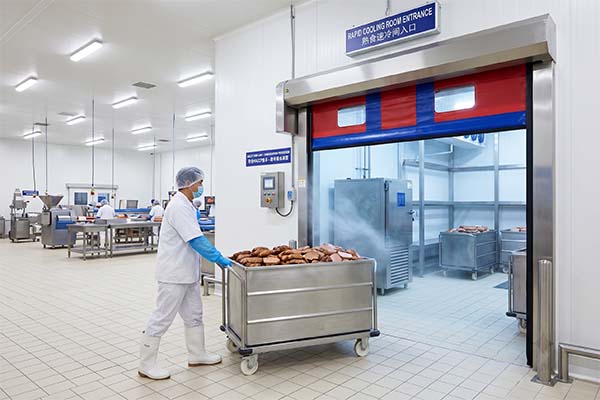
1. Eliminating Condensation and the Threat of Listeria
The absolute biggest biological threat at the entrance of a deli cooling room is condensation. When hot, humid air from the roasting or boiling room hits the freezing surface of a standard uninsulated door, water droplets immediately form. As these doors vibrate from machinery or open for traffic, this condensation can drip directly onto the freshly cooked, exposed deli meats waiting to enter the chiller.
This dripping water is a primary vector for Listeria monocytogenes and other highly dangerous pathogens. Because the food has already been cooked, it lacks any further heat-kill step before packaging, making it incredibly vulnerable.
Thermal Insulation Fast Doors solve this fatal problem through advanced thermal break technology. Unlike standard single-layer doors, these insulated fast doors for food processing utilize a specialized insulated core or multi-layer curtain design. This creates a definitive thermal barrier that prevents the outer surface of the door from freezing. By keeping the warm-side curtain above the ambient dew point, condensation is fundamentally prevented. No condensation means no dripping water, effectively neutralizing one of the highest-risk cross-contamination points in your entire facility.
2. Conquering the Bacteria Danger Zone with Speed
Food safety regulations and modern HACCP protocols mandate that cooked products must pass through the “Bacteria Danger Zone” (roughly 60°C down to 4°C) as rapidly as possible. Pathogens multiply exponentially when trapped at these temperatures.
When carts of hot deli meats approach the cooling room, every second counts. Heavy, manual doors are notoriously slow. They delay the transfer process and allow the precious freezing air inside the cooling zone to escape into the cooking area. This raises the ambient temperature of the chiller, meaning the refrigeration equipment has to work twice as hard to bring the temperature back down, unacceptably prolonging the time the food spends in the danger zone.
Thermal Insulation Fast Doors are engineered for rapid logistics. Operating at opening speeds of up to 2.0 meters per second, they ensure that the hot products can be transported into the blast chiller with absolute zero delay. The moment the cart clears the threshold, the door seals shut instantly. By using Thermal Insulation Fast Doors, this rapid cycle time securely locks the cold air inside, ensuring the cooling curves required by your food safety plan are met flawlessly with every single batch.
3. Optimizing Uninterrupted High-Volume Traffic Flow
A deli cooling room entrance is a zone of relentless, high-frequency activity. Throughout a single production shift, hundreds of batches must be moved from the ovens to the cooling zones. Standard commercial doors simply lack the mechanical endurance to handle thousands of open-and-close cycles per week without suffering catastrophic breakdowns, spring failures, or track derailments.
Furthermore, this continuous logistics flow relies on floor-level transport—such as stainless steel pushcarts, heavy-duty buggies, or Automated Guided Vehicles (AGVs)—which require seamless, hands-free passage to maintain throughput.
To manage this, Thermal Insulation Fast Doors are structurally designed for relentless, high-cycle operations. Equipped with advanced radar sensors, magnetic floor loops, or AGV-integrated transmitters, these rapid thermal doors for cooling zones open automatically as the carts approach and close immediately once they pass. This hands-free automation prevents workers from having to manually touch door handles and prevents traffic bottlenecks. Because they are engineered without traditional heavy tension springs, their direct-drive motors can effortlessly execute thousands of cycles without frustrating maintenance interruptions.
4. Preventing Ice Build-Up and Mechanical Jamming
A hidden danger in rapid cooling zones is the formation of ice on the door’s moving parts and sealing edges. As ambient moisture from the hot processing room leaks into the microscopic gaps of the cooling room doorway, it instantly crystallizes. Over just a few hours of continuous production, this ice can jam the tracks, freeze the bottom seal permanently to the concrete floor, or overwork the motor of standard doors, leading to expensive production downtime.
High-quality Thermal Insulation Fast Doors designed for this exact scenario are equipped with smart anti-freeze technology. Low-wattage heating elements are strategically integrated into the side guide rails and the bottom sealing edge of these thermal insulation roll up doors. This active heating system emits just enough warmth to prevent ambient moisture from freezing on the tracks or the floor. Even when the rapid cooling room is operating at deep sub-zero temperatures to blast-freeze ready meals, the door maintains smooth, frictionless operation.
5. Achieving Extreme Energy Efficiency in the Cold Chain
Refrigeration is consistently one of the highest operational costs in any meat or food processing facility. The industrial compressors running the rapid cooling tunnels consume massive amounts of electricity. Every time a door opens slowly, remains propped open by workers, or fails to seal properly upon closing, it is literally blowing profitability out onto the factory floor.
While facility managers rightly emphasize hygiene and biological safety, the financial ROI of Thermal Insulation Fast Doors cannot be ignored. The combination of hyper-fast opening/closing speeds and superior insulation values creates a highly robust airlock effect.
The heavy-duty bottom seals, combined with airtight side tracking systems, ensure zero cold air leakage when the door is closed. By drastically reducing the air exchange between the hot processing area and the freezing zone, the workload on your refrigeration compressors is significantly reduced. Facilities that upgrade to Thermal Insulation Fast Doors at their critical control points frequently report immediate, measurable drops in energy consumption. This leads to a rapid return on investment while simultaneously stabilizing the internal temperatures of the chillers for better product quality.
FAQ
Q1: Can Thermal Insulation Fast Doors really prevent condensation from dripping onto exposed deli meats?
Yes. The primary cause of condensation is warm, humid air making contact with a freezing surface. These specialized doors utilize a thermal break—either an insulating foam core or a double-layer air pocket—that prevents the warm-side curtain from dropping below the room’s dew point. By keeping the exterior surface of the door warm, condensation never forms, eliminating the risk of contaminated water dripping onto your food products.
Q2: What is the main difference between these fast doors and traditional cold storage doors?
It is important to understand that these two products serve entirely different functions. Traditional cold storage doors are thick, heavy barriers designed for deep-freeze sealing and long-term insulation when a room is not in active use. However, they are far too slow for active production shifts. Thermal Insulation Fast Doors are designed specifically for environmental separation during continuous, high-frequency traffic. They prevent heat transfer and block condensation during the active shift while allowing carts and AGVs to pass through at high speeds, working in tandem with, rather than replacing, your heavy overnight locking doors.
Q3: How do these doors accommodate the heavy floor traffic of food carts and AGVs without getting damaged?
These doors are built explicitly for high-traffic environments. Because they operate at high speeds via automated sensors (like radar or magnetic induction), they are completely out of the way before a cart or AGV reaches the threshold, minimizing the risk of collision. Additionally, many models feature soft bottom edges and photo-eye safety sensors that instantly reverse the door if an obstruction is detected, ensuring both personnel safety and continuous logistics flow.
Moving Beyond Standard Solutions
IIt is crucial for plant engineers and facility managers to recognize that a generic industrial barrier cannot survive the extreme transition zone of a deli cooling room. The unique combination of intense heat, extreme cold, heavy airborne moisture, and unrelenting high-traffic logistics requires a highly specialized piece of equipment.
By investing in purpose-built Thermal Insulation Fast Doors, you are directly addressing the root causes of condensation, biological contamination, and thermal loss. You are protecting your brand reputation from devastating product recalls and ensuring that your production floor operates at peak efficiency.
When evaluating equipment for your food processing plant, upgrading to Thermal Insulation Fast Doors ensures you have definitive thermal breaks and high-speed operation. In the delicate balance of food safety and industrial output, the entrance to your rapid cooling zone is not just a doorway—it is your first and most important line of defense.


