
Contents
- 1 Airlock Design Core: How Self-repairing Doors Prevent Pressure Collapse via Interlocking?
- 2 Why is the Airlock the Lifeline of Pressure Control?
- 3 Double-Door Interlocking: The Physical Barrier Against Pressure Collapse
- 4 Mitigating Human Error: The Critical Timeout Alarm System
- 5 Personnel vs. Material Channels:Self-repairing door Application Differences
- 6 Case Study: How a Multinational Biopharma Reduced Energy Use by 18%?
- 7 Conclusion
- 8 FAQ
Airlock Design Core: How Self-repairing Doors Prevent Pressure Collapse via Interlocking?
Introduction
In cleanrooms and high-grade manufacturing workshops, the airlock is the first physical line of defense to maintain the cleanliness of the core area. If passage doors lack airtightness or remain open for long periods, indoor pressure can collapse instantly, causing airflow reversal and fatal cross-contamination risks. This article explores how integrating a PLC-controlled self-repairing door with a “double-door interlocking system” and a “timeout alarm” creates an impeccable pressure protection mechanism in personnel and material channels.
Why is the Airlock the Lifeline of Pressure Control?
Under EU GMP and WHO regulations, sterile preparation workshops must establish a stable positive or negative pressure environment. Adjacent areas of different cleanliness levels generally need to maintain a pressure differential of at least 10 Pa (∆P≥10Pa). The airlock acts as a buffer zone, preventing low-cleanliness air from flowing directly into high-cleanliness areas. Traditional manual doors often result in both doors being open simultaneously during high-frequency traffic, causing direct air convection and destroying the HVAC pressure gradient.
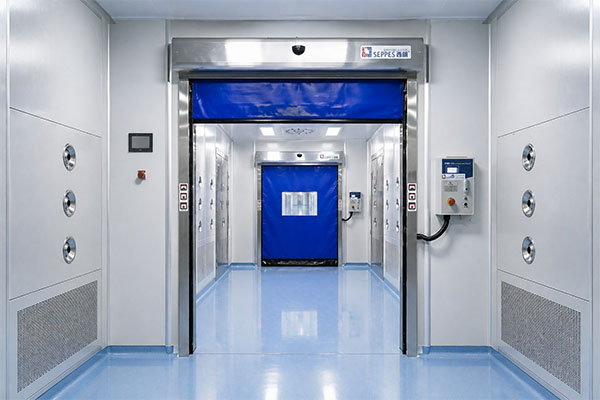
Double-Door Interlocking: The Physical Barrier Against Pressure Collapse
Exclusive Opening Principle:
The core of interlocking is “A open, B locked”. When door A is open or not fully closed, door B is forcibly electronically locked by the PLC system, and will not open even if the sensor is triggered.
Default Closed State:
Under normal circumstances, both doors remain tightly closed. The seamless zipper-track design of the self-repairing door ensures the pressure differential is stabilized at around the standard 15 Pa.
High-Speed PLC Control:
By receiving limit signals through an advanced PLC controller, the command response time is < 0.5 seconds, ensuring precise and zero-latency interlocking.
Mitigating Human Error: The Critical Timeout Alarm System
In actual production, employees often violate regulations by using objects to block the door, or logistics forklifts stall in the doorway, causing the door to remain open for a long time. To mitigate such human errors, a Timeout Alarm System is an indispensable configuration.
Smart Trigger Mechanism:
The system allows customizable door-open time limits (usually 10-15 seconds). If either door remains open beyond the preset value, the system will immediately emit a high-frequency buzzer alarm to remind personnel to leave and close the channel.
EMS Integration:
For high-level pharmaceutical plants, the timeout alarm signal can be directly connected to the facility’s EMS (Environmental Monitoring System) via dry contacts or Modbus protocols, enabling data recording and compliance traceability for operational violations.
Personnel vs. Material Channels:Self-repairing door Application Differences
The type of airlock determines the specific hardware configuration of the self-repairing door:
Core Requirement: Hygiene and touchless operation.
It is recommended to use touchless hand sensors or infrared radars across the board to reduce bacterial transmission through contact. The traffic rhythm is strictly set as: personnel enter -> door closes -> HVAC system delays 5 seconds for purification -> the opposite door unlocks.
Core Requirement: High-frequency, anti-collision, and self-repairing.
Material channels operate with forklifts or AGVs, making collisions highly likely. This is why a self-repairing door must be used: when logistics equipment accidentally scrapes the door, the curtain automatically derails to absorb the impact and automatically re-enters the track in the next operating cycle. This not only eliminates manual repairs but also prevents the risk of environmental loss of control caused by prolonged maintenance downtime.

Case Study: How a Multinational Biopharma Reduced Energy Use by 18%?
Background:
A multinational Active Pharmaceutical Ingredient (API) manufacturer’s ISO Class 7 sterile formulation buffering zone faced over 300 forklift passes daily. The legacy traditional rigid doors opened slowly, remaining open for an average of 12 seconds per cycle, causing the airlock pressure to frequently drop below 5 Pa, triggering over 20 EMS pressure alarms per week and posing a critical audit risk.
Solutions:
The engineering team upgraded the channel to a PLC-controlled cleanroom self-repairing doors interlocking system. The operating speed was set to a rapid 2.0 m/s, and a “15-second timeout alarm” function was mandatorily enabled. Additionally, all door frames were upgraded to 304 stainless steel to pass VHP cleaning validation.
Measurable Results:
1.The airlock pressure curve flattened perfectly at 12-15 Pa, with zero alarms recorded over 8 consecutive months.
2.Zero Maintenance Rate: During this period, there were 3 minor forklift scrapes; the self-repairing doors automatically reset within 10 seconds each time, resulting in zero downtime.
3.Energy Savings: The massive reduction in air leakage decreased the overload operation rate of the HVAC system in that area, saving 18% in overall energy consumption.
Conclusion
In modern cleanroom engineering, the double-door interlocking of airlocks is no longer a simple linkage, but a core method of precise environmental pressure management. Investing in a self-repairing door equipped with PLC interlocking logic, timeout alarms, and anti-collision features can thoroughly cut off the path of cross-contamination at the physical level. It not only protects your product yield but also helps your enterprise effortlessly meet the most stringent GMP and FDA audits, achieving long-term cost reduction and efficiency gains.
FAQ
Q1: Why choose a self-repairing door over a standard high-speed door for airlocks?
Standard high-speed doors often use brush seals on the edges, resulting in weaker airtightness; whereas a self-repairing door utilizes a seamless zipper-track design, offering excellent sealing performance. More importantly, its “anti-collision and self-resetting” feature completely eliminates prolonged downtime caused by forklift impacts, which is crucial for airlocks that must maintain a stable pressure differential 24/7.
Q2: Will the interlocking system hinder employee escape during a fire or power outage?
Absolutely not. In GMP facility design, fire safety always takes precedence over pressure control. A qualified system will be connected to the central fire control signal; once a fire alarm is triggered, the interlock logic is forcibly disabled. During a sudden power outage, the motor’s brakes will release automatically, ensuring the escape route remains absolutely clear.
Q3: Can the timeout alarm system be integrated with our existing workshop monitoring system?
Yes. Professional control boxes are equipped with rich expansion interfaces (such as dry contacts or RS485 ports). Alarm signals for door timeouts, pressure loss, or equipment failure can be seamlessly integrated into the facility’s central EMS system for convenient compliance recording.


