
Contents
- 1 How Self Repairing High Speed Doors Achieve Pressure Control in Cleanrooms?
- 1.1 Why Do Pharmaceutical Cleanrooms Require Strict Pressure Control?
- 1.2 Three Core Mechanisms of Self Repairing High Speed Doors for Pressure Management
- 1.3 Cleanroom Self Repairing High Speed Doors vs Traditional Doors
- 1.4 Hardware Configurations for Cleaning Validation
- 1.5 Case Study: How a Multinational API Manufacturer Eliminated Airlock Pressure Loss and Achieved 18% Energy Savings
- 1.6 FAQ
How Self Repairing High Speed Doors Achieve Pressure Control in Cleanrooms?
Introduction
In the pharmaceutical manufacturing field, environmental control in cleanrooms is directly related to product quality and production compliance. According to EU GMP Annex 1 and WHO HVAC guidelines, maintaining pressure control between adjacent areas of different cleanliness levels is a core strategy to prevent contamination. This article provides an in-depth analysis of how self repairing high speed doors, acting as advanced physical barriers, help pharmaceutical plants accurately maintain airlock pressure differentials and establish contamination prevention systems.
Why Do Pharmaceutical Cleanrooms Require Strict Pressure Control?
Under GMP regulations, sterile preparation workshops or high-potency drug production areas must establish a stable positive or negative pressure environment. Adjacent areas of different cleanliness levels generally need to maintain a pressure differential of at least 10 Pa.
If passage doors lack airtightness, indoor pressure can collapse instantly, causing airflow reversal. This not only increases HVAC energy loads but also triggers severe cross-contamination risks due to unfiltered air backflow. Therefore, selecting self repairing high speed doors for pharmaceutical cleanrooms with high sealing standards is a necessity for compliance.

Three Core Mechanisms of Self Repairing High Speed Doors for Pressure Management
Standard industrial doors cannot meet strict GMP cleanroom requirements; pharmaceutical workshops must specifically install “cleanroom self repairing high speed doors“. They maintain environmental stability through:
1. Zipper Track Airtightness
The curtain edge abandons traditional rigid wind bars in favor of a zipper structure nested directly inside the guide rail (zipper track), achieving seamless sealing and minimizing air leakage
2.Airlock Interlocking System
Interlocking is a key technical method to ensure cleanliness. Installing doors on both sides of an airlock and using a PLC controller to achieve an interlocking system ensures that when door A is open, door B is forcibly locked.
3. Anti-collision & Self-repairing
Pharmaceutical plants frequently use transport carts. If the curtain is derailed by an impact, the anti-collision door features a self-repairing function, automatically re-entering the track in one operating cycle, avoiding secondary contamination from manual maintenance.
Cleanroom Self Repairing High Speed Doors vs Traditional Doors
To better understand why EU GMP guidelines favor dedicated cleanroom doors, let’s compare their core parameters:
Dimension | Traditional Doors | Self Repairing High Speed Doors | Impact |
Sealing | Obvious gaps | Seamless zipper track | Traditional doors are unable to stably maintain a pressure differential standard of ≥ 10 Pa. |
Durability | Damage & downtime after impact | Self-resetting after collision | The self-healing function significantly reduces the maintenance rate and the probability of secondary pollution. |
Hygiene | Aluminum corrodes easily | 304 SS frames & anti-static curtains | The specialized high-speed door eliminates dead corners, successfully passing cleaning validation. |
Hardware Configurations for Cleaning Validation
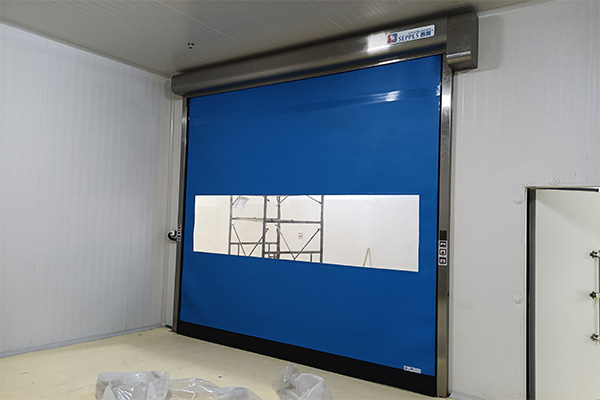
cleanroom self repairing high speed doors:For GMP cleaning validation, cleanroom self repairing high speed doors must have these professional configurations:
- Anti-corrosion 304 SS Frame:Meets requirements for regular fumigation and sterilization using VHP and alcohol, ensuring no rust.
- Touchless Sensors:Equipped with touchless sensors to prevent cross-infection from hand contact.
Anti-static Medical-grade Curtains: Prevents fine dust from adhering via static electricity, reducing suspended particles.
Case Study: How a Multinational API Manufacturer Eliminated Airlock Pressure Loss and Achieved 18% Energy Savings
Background & The Challenge: A Top-20 multinational Active Pharmaceutical Ingredient (API) manufacturer was experiencing frequent compliance risks in their ISO Class 7 sterile formulation buffering zone. Due to the high volume of daily forklift traffic, the legacy electric sliding doors remained open for an average of 8-10 seconds per cycle. This slow operation triggered over 15 pressure-drop alarms per week, causing the airlock pressure differential to plummet from the required 15 Pa down to a critical 4 Pa, risking severe cross-contamination.
The Solutions: To resolve this, the engineering team executed a targeted upgrade during a 48-hour scheduled maintenance window:
Advanced Interlocking: Replaced the legacy doors with a cleanroom self-repairing high-speed doors interlocking system. Powered by a PLC controller with a sub-0.5-second response time, it strictly enforced an “A-open, B-locked” logic, making it physically impossible for both doors to open simultaneously.
High-Speed Operation: Upgraded the opening speed to 2.0 meters per second, drastically reducing the air exposure time.
Hygiene Compliance: Installed full 304 stainless steel frames and track systems, engineered to withstand the facility’s daily Vaporized Hydrogen Peroxide (VHP) sterilization cycles without corroding.
Measurable Results:
100% Pressure Stability: The airlock pressure curve flattened immediately, consistently maintaining a safe 12–15 Pa differential with zero alarms recorded over the past 6 months.
Cost Reduction: By sealing the airlock and stopping HVAC overcompensation, the facility reduced its cleanroom HVAC energy consumption by 18%.
Audit Success: The site flawlessly passed its annual EU GMP Annex 1 official audit, with auditors specifically commending the upgraded contamination control strategy.


