
Rapid doors play a critical role in separating raw and cooked zones in food processing plants. In meat, seafood, bakery, dairy, and ready-meal production, the boundary between raw materials and cooked or ready-to-eat products is one of the most sensitive points in the whole facility. If the wrong door is used, the opening may become a weak point for airflow, moisture, insects, trolley traffic, and personnel movement.
In a modern food factory, rapid doors are not just traffic doors. They are part of the hygienic zoning strategy. A well-selected door can help reduce unnecessary exposure between high-risk and low-risk areas, support smoother material flow, and make daily cleaning easier. However, the best solution depends on the product, the process, the cleaning method, the room temperature, and the level of hygiene control required.
This guide explains where rapid doors should be installed between raw and cooked areas, which door types are suitable for different food processing zones, and how to choose a door that supports food safety without slowing down production.
Contents
- 1 Why Raw-to-Cooked Separation Matters in Food Processing
- 2 Where Should Rapid Doors Be Installed Between Raw and Cooked Zones?
- 3 7 Critical Selection Factors for Rapid Doors in Raw and Cooked Area Separation
- 4 Which Type of Rapid Doors Fits Each Food Processing Zone?
- 5 Door Selection Table for Raw-to-Cooked Separation Areas
- 6 Common Mistakes When Choosing Doors for Raw and Cooked Area Separation
- 7 Recommended Door Solutions by Food Industry
- 8 Final Selection Checklist for Rapid Doors
- 9 Conclusion
- 10 FAQ About Rapid Doors for Raw and Cooked Area Separation
- 10.1 What are the best rapid doors for separating raw and cooked food areas?
- 10.2 Are rapid doors suitable for RTE food production areas?
- 10.3 Why are stainless steel rapid doors used in food factories?
- 10.4 Can rapid doors prevent cross-contamination completely?
- 10.5 Do cooked zones need interlocked rapid doors?
Why Raw-to-Cooked Separation Matters in Food Processing
Raw areas usually handle ingredients that may carry soil, blood, scales, feathers, shells, microorganisms, allergens, or other contaminants. Cooked areas, especially ready-to-eat or exposed product areas, require a higher level of protection because the product may not receive another kill step before packaging or consumption.
This is why raw-to-cooked separation is more than a simple wall layout. It includes the control of personnel flow, trolley flow, packaging flow, air movement, condensation, drainage, cleaning tools, and door openings. If doors stay open for too long, contaminated air, water vapor, dust, pests, or traffic from the raw side may enter the cooked side.
Rapid doors help solve this problem by opening quickly for authorized traffic and closing quickly after passage. Compared with slow manual doors or doors that are often left open, these high-speed door systems can reduce open-door time and help maintain a clearer hygiene boundary.
Where Should Rapid Doors Be Installed Between Raw and Cooked Zones?
The most important installation points are not always the largest door openings. They are the openings where risk transfer is most likely to happen.
Common locations include raw material corridors leading to cooked production rooms, thermal processing exits, cooling room entrances, cooked product slicing rooms, ready-to-eat packaging rooms, hygiene airlocks, trolley washing rooms, utensil transfer areas, and chilled cooked product storage rooms.
For example, in a cooked meat plant, the door between the cooking exit and the cooling area must support frequent trolley movement while reducing exposure to raw-side corridors. In a seafood facility, the boundary between wet raw processing and cooked product packing may require stainless steel door systems with strong sealing and washdown-friendly surfaces. In a bakery or ready-meal factory, the entrance to a high-care packaging room may need interlocked door systems to prevent both doors from opening at the same time.
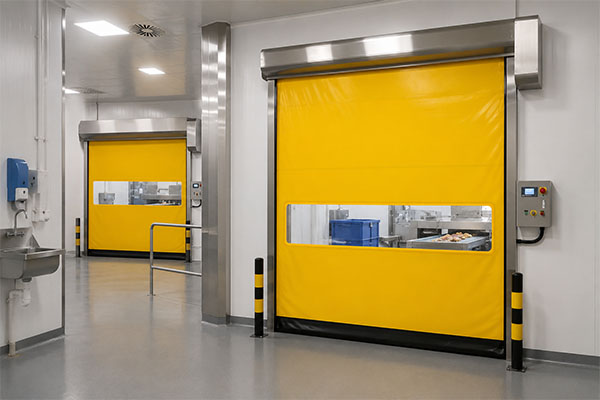
7 Critical Selection Factors for Rapid Doors in Raw and Cooked Area Separation
1. Hygiene Zoning Level
The first question is not “How fast is the door?” but “What hygiene zone does this door protect?”
A door used in a low-risk raw material warehouse may only need basic dust and pest control. A door used at the entrance of a cooked slicing room or RTE packaging area needs much better sealing, easier cleaning, and stronger traffic control. For high-care zones, rapid doors should work with airlocks, personnel hygiene procedures, and clear separation of raw and cooked flows.
2. Sealing Performance
Sealing is one of the most important reasons to choose rapid doors for raw and cooked area separation. A poor seal allows airflow, odors, water vapor, insects, and dust to pass through the opening even when the door is closed.
For cooked zones, zipper-style rapid doors are often a strong option because the curtain edges run inside a sealed zipper track. This structure helps improve tightness and can also allow the curtain to self-repair after accidental impact. For hygiene airlocks, better sealing also helps support pressure difference control between adjacent rooms.
3. Washdown and Corrosion Resistance
Food factories often use water, foam, cleaning chemicals, and high humidity. In meat, poultry, seafood, dairy, and vegetable processing areas, ordinary steel doors may rust quickly if the frame, hardware, and control box are not suitable for wet environments.
For wet processing areas, stainless steel door systems are usually recommended. Look for a 304 stainless steel frame, smooth surfaces, protected electrical components, sealed motor covers, and easy-access parts for cleaning. The goal is not only to make the door look clean, but also to reduce areas where dirt, water, and microorganisms can accumulate.
4. Traffic Frequency and Opening Speed
Raw-to-cooked boundaries often have high traffic from trolleys, carts, forklifts, or AGVs. If the door is too slow, workers may bypass it, keep it open, or damage it with frequent contact.
Rapid doors for food processing plants improve workflow by reducing waiting time. This is especially important in cooked product transfer, cooling tunnels, packing rooms, and internal logistics corridors. The door should open fast enough for smooth movement and close quickly after passage, but it must also include safety sensors such as light curtains, bottom edges, or radar activation.
5. Temperature and Condensation Control
Some cooked zones are chilled immediately after thermal processing. Cooling rooms, chilled packing rooms, and cooked product cold storage areas may have large temperature differences from adjacent corridors. In these areas, the wrong door can cause condensation, energy loss, slippery floors, and unstable room temperature.
Insulated rapid doors for chilled cooked zones are a better choice for cooling rooms and cold chain areas. They help reduce temperature exchange while maintaining fast access. For facilities handling cooked meat, dairy products, seafood, or ready meals, this can improve both hygiene control and energy efficiency.
6. Interlocking and Access Control
In high-care or RTE areas, a single door is often not enough. A hygiene airlock with two interlocked doors can prevent direct air exchange between raw-side corridors and cooked-side rooms. When one door is open, the other remains closed.
Interlocked rapid doors for hygiene airlocks are especially useful for personnel entrances, trolley transfer points, packaging material transfer areas, and clean corridor access. They can also work with card readers, pull cords, radar sensors, touchless switches, and traffic lights to create a more controlled movement pattern.
7. Maintenance and Impact Recovery
Food plants need doors that can survive daily production, not just look good during installation. Trolleys, forklifts, and cleaning equipment often hit door curtains or side frames. If a door stops production after every impact, the real cost becomes much higher than the purchase price.
Self-repairing zipper rapid doors can be valuable in busy internal passages because the curtain can return to the guide after impact. This reduces downtime and maintenance calls. For cooked area entrances, lower downtime also means fewer cases where workers leave the opening exposed because the door is out of service.
Which Type of Rapid Doors Fits Each Food Processing Zone?
For raw material receiving and low-risk internal passages, PVC high-speed roll-up doors can be a cost-effective option. They are suitable for frequent traffic, basic dust control, and separation between general production areas.
For raw-to-cooked boundaries, zipper-style rapid doors are usually a better solution because they offer stronger sealing and self-repairing performance. They are suitable for cooked product transfer rooms, internal hygiene corridors, and high-frequency trolley passages.
For wet processing areas, stainless steel door systems are recommended. They are suitable for meat cutting rooms, poultry processing areas, seafood processing zones, vegetable washing rooms, tray washing rooms, and other washdown environments.
For RTE packaging rooms and high-care areas, interlocked rapid doors or airtight zipper door systems should be considered. These doors support controlled access, pressure difference management, and better separation between hygiene zones.
For chilled cooked zones, insulated high-speed doors are suitable for cooling rooms, chilled packing rooms, cooked product cold rooms, and cold chain transfer passages. They help reduce temperature loss and condensation while keeping traffic efficient.
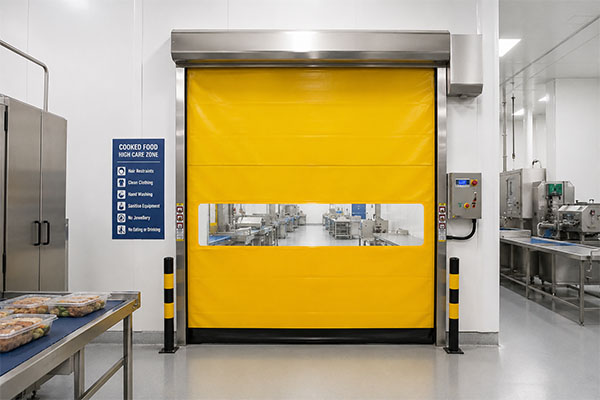
Door Selection Table for Raw-to-Cooked Separation Areas
Different food processing areas require different rapid doors. A raw material receiving area does not need the same door configuration as an RTE packaging room or a cooked product cooling zone. The table below gives a practical selection guide based on hygiene risk, cleaning conditions, temperature control, and traffic frequency.
| Food Processing Area | Risk Level | Recommended Door Type | Key Features to Consider | Why It Fits |
|---|---|---|---|---|
| Raw Material Receiving Area | Medium | PVC rapid doors / industrial rapid roll-up doors | Fast opening, dust control, insect prevention, forklift access | Suitable for frequent logistics traffic and basic separation from outdoor or warehouse areas. |
| Raw Meat / Poultry / Seafood Processing Area | High | Stainless steel rapid doors | 304 stainless steel frame, washdown design, corrosion resistance, smooth surface | Wet raw processing areas require doors that resist water, cleaning chemicals, blood, salt, and high humidity. |
| Washing / Cleaning / Tray Washing Room | High | Washdown rapid doors | Waterproof components, sealed motor cover, stainless steel structure, easy-to-clean curtain | Helps withstand frequent cleaning and reduces the risk of rust, residue buildup, and hygiene dead corners. |
| Thermal Processing Exit | Very High | Zipper rapid doors / hygienic rapid doors | Tight sealing, fast closing, self-repairing curtain, touchless activation | This is a key transition point from raw processing to cooked product handling, so fast and sealed separation is important. |
| Cooked Product Cooling Area | High | Insulated rapid doors | Thermal insulation, fast operation, condensation control, good sealing | Helps reduce temperature fluctuation, cold air loss, and condensation near cooked product areas. |
| Cooked Product Slicing / Cutting Room | Very High | Hygienic zipper rapid doors | High sealing performance, smooth curtain, non-contact opening, easy cleaning | Exposed cooked products are vulnerable to secondary contamination, so the door should reduce airflow and unnecessary exposure. |
| RTE Food Packaging Area | Very High | Airtight rapid doors / interlocked rapid doors | Airlock design, double-door interlock, pressure difference control, access control | Suitable for ready-to-eat products and high-care zones where controlled personnel and material flow is required. |
| Hygiene Airlock / Buffer Room | Very High | Interlocked rapid doors | Two-door interlock, traffic lights, sensors, access control | Prevents both doors from opening at the same time and helps maintain separation between raw and cooked zones. |
| Cooked Product Cold Storage | Medium to High | Insulated rapid doors | Insulated curtain or panel, fast cycle, low-temperature compatibility | Helps protect chilled cooked products while improving energy efficiency and reducing cold air exchange. |
| Finished Product Dispatch Area | Medium | Industrial rapid doors / sectional doors | Durability, forklift safety, thermal control, large opening size | Suitable for packed products, logistics movement, and connection with loading or warehouse areas. |
The key point is not to use one door type for every opening. Rapid doors should be selected according to the hygiene risk level, moisture exposure, temperature difference, traffic type, and whether the area requires interlock or pressure control.
Common Mistakes When Choosing Doors for Raw and Cooked Area Separation
One common mistake is choosing only by price. A cheaper door may work in a dry warehouse, but it may fail quickly in a wet food processing room. Rust, poor sealing, difficult cleaning, and frequent downtime can create higher long-term costs.
Another mistake is using the same door type for every area. A raw material storage room, a seafood washing area, a cooked slicing room, and an RTE packaging room do not have the same risk level. Rapid doors should be selected according to hygiene zone, cleaning intensity, temperature, and traffic pattern.
A third mistake is ignoring the door control system. In many food plants, the door itself is acceptable, but the activation method creates problems. Workers may touch buttons with wet gloves, forklifts may stop too close to the opening, or both doors of an airlock may open together. Touchless activation, radar sensors, pull cords, card access, and interlock control can make the whole system more hygienic and efficient.
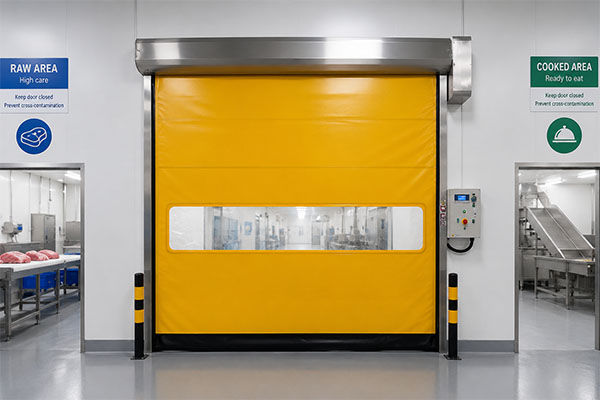
Recommended Door Solutions by Food Industry
For meat and poultry processing, stainless steel zipper-style rapid doors are suitable for wet raw areas, cutting rooms, cooked meat transfer points, and high-care packing entrances. The focus should be sealing, washdown resistance, and impact recovery.
For seafood processing, choose stainless steel door systems with corrosion-resistant components and smooth surfaces. Seafood plants often have salt, water, low temperature, and frequent cleaning, so the door must resist corrosion and be easy to wash.
For bakery and frozen food plants, PVC high-speed doors or insulated high-speed doors may be used depending on the temperature and hygiene level. Cooked or baked products entering cooling and packaging areas should be protected from dust, insects, and uncontrolled personnel movement.
For dairy and ready-meal facilities, high-care zones may require airtight zipper door systems, interlocked rapid doors, and touchless access systems. These areas often involve exposed cooked products, so the door must support strict separation and controlled movement.
Final Selection Checklist for Rapid Doors
Before selecting rapid doors for cross-contamination control, ask these questions:
Is the door installed in a raw area, cooked area, high-care area, or RTE area?
Will the door be exposed to water, foam cleaning, chemicals, or high humidity?
Does the area require stainless steel construction?
Is there a temperature difference between the two sides?
Does the door need to support pressure difference control?
Will trolleys, forklifts, or AGVs pass through frequently?
Is self-repairing performance important?
Does the opening require interlock control?
Should the door use touchless activation?
Can the door be cleaned and maintained easily?
The right rapid doors should support your hygiene zoning plan, not create a weak point in it. For food processors, the best door is not simply the fastest door. It is the door that matches the risk level of the area, protects the cooked product side, withstands daily cleaning, and keeps production moving safely.
Conclusion
Rapid doors are an important part of raw-to-cooked separation in food processing plants. When correctly selected, they help reduce open-door time, improve hygiene zoning, support washdown cleaning, protect chilled cooked products, and control traffic between areas with different risk levels.
For food factories producing meat, seafood, bakery products, dairy items, frozen foods, or ready meals, the right rapid doors can support safer production and smoother operations. The key is to match each door to the real conditions of the area: hygiene level, moisture, temperature, cleaning method, traffic frequency, and the need for interlock or pressure control.
A professional door selection plan should never treat every opening the same. It should identify the risk at each boundary and choose the rapid doors that help protect product safety, reduce maintenance problems, and keep the production line moving.
FAQ About Rapid Doors for Raw and Cooked Area Separation
What are the best rapid doors for separating raw and cooked food areas?
For most raw-to-cooked boundaries, zipper-style rapid doors or stainless steel door systems are recommended because they provide better sealing, easier cleaning, and stronger impact recovery than basic internal doors.
Are rapid doors suitable for RTE food production areas?
Yes. Rapid doors for RTE food production areas can be suitable when they are correctly selected and integrated with hygiene zoning, airlocks, interlock control, touchless activation, and cleaning procedures.
Why are stainless steel rapid doors used in food factories?
Stainless steel rapid doors for food processing are used because wet food processing areas require corrosion resistance, smooth surfaces, and better washdown compatibility. They are especially useful in meat, seafood, dairy, and tray washing areas.
Can rapid doors prevent cross-contamination completely?
No door can prevent cross-contamination by itself. Rapid doors should be part of a wider food safety system that includes sanitation, personnel hygiene, pest control, airflow management, traffic control, and HACCP-based procedures.
Do cooked zones need interlocked rapid doors?
Cooked zones, high-care areas, and RTE packaging rooms may need interlocked door systems when direct air exchange or uncontrolled personnel movement creates a higher risk. An interlock system helps ensure that two connected doors do not open at the same time.


