
Contents
- 1 Cleanroom Rapid Door Cleaning Validation: Seamless Design & Disinfectant Resistance
- 1.1 Introduction
- 1.2 Why Are Doors a High-Risk Area in Cleaning Validation?
- 1.3 Key Parameter 1: Seamless & Flush Design for “Zero Dust Accumulation”
- 1.4 Key Parameter 2: Resistance to VHP and Strong Disinfectants
- 1.5 Key Parameter 3: Low Dust Generation & Anti-static Control
- 1.6 Traditional Doors vs. Cleanroom Rapid Door
- 1.7 Case Study: How a Vaccine Plant Passed FDA Audits via Door Upgrades
- 1.8 Conclusion
- 1.9 FAQ
Cleanroom Rapid Door Cleaning Validation: Seamless Design & Disinfectant Resistance
Introduction
In pharmaceutical and biotechnology facilities, “Cleaning Validation” is the core process ensuring products remain free from cross-contamination. Any equipment with hygienic dead angles can lead to severe FDA warning letters or production shutdowns. As a high-frequency physical barrier, the selection of cleanroom rapid door directly determines whether a workshop can smoothly pass validation. This article will deeply analyze the three core parameters required for cGMP-compliant cleanroom rapid door : seamless flush design, excellent chemical disinfectant resistance, and extremely low dust generation, helping you easily navigate strict compliance audits.
Why Are Doors a High-Risk Area in Cleaning Validation?
According to FDA 21 CFR 211.67 and EU GMP Annex 1, pharmaceutical equipment and surfaces must be “smooth, easily cleanable, and free of dead legs where contaminants can accumulate.” Traditional industrial doors have fatal flaws in sterile environments: exposed hinge gaps, bottom brush seals, and carbon steel frames that easily rust after fumigation. These defects not only trap microorganisms but also release particles during every open/close cycle, making them a primary target for auditors during surface swab testing.
Key Parameter 1: Seamless & Flush Design for “Zero Dust Accumulation”
High-quality cleanroom rapid door must achieve an absolutely smooth structural design to meet cleaning validation requirements:
1. No Exposed Fasteners
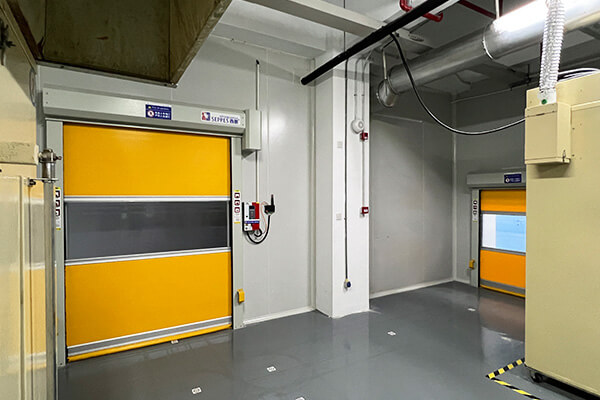
The surfaces of the door frames, guide rails, and motor hoods must have absolutely no exposed screws, rivets, or seams. Screw holes are breeding grounds for bacteria and disinfectant residues. Professional cleanroom rapid door use internally concealed fastening designs, presenting a completely smooth surface from the outside.
2. Sloped & Curved Surfaces
The top hood should not be flat; it must adopt a 15° to 30° sloped design, and track edges should be curved. This design prevents cleaning liquid residues, avoids the formation of dust accumulation platforms, and truly achieves “wipe-and-clean” efficiency.
3. Flush with the Wall
To avoid forming protruding dust platforms, the door frame design should be flush-mounted and sealed with the cleanroom’s sandwich panel walls, utilizing food-grade silicone sealant to completely eliminate gaps.
Key Parameter 2: Resistance to VHP and Strong Disinfectants
1. Withstanding VHP Sterilization
Sterile workshops (such as Grade A filling areas with Grade B backgrounds) frequently use high-concentration VHP (Vaporized Hydrogen Peroxide) for periodic fumigation. Aluminum alloy or standard painted doors will quickly oxidize and peel during this process. Therefore, frames must be made of 304 or 316L medical-grade stainless steel and undergo mirror or brushed passivation treatment.
2. Handling Daily Chemical Wipe-downs
Besides VHP, doors must resist daily corrosion from strong solvents like 70% Isopropyl Alcohol (IPA) and sodium hypochlorite (chlorine bleach). Only high-quality stainless steel structures and corrosion-resistant PVC curtains can remain non-fading and non-brittle under years of chemical exposure.
3. IP65 Rating for Electronics
During washdowns or spray disinfection, motors and control boxes face short-circuit risks. Compliant cleanroom rapid door feature concealed built-in motors and are equipped with IP65 or IP67 rated waterproof and dustproof stainless steel control boxes, ensuring the absolute safety of internal electronic components.
Key Parameter 3: Low Dust Generation & Anti-static Control
1. Seamless Zipper Tracks Reduce Friction
Unlike traditional doors with brushes, cleanroom rapid door typically utilize seamless zipper tracks. This design drastically reduces physical hard friction when the curtain moves at high speeds, bringing particle generation close to zero at the source.
2. FDA-Compliant Anti-static Curtains
Standard plastic curtains easily generate static electricity, which attracts micro-dust and airborne bacteria. Dedicated pharmaceutical high-speed doors must use low-dust, anti-static curtain materials that comply with FDA and EU standards, cutting off the hidden chain of cross-contamination.
Traditional Doors vs. Cleanroom Rapid Door
To intuitively understand why traditional industrial doors fail cleaning validation, please refer to the following core parameter comparison. This clearly demonstrates the indispensability of GMP cleanroom doors in controlled environments:
| Evaluation Item | Traditional Industrial Doors | Cleanroom Rapid Door | Audit Risk / Impact |
| Material & Surface | Aluminum/painted steel, flat top gathers dust. | 304/316L SS with 15°-30° sloped hood. | Traditional doors peel/rust, acting as contamination sources. |
| Fasteners & Dead Angles | Exposed screws, 90-degree dead angles. | No exposed fasteners, concealed fixing, curved transitions. | Exposed screws trap microbes, causing swab test failures. |
| Airtight Structure | Brush seals trap dirt, high air leakage. | Seamless zipper track, fully enclosed sealing. | Brushes cannot be disinfected and shed, threatening Grade A/B cleanliness. |
| VHP Resistance | Poor, oxidizes and turns white quickly after fumigation. | Excellent, mirror/passivated finish withstands high-concentration VHP. | Poor corrosion resistance leads to frequent replacements and downtime. |
| Static & Dust Control | Standard PVC, generates static and attracts particles. | FDA-compliant anti-static, low-dust medical-grade curtain. | Static leads to excessive airborne particles, increasing cross-contamination risks. |
Traditional doors not only fail to resist chemical disinfectants, but their brushes and exposed screws are fatal flaws in cleaning validation. Only by choosing fully enclosed, seamless GMP cleanroom doors from the initial design stage can the pathways for microbial concealment be completely cut off.
Case Study: How a Vaccine Plant Passed FDA Audits via Door Upgrades
Background:
A leading global recombinant vaccine production facility discovered during routine QA environmental monitoring that the airborne particle counts in its ISO 7 airlock area were frequently bordering on non-compliance. Investigation revealed the source was traditional aluminum high-speed doors. After a year of high-frequency VHP fumigation, the aluminum tracks oxidized, shedding invisible metal and plastic particles during every operation, and the bottom brushes showed massive bacterial colony residues during ATP swab testing.
Solutions:
The engineering director immediately replaced all passage doors in the area with 304 stainless steel zipper-type GMP cleanroom rapid door . The new doors featured fully enclosed sloped hoods, eliminated all exposed screws and brushes, and were equipped with anti-static medical-grade curtains.
Measurable Results:
Just one month post-upgrade, the airborne particle concentration in the area plummeted by 85%. During the subsequent annual FDA on-site cleaning validation audit, the swab test pass rate on the door frames and tracks hit 100%. The auditors highly praised this “zero dust accumulation” anti-contamination upgrade.
Conclusion
Under strict cGMP regulations, an excellent cleanroom door is far more than just an opening passage; it is core production equipment that guarantees drug quality and determines the success of FDA cleaning validation.Choosing cleanroom rapid door that meet the standards of “seamless flush design, corrosion resistance, and zero dust generation” may have a slightly higher initial investment than standard industrial doors, but it thoroughly averts exorbitant downtime costs and compliance risks. In future facility planning, be sure to make 304/316L stainless steel, IP65 protection, and no exposed fasteners mandatory indicators for your door procurement.
FAQ
Q1: Can standard high-speed doors with brush seals pass GMP cleaning validation?
No. Brushes are severe hygienic dead legs. They absorb dust, moisture, and microorganisms like a sponge and are almost impossible to clean and disinfect thoroughly. For controlled environments, doors with seamless structures using zipper tracks or rubber bottom seals must be used.
Q2: Why must the control box of a cleanroom rapid door require an IP65 rating or higher?
In pharmaceutical workshops (like bottle washing rooms or equipment cleaning areas), high-pressure water jets or liquid disinfectants are frequently used for washdowns. IP65 means completely dust-tight and protected against low-pressure water jets, preventing liquid ingress that causes short circuits or equipment damage.
Q3: How does surface passivation help with disinfectant resistance?
Passivation removes free iron ions from the stainless steel surface, forming a dense, chromium-rich oxide film. This film significantly enhances the door’s corrosion resistance to hydrogen peroxide (VHP) and chlorine disinfectants, ensuring the door remains bright and rust-free even after a decade of use.


