
Contents
- 1 Introduction
- 2 Why Do Oncology & Hormone Facilities Need “Absolute Negative Pressure”?
- 3 3 Mandatory Safety Configurations for Rapid Roll Up Doors in HPAPI Facilities
- 4 Comparison Table: Traditional Doors vs. Rapid Roll Up Doors
- 5 Case Study: A Multinational Oncology Pharma’s OEB 4 Facility Upgrade
- 6 Conclusion
- 7 FAQ
Introduction
In the production of Highly Potent Active Pharmaceutical Ingredients (HPAPI) such as hormones and oncology drugs, powder leakage is not just a quality issue; it is a fatal EHS (Environment, Health, and Safety) accident. Unlike standard sterile workshops that use “positive pressure” to prevent contamination, highly potent facilities must establish strict “negative pressure isolation.” In such extreme pressure environments, choosing highly airtight rapid roll up doors becomes the core of ensuring containment. Based on OEB (Occupational Exposure Band) standards, this article deeply analyzes the three mandatory safety configurations these doors must have in HPAPI areas: negative pressure wind resistance, ATEX explosion-proof capability, and anti-static properties.
Why Do Oncology & Hormone Facilities Need “Absolute Negative Pressure”?
Highly potent drugs (like cytotoxic drugs) are extremely toxic to operators and the external environment. Standard cleanrooms usually keep internal pressure higher than external (positive pressure) to protect the drug; however, HPAPI workshops must not only be sterile but also ensure toxic powders absolutely cannot escape into corridors or outdoors.
The airlock maintains a continuous negative pressure relative to the external corridor (usually set between -15 Pa and -30 Pa) to ensure airflow always moves inward (toward the contamination source), firmly “locking” toxic powders inside the core production area. During this process, if the peripheral doors deform or are sucked open by strong negative pressure, toxic air will instantly spill out.
3 Mandatory Safety Configurations for Rapid Roll Up Doors in HPAPI Facilities
In harsh negative pressure containment environments, standard industrial doors are entirely inadequate. Qualified rapid roll up doors must meet the following three technical specifications:
1. Resisting Pressure Collapse: Zipper Track High Airtightness
- Pain Point: The air infiltration rate in negative pressure zones directly determines HVAC energy consumption and toxic dust containment capacity.
- Technical Solution: Fully enclosed zipper tracks must be used. The curtain edges interlock directly inside seamless guides like a zipper. It achieves near 100% perimeter sealing and keeps the curtain flat and taut under continuous negative pressure wind resistance, ensuring the airlock’s pressure gradient is not lost.
2. Dust Explosion Certification: ATEX Motors & Systems
- Pain Point: API reactor areas are often accompanied by high concentrations of flammable organic solvent vapors and suspended fine chemical dust. A tiny electrical spark can easily trigger a devastating dust explosion.
- Technical Solution: In ATEX explosion-proof zones (like Zone 21/22), the drive motors, control boxes, and even infrared sensors of the doors must possess internationally recognized ATEX certifications, utilizing flameproof enclosures to completely eliminate the risk of electrical sparks during operation.
3. Eliminating Static Adsorption: Medical-grade Anti-static Curtains
- Pain Point: Potent API powders float with airflow. If the curtain generates static electricity during high-speed friction, it will attract massive amounts of these toxic powders, contaminating passing logistics vehicles and increasing local dust concentrations, which may induce deflagration.
- Technical Solution: It is mandatory to equip medical-grade anti-static curtains with low surface resistance to effectively dissipate charges and cut off the adsorption path of toxic dust.
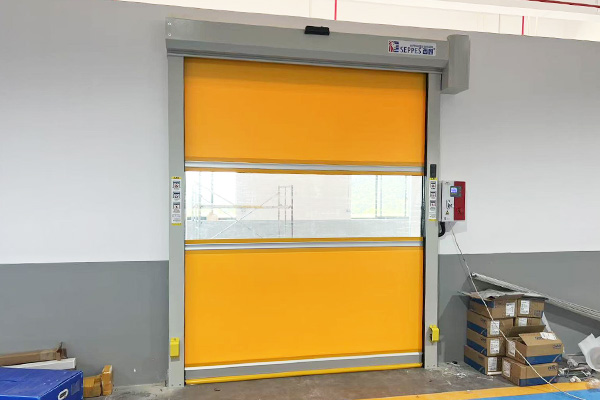
Comparison Table: Traditional Doors vs. Rapid Roll Up Doors
To intuitively demonstrate the selection differences for high-grade containment workshops, please refer to the following comparison chart:
| Dimension | Traditional Industrial Doors | HPAPI Dedicated Doors | EHS Impact |
| Negative Pressure Sealing | Brush seals, easily sucked open at -15 Pa, leaking air. | Seamless zipper track, perfectly locks -30 Pa differential. | Determines if toxic dust escapes into public corridors. |
| Explosion-proof Rating | Standard motors, no certs, prone to sparks. | Full ATEX Zone 21/22 certified explosion-proof system. | ATEX motors are the ultimate baseline against dust deflagration. |
| Curtain Material | Standard PVC, generates high static during operation. | FDA-compliant anti-static, low-dust medical curtain. | Anti-static directly prevents lethal cytotoxic dust adsorption. |
Case Study: A Multinational Oncology Pharma’s OEB 4 Facility Upgrade
- Background: A global Top 20 pharma company building a new milling room for targeted oncology drugs (OEB 4 exposure risk) found that the original airlock doors deformed severely under -20 Pa negative pressure. The air leakage rate at the seams hit 18%, triggering a dust exceedance warning during internal EHS spot checks.
- Solution: The engineering department urgently introduced dedicated rapid roll up doors equipped with an ATEX explosion-proof system, anti-static curtains, and PLC interlock logic. The curtain edges utilized high-strength zipper structures tightly biting into the tracks.
Measurable Results: Post-upgrade, the airlock’s negative pressure stability reached 100% (stabilized at -20 Pa), with zero toxic backflow. The facility successfully passed the stringent OEB 4 occupational exposure safety audit, and the exhaust system’s energy consumption dropped by 12% due to improved airtightness.
Conclusion
In API and HPAPI manufacturing, there is no such thing as “almost” compliant. A rapid roll up door that perfectly adapts to negative pressure, features ATEX explosion-proof components, and resists static is not just an extension of the HVAC system; it is a direct responsibility for employee safety and the ecological environment.
When selecting doors, procurement and EHS teams must strictly review suppliers’ zipper airtightness test reports, ATEX certificates for core components, and anti-static resistance parameters of the curtain to ensure the facility’s efficiency and absolute safety.
FAQ
Q1: How is the wind resistance of rapid roll up doors under negative pressure environments?
Excellent. Unlike traditional doors relying on bottom weights, these use a zipper track where the curtain is firmly locked inside both side rails, distributing pressure like a filled sail. They easily withstand indoor/outdoor pressure differentials up to 50 Pa without derailing or leaking.
Q2: How do ATEX explosion-proof doors ensure safe personnel escape during power outages?
Safety is always the priority. Professional explosion-proof motors come standard with a power-off brake release function or a manual crank device. In the event of a total blackout, employees can effortlessly lift the curtain manually, ensuring the escape route is absolutely clear.
Q3: Why are anti-static curtains more important in API facilities than in standard sterile rooms?
In standard sterile rooms, anti-static measures mainly prevent dust/particles to protect the product. However, in API facilities, highly toxic active ingredients or flammable powders are suspended in the air. Anti-static curtains directly prevent these powders from accumulating on the door and causing explosions (ATEX risks) or transferring to HAZMAT suits when employees pass by, preventing occupational exposure poisoning.


