
An aluminum roller shutter has more working parts than the visible metal curtain. The slats form the closure, the guides control its path, the barrel takes up the curtain, and the bottom bar finishes its lower edge. On a powered door, the motor and controls manage movement. Understanding these aluminum roller shutter components helps you read a quotation, discuss a drawing and describe a damaged part accurately.
This guide covers a generic commercial or industrial coiling shutter. It explains component roles rather than prescribing dimensions or a repair procedure. The illustrations show concepts, not a particular SEPPES model. For a new opening, start with the available aluminum roller shutter door configurations and request a drawing for the proposed assembly.
Contents
- 1 Aluminum roller shutter components at a glance
- 2 Aluminum roller shutter slats: the visible curtain
- 3 Roller shutter guide rails: the curtain’s side path
- 4 The roller shutter bottom bar and seal
- 5 The roller shutter barrel, supports and cover
- 6 The roll up door motor and drive arrangement
- 7 Controls, limits and protective devices
- 8 How the components work together
- 9 What to confirm on the component drawing
- 10 Frequently asked questions
- 10.1 Are all parts of an aluminum roller shutter made from aluminum?
- 10.2 Is the bottom bar the same as the last slat?
- 10.3 Can I replace the curtain and keep the original motor?
- 10.4 Does a rubber bottom seal mean the door has a safety edge?
- 10.5 Which information should I send when I cannot identify a part?
- 11 Discuss your door configuration
Aluminum roller shutter components at a glance
Use these names to orient yourself on a door drawing: slats make up the curtain; guide rails run beside it; the barrel sits above the opening; the bottom bar travels with the curtain’s lower edge; and the operator drives the assembly. Brackets, bearings, fixings, covers and protective devices complete the configuration. Some of these parts are concealed on an installed door.
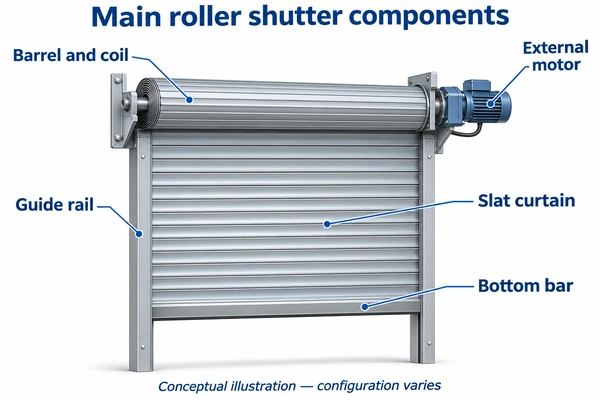
A supplier may use different names for the same part. For example, a quotation might call the winding assembly a barrel, tube or shaft assembly. Ask the supplier to mark each item on the general arrangement drawing. The Cornell rolling-door glossary is a useful terminology reference, but its product-specific construction details should not be assumed to apply to every aluminum shutter.
Aluminum roller shutter slats: the visible curtain
Individual horizontal slats connect along their edges to form a flexible curtain. Their joints allow the curtain to coil above the opening. The visible slat face is only part of the profile: the edge shape and connection geometry also determine which profiles can work together.
When reviewing aluminum roller shutter slats, request the profile designation and a section drawing. Check whether a quoted thickness means metal wall thickness or the overall depth of the profile. Also ask whether the section is single skin, hollow double skin or filled. A double skin description alone does not establish insulation performance.
For a replacement request, identify the existing door before ordering a visually similar slat. Send photographs of the curtain and an accessible end profile, together with the door label and available drawings. Do not dismantle a loaded curtain to obtain a sample. Matching the colour and face width is not enough to establish compatibility.
Roller shutter guide rails: the curtain’s side path
Roller shutter guide rails sit at the sides of the opening and guide the curtain during travel. Depending on the design, the guide assembly may include inserts, seals or features that work with the curtain’s end retention. These details belong on the manufacturer’s drawing.
A guide is part of the complete assembly, not simply a channel selected by appearance. For procurement, confirm the guide section, mounting arrangement and compatibility with the curtain. Where wind performance matters, ask for evidence covering the proposed door size and assembly. An enlarged guide or a thicker slat is not, by itself, proof of a wind rating.
The phrase roll up door track sometimes appears in enquiries. Clarify whether the buyer means the vertical guide of a coiling shutter or the track system of a sectional door. The two mechanisms require different components and installation space.
The roller shutter bottom bar and seal
The roller shutter bottom bar is the lower finishing member of the curtain. The bottom seal, where fitted, meets the threshold when the door closes. A seal and a safety edge have different purposes: a plain weather seal should not be described as an obstruction-detection device.
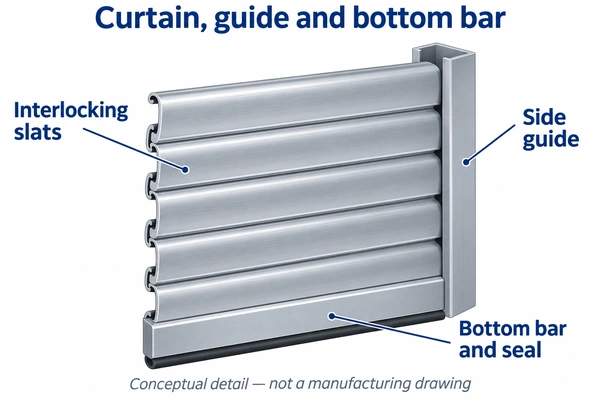
Ask the supplier to identify the bottom profile, seal and any sensing arrangement separately. If the project needs a safety edge, confirm its compatibility with the controller and the specified response to contact or a fault. Do not assume that a rubber strip visible beneath the door contains a sensor.
A replacement bottom bar also needs a compatibility check. Its connection to the last slat, guide clearance, attached devices and effect on the moving assembly all need review. For a bent or detached lower member, stop using the door and obtain a qualified assessment rather than forcing it against the floor.
The roller shutter barrel, supports and cover
The roller shutter barrel is the rotating assembly above the opening around which the curtain winds. The coil is the curtain wrapped around that assembly. A hood or cover, if fitted, encloses the roll area; it is not the barrel itself.
Brackets and bearings support the winding assembly. Their fixing details and the supporting building structure need to suit the proposed door. The glossary referenced above distinguishes these component roles; the actual construction must come from the selected manufacturer’s drawings.
For a new project, request the required headroom, side space, roll envelope and access for maintenance. A change in curtain profile can affect the space occupied by the rolled curtain, so an existing cover should not be assumed suitable for a replacement curtain.
Some designs use a counterbalance arrangement, while others use a different drive configuration. Do not infer the presence or type of a spring from an external photograph. Barrel, spring, bracket and curtain-support work belongs to qualified personnel following the manufacturer’s instructions. This component guide does not provide tensioning or dismantling steps.
The roll up door motor and drive arrangement
The roll up door motor supplies the motion for a powered assembly. The operator may include a gearbox, brake and an emergency operating arrangement, depending on the model. A tubular drive and an externally mounted operator occupy different positions, so the motor shown in an illustration is not a universal layout.
Ask for the proposed drive designation, electrical supply requirements, operating duty and installation position. The supplier needs more than the opening width to select a drive. Provide the door configuration and expected operating pattern, including the busiest period of repeated use.
Replacing an operator requires more than matching a power figure on the label. The mounting, output connection, holding arrangement, controls and intended duty must work with the existing door. For a complete powered-door enquiry, review the electric roller shutter options and ask which components are included in the proposed package.
Controls, limits and protective devices
The control system links an operating command to the drive. Position information helps the system manage the intended travel limits. Protective inputs, such as compatible photocells or a safety edge, can affect whether movement is permitted and how the door responds to a detected condition.
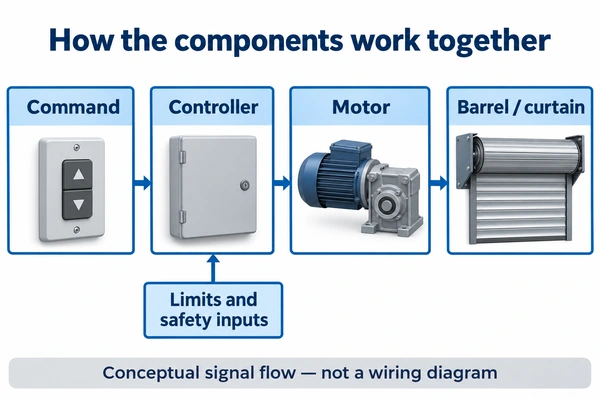
These functions must be checked as a system. As a manufacturer example, GfA’s TS 971 control documentation distinguishes limit-switch inputs, safety-edge evaluation and selectable operating modes. That illustrates why sensor names alone do not define the behaviour of a complete door. It does not mean this controller is standard equipment on a SEPPES shutter.
A limit system and an obstruction detector perform different jobs. Likewise, an operating button does not establish a safe power-failure procedure. Ask for the approved control description, device list and emergency instructions for the specified model. Never bypass protection to make a door move.
How the components work together
During a normal opening cycle, the control system accepts a permitted command and operates the drive. The winding assembly takes up the curtain while the guides maintain its path. The bottom bar rises with the curtain, and the configured position system manages the end of travel. Closing reverses the movement under the control and protective arrangements specified for the door.
This relationship explains why one symptom does not identify one failed part. A door that stops moving might have a control condition, mechanical interference or a drive problem. A parts diagram helps you describe what you can see; it does not replace diagnosis. Record the symptom and the door identification before requesting technical advice.
What to confirm on the component drawing
Before approving a complete door or a replacement component, ask the supplier to connect the drawing to the quotation. A useful review covers the following items.
- The curtain profile designation, construction, finish and connection details.
- The guide and bottom-bar sections, seals and any end-retention arrangement.
- The barrel assembly, supports, fixing interfaces and required installation space.
- The operator designation, supply requirements, operating duty and emergency arrangement.
- The controller and protective-device list, with the intended operating behaviour.
- The supplied items, site responsibilities and documents required for installation and handover.
For replacement rolling door parts, add the existing door serial number or label, approximate age, photographs and previous drawings where available. Ask the supplier to confirm interchangeability in writing. A list of generic aluminum roller shutter components is a starting point for identification, not a universal spare-parts catalogue.
Frequently asked questions
Are all parts of an aluminum roller shutter made from aluminum?
No. The description commonly refers to the curtain material. Other components may use different materials according to their function and the selected design. Request a component specification if material choice matters to the project.
Is the bottom bar the same as the last slat?
They have different roles. The slats form the repeating curtain profile, while the bottom bar forms its lower finishing member. Confirm how they connect on the selected door rather than assuming the profiles are interchangeable.
Can I replace the curtain and keep the original motor?
Only after a compatibility review. A different curtain can change the moving weight, coiling geometry and drive requirements. Have the supplier or qualified door specialist assess the complete assembly before ordering.
Does a rubber bottom seal mean the door has a safety edge?
No. A seal can provide contact with the threshold without sensing an obstruction. Check the component list and controller documentation to identify any installed sensing system.
Which information should I send when I cannot identify a part?
Start with the door label, an overall photograph and a close-up taken from a safe position. Describe the part’s location and the observed problem. Avoid removing guards or touching electrical and loaded mechanical components to obtain a photograph.
Discuss your door configuration
Use this aluminum roller shutter components guide to prepare a clearer enquiry. For a new project, send SEPPES the opening dimensions, quantity, application, destination and expected use. Include drawings or site photographs and ask for the proposed curtain, guides, bottom bar, barrel, operator and controls to be identified together.
You can compare the roller shutter door range or contact SEPPES with your requirements. For an existing door, provide its identification first so that component compatibility and the available supply scope can be checked.


