
Choosing an aluminum roller shutter starts with the job the opening must do. A single skin curtain can be a practical option for basic closure where thermal insulation is not a priority. A double skin curtain deserves consideration when the project needs a different profile construction or a foam-filled option. The number of skins alone does not establish strength, security or thermal performance.
For contractors, distributors and facility buyers, the useful comparison is between three specified constructions: single skin, hollow double skin and foam-filled double skin. Ask for a section drawing before comparing prices. Two quotations that both say “double layer” may describe different products.
This guide explains what changes with the slat construction, which claims need supporting evidence, and what to confirm before ordering. Use it alongside the available aluminum roller shutter door configurations to discuss a suitable assembly for your opening.
Contents
- 1 Aluminum roller shutter slats: what the terms mean
- 2 Compare single skin, hollow and foam-filled slats
- 3 When single skin is worth considering
- 4 When double skin or foam filling deserves a closer look
- 5 Check insulation, security and noise at door level
- 6 Confirm weight, roll size and motor compatibility
- 7 Request comparable quotations
- 8 Questions buyers ask about single and double skin slats
- 9 Choose the profile against a written requirement
Aluminum roller shutter slats: what the terms mean
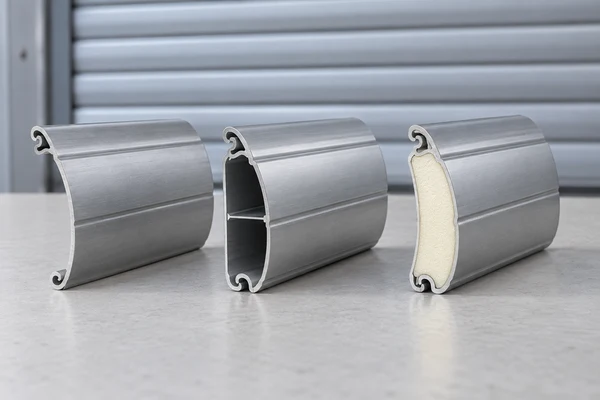
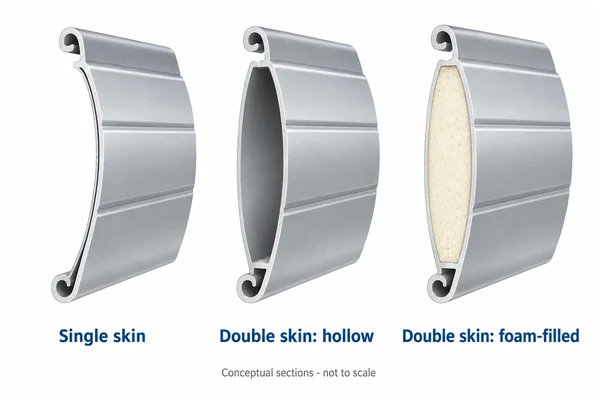
A single skin slat has one main metal wall shaped into a profile, with edges that connect to adjacent slats. It does not have a second face enclosing an insulating core. The actual section shape and metal thickness still matter.
A double skin slat has two faces separated by a cavity. That cavity may be hollow or contain a filling material such as polyurethane, commonly called PU foam. Ask the supplier to identify the filling explicitly; “double skin” does not automatically mean “foam-filled.”
Single layer and double layer are alternative descriptions of these arrangements. They describe the slat cross section, not two separate curtains installed one behind the other.
Also distinguish construction from manufacturing method. Profiles may be roll-formed or extruded. ALUTECH’s profile overview identifies foam-filled roll-formed profiles and extruded profiles with different wall and stiffener arrangements. This illustrates why skin count and manufacturing method should be separate entries in a specification, rather than treated as interchangeable labels.
Compare single skin, hollow and foam-filled slats
| Slat type | Construction and checks |
|---|---|
| Single skin | One main metal wall; no enclosed foam core. Confirm profile geometry, metal thickness, supported opening size and complete-door performance. |
| Hollow double skin | Two faces enclose an unfilled cavity. Confirm wall thickness, internal webs, curtain weight and applicable assembly ratings. |
| Foam-filled double skin | Two faces enclose an identified filling material. Confirm the core specification, thermal evidence, seals, weight and drive compatibility. |
Compare complete proposals at the same opening size and operating duty. A thick single skin extrusion and a thin foam-filled profile cannot be ranked reliably by counting their faces. Similarly, the overall depth of a slat is different from the thickness of its metal wall.
When single skin is worth considering
For a sheltered internal opening or an unconditioned storage area, temperature separation may have little influence on the purchase. In that situation, a single skin aluminum roller shutter is worth evaluating against the required closure, appearance and operating duty.
For example, a shutter that closes a stockroom after trading hours may need straightforward access control and a suitable finish. If the spaces on both sides operate at similar temperatures, paying for a foam core may not address the buyer’s main need. The supplier must still confirm the selected profile and door assembly for the opening.
Keep the price comparison specific. A single skin design can offer a simpler curtain construction, but it is not always the cheapest or lightest proposal. Extrusion size, metal content, finish, guides and drive selection can change both cost and weight.
For an exposed opening, do not choose the profile from this general description alone. Give the supplier the opening width, installation conditions and project wind requirements, then request the evidence for the proposed assembly.
When double skin or foam filling deserves a closer look
Double skin aluminum roller shutter slats offer a different section geometry and can provide a cavity for insulation. Whether a particular profile improves rigidity depends on its shape, wall thickness, internal webs and material. Ask the supplier to explain the proposed section instead of accepting “double layer is stronger” as the full answer.
A hollow double skin profile may be proposed where its construction suits the opening and finish requirements. It remains a hollow profile unless the quotation identifies a filling. Do not assign it the thermal performance of a foam-filled alternative.
Where an aluminum roller shutter separates a conditioned workspace from outside air, a foam-filled proposal is worth reviewing. The core can reduce heat transfer through the slat, but the installed result also depends on the joints, perimeter seals, door size and time spent open.
For a workshop that keeps its entrance closed for long periods, thermal performance may carry more weight in the decision. For a busy delivery opening that stays open much of the shift, first examine traffic flow and opening time alongside the curtain specification. A foam core cannot control air exchange through an open doorway.
Check insulation, security and noise at door level
Thermal performance and sealing
If the purchase requires an insulated roller shutter, ask what the quoted thermal figure describes: the filling material, one slat or the complete door. Request the test or calculation basis and the configuration to which it applies. Values for different components are not directly comparable.
Review the bottom seal, guide seals, slat joints and any ventilation openings. The two metal faces may remain connected through the profile, so a foam-filled section should not automatically be described as thermally broken. For cold storage or a defined temperature-control target, have the supplier confirm a suitable complete door rather than relying on the word “insulated.”
Wind resistance and security
The curtain works with the guides, end retention, bottom rail, fixings and supporting structure. A double skin label is not proof of a particular wind or burglary-resistance classification. Ask for evidence that covers the quoted model, opening dimensions and installation arrangement.
Keep fire separation as a separate requirement. Neither aluminum construction nor PU filling establishes a fire rating. Where a project specifies a tested classification, request the corresponding product and documentation.
Noise during operation
Foam filling may change how a curtain sounds, but it does not guarantee quiet operation. Slat connections, guide contact, alignment, motor drive and maintenance also affect noise. If a noise limit matters, ask for the measurement conditions and whether the figure concerns operating noise or sound passing through a closed door.

Confirm weight, roll size and motor compatibility
Changing the curtain can affect more than the visible slats. For your aluminum roller shutter, request the proposed curtain weight, roll diameter and installation drawing at the actual opening size. Profile depth and interlocking geometry influence how the curtain coils.
The supplier should check the barrel, brackets, guides, operator and any balancing arrangement together. Ask whether the proposed motor suits both the load and the expected operating pattern. A motor selected for occasional closure should not be assumed suitable for repeated cycles just because it can lift the curtain.
On a replacement project, provide the existing door identification and available drawings. Do not assume that double skin slats can be fitted into a single skin curtain’s guides or connected to its existing slats. A curtain conversion needs a compatibility review before parts are ordered.
After installation, either construction needs appropriate inspection and care. The aluminum roller shutter maintenance guide explains what operators can observe and when a technician should check the assembly.
Request comparable quotations
For a single vs double skin aluminum roller shutter comparison, send both suppliers the same opening information. State the clear width and height, available headroom and side space, indoor or outdoor location, power supply, daily cycles and busiest operating period.
Then ask each supplier to identify the exact profile, manufacturing method, metal wall thickness, overall profile depth and filling. Include the finish, guides, seals, motor, controls, safety devices and installation responsibilities in the comparison. This makes it easier to see whether a higher price buys a different curtain or a more complete package.
If thermal, acoustic, security or wind performance affects acceptance, write the requirement into the inquiry and request applicable supporting evidence. Avoid a specification that asks only for the “best double layer door.” It gives the supplier no measurable selection target.
Before approving manufacture, check the complete commercial roller shutter procurement checklist. It covers the site dimensions, operating requirements and supply items that need agreement beyond the slat choice.
Questions buyers ask about single and double skin slats
Is a double skin aluminum roller shutter always better?
No. It must suit the opening and the required performance. A suitable single skin profile can meet a basic closure brief, while a specified foam-filled profile may better address a thermal requirement. Compare the actual assemblies and evidence.
Does double skin always mean insulated?
No. Double skin describes two faces around a cavity. Ask whether that cavity is hollow or filled, which material is used and what thermal performance has been established for the quoted product.
Is a single skin curtain always lighter?
No. Weight depends on the profile’s metal content, dimensions and construction. Request the curtain mass for the same opening size; the label alone does not determine the motor or support requirements.
Can I replace only the slats to upgrade an existing door?
Only after the supplier or qualified door specialist confirms compatibility. Interlocks, guides, roll space, curtain weight and drive capacity must suit the replacement. Similar-looking slats are not necessarily interchangeable.
What should I ask SEPPES to quote?
Send the opening dimensions, quantity, application, destination and expected daily use. State whether you need basic closure, documented thermal performance or another specific requirement. Ask SEPPES to identify the available profile and confirm the complete configuration and supply scope.
Choose the profile against a written requirement
Start with the need the aluminum roller shutter must meet, then compare a specified single skin, hollow double skin or foam-filled construction. A section drawing explains what you are buying; the complete-door proposal establishes whether it fits the site.
Request a slat and door configuration review with your opening dimensions, site conditions and priorities. Include photos or drawings if available, and ask for the proposed curtain, guides, seals and drive to appear together in the quotation.


