
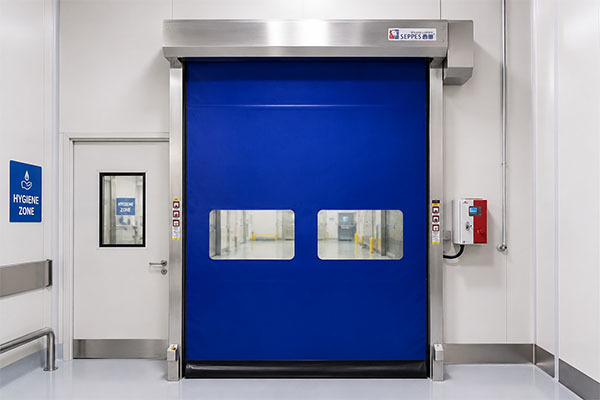
Airtight high-speed doors are the ultimate frontline defense for modern food processing facilities looking to eliminate deadly cross-contamination at critical facility junctions. Maintaining an absolute separation between raw and cooked areas is a non-negotiable directive for food safety compliance. Unlike standard industrial transitions, the entryways to high-hygiene zones—such as GMP cleanrooms, changing room exits, and air shower passages—serve as strict unidirectional bottlenecks. If these high-traffic access points are fitted with subpar barriers, the entire facility risks micro-environment breakdown, microbial infiltration, and expensive recall batches.
To mitigate these regulatory and operational hazards, top-tier food plants rely on advanced airtight high-speed doors to execute perfect micro-environment isolation. Below are five proven ways these engineering solutions protect your high-hygiene clean zones from contamination while maintaining streamlined operational workflows.
Contents
- 1 1. Preserving Strict Positive Pressure Maintenance
- 2 2. Enforcing 100% Touchless Entry to Prevent Cross-Contamination
- 3 3. Implementing Smart Interlocking for Air Showers
- 4 4. Eliminating Hygiene Dead Zones with FDA-Compliant Materials
- 5 5. Establishing a Foolproof Barrier with Airtight High-Speed Doors
- 6 FAQ
- 6.1 Q1: Why can’t we use standard automatic sliding doors for our cleanroom and air shower entrances?
- 6.2 Q2: Can the automated sensors and door components withstand daily high-pressure washdowns?
- 6.3 Q3: How do touchless entry sensors perform if employees are wearing thick sanitary gloves or pushing carts?
1. Preserving Strict Positive Pressure Maintenance
According to international GMP standards, high-hygiene rooms must maintain a higher differential air pressure relative to surrounding lower-hygiene areas (often a gradient of 5 to 10 Pascals or more). This pressure differential ensures that whenever a barrier is breached, clean air flows out, physically blocking unconditioned, untreated air from flowing back in. However, standard slow-moving commercial doors cause severe pressure drops during open cycles.
Specialized airtight high-speed doors solve this issue by offering rapid operating cycles, with opening speeds reaching up to 2.0 meters per second. By minimizing the time a portal remains open, these systems dramatically reduce the air leak rate. The integrated high-performance side guides and tight bottom seals ensure continuous positive pressure maintenance, completely preventing airborne bacteria, mold spores, and particulate matter from drifting from raw material receiving zones into high-cleanliness packaging rooms.
2. Enforcing 100% Touchless Entry to Prevent Cross-Contamination
Personnel behavior management is one of the most volatile variables in food safety QA. Even if a worker undergoes rigorous hand washing and sanitization protocols in the changing room, touching a manual door handle or a physical push-button immediately recontaminates their hands with pathogens like Listeria monocytogenes or Salmonella. Physical touchpoints are notorious vectors for cross-contamination.
To eliminate this threat, high-hygiene cleanroom entrances utilize advanced automation. Equipping airtight high-speed doors with a non-contact radar sensor or a digital hand-wave sensor ensures completely hands-free operation. Workers simply wave their hands near the sensor or approach the zone to trigger an immediate, automated opening cycle. By eliminating manual contact, these touchless airtight roll up doors ensure that employee hands remain entirely sterile from the sanitization station directly into the core production floor.
3. Implementing Smart Interlocking for Air Showers
The entrance to a core GMP production zone functions as a critical checkpoint. To ensure that personnel do not bypass safety protocols, facilities implement airtight high-speed doors integrated into smart air shower interlocking doors configurations. In this scenario, multiple doors are managed by an automated logic controller that strictly prevents both doors from being open at the same time.
Critical Safety Logic: When an employee enters the air shower chamber from the changing room, the entrance door closes and strictly seals the space. The system logic dictates that the exit door leading into the high-hygiene zone remains strictly closed and locked during the entire air shower decontamination cycle. Only after the high-velocity air-dusting process completes will the system unlock the exit door, creating a foolproof raw to cooked zone airtight doors system that eliminates human error.
4. Eliminating Hygiene Dead Zones with FDA-Compliant Materials
Standard industrial doors often feature exposed springs, deep tracks, and porous fabric layers that harbor moisture and trap organic matter, creating dangerous bacterial biofilms. In a high-hygiene zone, equipment must be designed from the ground up to support intense hygiene regimens without degrading.
Purpose-built cleanroom airtight high-speed doors feature a structure made entirely from heavy-duty 304 stainless steel. The frames are engineered with smooth, sloped surfaces to prevent dust accumulation and liquid pooling. Furthermore, the flexible door curtains are constructed using premium FDA-compliant materials that contain no toxic PVC plasticizers and resist aggressive chemical sanitizers. These smooth, washdown-ready profiles allow QA teams to perform deep high-pressure washdowns without worrying about structural corrosion or hidden hygiene dead zones, making regulatory compliance effortless during strict third-party audits.
5. Establishing a Foolproof Barrier with Airtight High-Speed Doors
Ultimately, a high-performance positive pressure isolation door acts as more than a physical partition—it acts as an automated compliance tool. By optimizing the physical entry barrier, food processing plants can reliably secure a predictable micro-environment. Instead of relying entirely on employees remembering to close doors or avoid touching surfaces, the infrastructure itself prevents cross-contamination.
By upgrading your facility’s high-hygiene entrances with automated airtight high-speed doors, you successfully isolate critical production zones, safeguard shelf-life consistency, and ensure that your plant effortlessly satisfies global food safety frameworks such as BRC, IFS, and FSMA.
FAQ
Q1: Why can’t we use standard automatic sliding doors for our cleanroom and air shower entrances?
A: Standard automatic doors operate too slowly and lack the rigorous structural sealing required to maintain a strict micro-environment. In a GMP cleanroom, losing positive pressure during a slow door cycle allows unconditioned, potentially contaminated air to rush into the hygiene zone. Airtight high-speed doors operate at speeds up to 2.0m/s and feature specialized side guides and zipper seals. This rapid action minimizes air exchange, locks in the pressure cascade, and ensures that the raw-to-cooked zone isolation remains uncompromised.
Q2: Can the automated sensors and door components withstand daily high-pressure washdowns?
A: Absolutely. In meat, dairy, or ready-to-eat (RTE) facilities, equipment must endure harsh daily sanitization. The motors, control boxes, and touchless sensors (such as radar and digital hand-wave units) on purpose-built airtight high-speed doors for food processing are enclosed in high IP-rated housings (typically IP65 or IP67), making them completely waterproof and dust-tight. Combined with a 304 stainless steel sloped frame, the entire system is designed to handle aggressive, high-pressure chemical washdowns without risking electrical failure or harboring bacterial biofilms.
Q3: How do touchless entry sensors perform if employees are wearing thick sanitary gloves or pushing carts?
A: The advanced non-contact sensors used in these high-hygiene setups do not rely on skin conductivity or heat signatures. Microwave and radar sensors detect motion and mass, while infrared wave-to-open sensors detect proximity within a specific adjustable range. This means employees can seamlessly trigger the opening cycle of their airtight high-speed doors while wearing thick sterile gloves or when their hands are full pushing material carts. This guarantees a 100% hands-free process, completely eliminating the risk of surface-to-hand cross-contamination.


