
Food grade rapid doors are the ultimate operational backbone for any meat portioning area and wet zone. In a meat processing plant, rough processing and cleaning areas face extreme challenges: ambient temperatures strictly controlled around 10°C – 12°C, daily heavy washdowns, and relentless pushcart traffic. Ordinary industrial doors simply cannot survive this environment, inevitably leading to rust, cold air loss, and severe hygiene violations.
To maintain strict HACCP standards and operational efficiency, here are the 5 proven secrets to choosing the right doors for your facility.
Contents
Why Ordinary Doors Fail in the Meat Portioning Area
The wet zone is a punishing, corrosive environment. Daily cleaning protocols involve high-pressure water jets, aggressive foam cleaners, and chemical sanitizers. When you add the high frequency of pushcart logistics moving raw meat between the cold room and the cutting tables, standard doors quickly become a liability. They rust easily, their side tracks harbor bacteria, and their slow operation causes massive thermal loss. This is exactly where washdown food grade rapid doors step in to solve the crisis permanently.
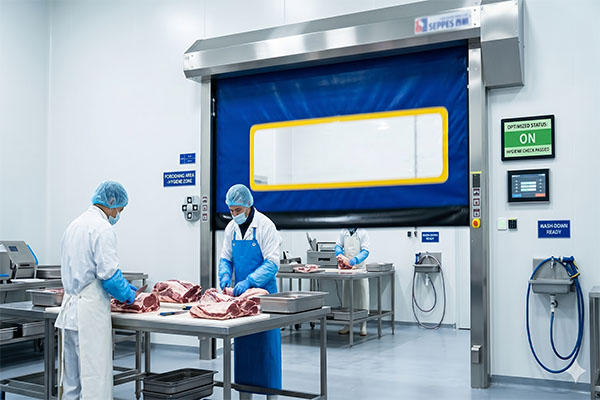
5 Secrets to Mastering Food Grade Rapid Doors in Wet Zones
How do you guarantee that your facility passes rigorous hygiene inspections while maximizing workflow? You must demand these specific technical features from your food grade rapid doors for meat processing.
1. IP69K and SUS304 for Ultimate Washdown Protection
In a meat portioning area, blood, fat, and bone fragments require extreme cleaning. Stainless steel food grade rapid doors must be constructed entirely of SUS304 (or SUS316) steel. More importantly, the drive motor and control box must achieve an IP69K rating. This ensures the equipment can withstand daily, high-temperature, high-pressure washdowns without short-circuiting or corroding over time.
2. Broken-Bridge Thermal Insulation Eliminates Condensation
The temperature difference between a chilled meat portioning area and a warmer washing zone causes severe surface condensation. Drops of condensation can fall onto raw meat below, causing unacceptable cross-contamination. High-quality insulated food grade rapid doors utilize a broken-bridge thermal insulation structure in the side guides. This blocks the thermal bridge effect, effectively eliminating condensation and keeping the passage dry.
3. Continuous Physical Isolation for Zero Contamination
In a meat processing plant, the high-humidity washing area and the strictly sanitized cutting area must be completely separated. When not actively facilitating traffic, food grade rapid doors provide an impenetrable environmental barrier. By sealing the opening tightly with specialized gaskets, they deliver continuous physical isolation. This permanently blocks airborne bacteria, chemical odors from cleaning agents, and heavy moisture in the wet zone from drifting into the highly sanitized meat portioning areas, ensuring absolute zero cross-contamination and safeguarding your product quality.
4. Lightning-Fast Response for Pushcart Logistics
In facilities operating without overhead meat rails, personnel and pushcart traffic dictate the workflow. Food grade rapid doors operate at speeds up to 2.5 meters per second. This extreme speed ensures that logistics pushcarts experience “zero waiting time” when moving between zones, drastically reducing the time the cold room is exposed to warmer air and minimizing energy consumption.
5. Crevice-Free Hygiene Design
Bacteria thrive in hidden tracks and exposed mechanical parts. IP69K food grade rapid doors feature a minimalist, crevice-free design. The bottom of the side tracks is sloped so water drains instantly after a washdown, completely avoiding water accumulation. By eliminating exposed screws and complex mechanical components, there is simply nowhere for meat residues or blood to hide.
Conclusion
Upgrading to food grade rapid doors is not just an operational cost; it is a critical investment in food safety and long-term efficiency. By insisting on SUS304 stainless steel, IP69K washdown capabilities, and continuous physical isolation, your meat portioning area will easily exceed international hygiene standards and run flawlessly.
FAQ
Q1: Can food grade rapid doors withstand daily high-pressure chemical washdowns in wet zones?
A: Yes. In a meat processing wet zone, doors must survive aggressive cleaning protocols. Our food grade rapid doors are constructed entirely from SUS304 stainless steel and are equipped with IP69K-rated motors and control boxes. This guarantees they can handle daily high-temperature, high-pressure water jets and harsh chemical foam cleaners without any risk of short-circuiting, rusting, or peeling.
Q2: How do these doors prevent condensation from dripping onto raw meat during transfer?
A: Condensation is a major cross-contamination risk when moving meat between a cold portioning area (10°C) and a warmer washing zone. To solve this, our food grade rapid doors utilize a broken-bridge thermal insulation design in the side tracks. This blocks the thermal transfer between the two distinct temperature zones, keeping the door surfaces completely dry and eliminating the risk of contaminated water droplets falling onto your product.
Q3: Are the doors fast enough to handle high-frequency pushcart traffic without losing cold air?
A: Absolutely. Since these specific meat portioning corridors rely on manual and pushcart logistics rather than overhead meat rails, speed is critical. Operating at up to 2.5 meters per second, food grade rapid doors allow pushcarts to pass with zero waiting time. This ultra-fast cycle minimizes the time the doorway is open, aggressively preventing cold air loss, saving energy, and maintaining the strict temperature control required by HACCP.


