
Aluminum roll up doors vs steel roll up doors is a common comparison for buyers specifying entrances for warehouses, factories, commercial buildings, service areas and storefronts. Both systems use a vertically rolling curtain that coils above the opening, but changing the curtain material can affect door weight, corrosion resistance, structural requirements, appearance, security, maintenance and even motor selection.
There is no single material that is automatically better for every project.
Aluminum is often considered where lower curtain weight, corrosion resistance and architectural appearance are important. Steel is frequently selected where strength, security and demanding industrial use are higher priorities.
However, material alone should never determine the final specification. Slat profile, material thickness, guide rails, opening dimensions, wind exposure, operating frequency, surface treatment and the complete drive system can significantly affect the performance of both aluminum and steel doors.
This guide compares the two materials from a commercial and industrial project perspective so that you can make a more informed choice.
Contents
- 0.1 What Are Aluminum and Steel Roll Up Doors?
- 0.2 Aluminum Roll Up Doors vs Steel Roll Up Doors: Quick Comparison
- 0.3 1. Weight and Structural Load
- 0.4 2. Strength and Security
- 0.5 3. Corrosion Resistance
- 0.6 4. Appearance and Architectural Design
- 0.7 5. Motor and Operating Requirements
- 0.8 6. Maintenance and Expected Service Life
- 0.9 7. Aluminum vs Steel Roll-Up Door Cost
- 0.10 8. Best Applications for Aluminum Roll-Up Doors
- 0.11 9. Best Applications for Steel Roll-Up Doors
- 0.12 10. Which Should You Choose: Aluminum or Steel?
- 0.13 11. What Information Should You Give a Manufacturer Before Ordering?
- 0.14 Final Verdict: Aluminum or Steel?
- 1 Frequently Asked Questions
- 1.0.1 Are aluminum roll-up doors better than steel roll-up doors?
- 1.0.2 Are steel roll-up doors stronger than aluminum doors?
- 1.0.3 Do aluminum roller shutters rust?
- 1.0.4 Are galvanized steel roll-up doors corrosion resistant?
- 1.0.5 Which roll-up door is better for a warehouse?
- 1.0.6 Which is more expensive, aluminum or steel roll-up doors?
- 1.0.7 Can both aluminum and steel roll-up doors be motorized?
- 1.0.8 Are aluminum or steel roll-up doors suitable for outdoor use?
What Are Aluminum and Steel Roll Up Doors?
Before comparing them, it helps to understand what actually changes between the two door systems.
Aluminum Roll Up Doors
Aluminum roll up doors use interconnected aluminum slats to create the rolling curtain. When the door opens, the curtain travels vertically through side guides and coils around a barrel or shaft above the opening.
An aluminum roller shutter is commonly considered for commercial entrances, service openings, storage areas and selected industrial applications where lower weight, corrosion resistance or appearance is important.
Depending on the project, aluminum slats can be combined with:
- Powder-coated or other suitable surface finishes
- Motorized or manual operation
- Guide rails and bottom bars
- Hood covers
- Remote controls or wall controls
- Access-control interfaces
- Photocells or other safety devices
The exact configuration should always be selected around the opening and operating requirements.
Steel Roll-Up Doors
Steel roll up doors, also called rolling steel doors or steel roller shutter doors, use interconnected steel slats that roll around an overhead barrel.
Galvanized steel is widely used because the protective coating improves corrosion resistance compared with untreated carbon steel.
Rolling steel systems are commonly considered for:
- Warehouses
- Manufacturing plants
- Logistics facilities
- Workshops
- Loading and service entrances
- Restricted-access openings
- Industrial buildings
For larger or heavier curtains, the shaft, guide system, support structure and motor must be matched to the calculated load rather than selected from opening dimensions alone.
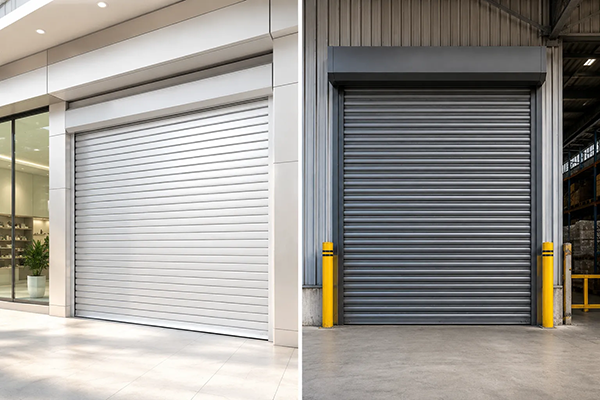
Aluminum Roll Up Doors vs Steel Roll Up Doors: Quick Comparison
The following table provides a useful starting point.
| Comparison Factor | Aluminum Roll-Up Doors | Steel Roll-Up Doors |
|---|---|---|
| Curtain Weight | Generally lighter | Generally heavier |
| Corrosion Resistance | Naturally good corrosion resistance | Depends more on galvanizing, coating and maintenance |
| Structural Strength | Suitable for many commercial and selected industrial applications | Often preferred for demanding industrial and security-focused applications |
| Security | Depends on slat profile, guides and locking system | Commonly selected where stronger physical protection is required |
| Appearance | Clean, architectural appearance | More industrial appearance |
| Motor Load | Lower curtain weight can reduce drive load | Heavier curtain may require a higher-capacity drive system |
| Maintenance | Attractive for humid or corrosion-sensitive environments | Surface protection should be inspected for damage |
| Typical Applications | Commercial entrances, storefronts, humid environments | Warehouses, factories, loading areas, industrial buildings |
| Cost | Depends on alloy, profile, size and configuration | Depends on steel gauge, coating, size and configuration |
This comparison should be treated as a selection guide rather than a universal engineering specification.
A well-designed aluminum shutter can outperform an unsuitable steel door in one project, while a properly engineered steel system may be much more appropriate in another.
1. Weight and Structural Load
One of the most important differences between aluminum and steel is weight.
Aluminum has a much lower material density than steel. As a result, a comparable aluminum curtain will generally be lighter, although the actual door weight still depends on slat profile, thickness, reinforcements and dimensions.
Why does this matter?
A rolling door curtain is part of a complete mechanical system. Its weight affects several components.
Shaft and Barrel Design
The barrel or shaft must support and roll the complete curtain.
A heavier steel curtain may require:
- A stronger shaft
- Larger support brackets
- More substantial bearings
- A stronger mounting structure
An aluminum curtain can reduce some of this load, although the shaft should still be engineered around the actual opening.
Motor Selection
Curtain weight is also one factor in motor sizing.
A lighter aluminum curtain may place less load on the drive system, but this does not mean that every aluminum door can use a small motor.
Motor selection also depends on:
- Door width and height
- Shaft diameter
- Curtain construction
- Operating frequency
- Installation method
- Required opening speed
- Local voltage and frequency
- Emergency operating method
For this reason, the motor, curtain, shaft and guides should be specified as one coordinated door system.
Building Structure
Large rolling doors transfer loads into the surrounding supporting structure.
For oversized or exposed openings, the supporting steelwork, guide anchoring and wind-load requirements should be reviewed before production.
Selection takeaway: If reducing curtain weight or structural load is important, aluminum can be attractive. For demanding industrial openings, the complete structure still needs engineering review regardless of curtain material.
2. Strength and Security
For security-focused industrial entrances, steel is often the first material buyers consider.
This is one reason industrial steel roll up doors are commonly used at warehouses, factories and restricted-access service openings.
Steel can provide a strong curtain construction, particularly when combined with an appropriate slat profile and material thickness.
However, saying that a steel door is automatically “secure” simply because it is made from steel is misleading.
Security Depends on the Complete Door
The resistance of a rolling door to forced access depends on more than curtain material.
Important components include:
- Interlocking curtain slats
- Slat thickness and profile
- Side guide rails
- Guide anchoring
- Bottom bar construction
- Locking arrangement
- Barrel and shaft
- Motor brake
- Supporting structure
A heavy curtain installed into inadequate guides or weak structural supports will not deliver the security expected from the material.
Likewise, aluminum roller shutters can also provide effective controlled access when the complete system has been designed for the required security level.
When Steel Makes More Sense
Steel is often preferred when the project priorities include:
- Higher physical security
- Industrial service conditions
- Stronger impact resistance requirements
- Large warehouse or factory entrances
- Restricted-access areas
- Heavy-duty curtain construction
For applications where appearance, low weight or corrosion behavior matters more, aluminum may offer a better balance.
3. Corrosion Resistance
Corrosion is another major difference when comparing aluminum and steel.
Why Aluminum Performs Well in Corrosive Environments
Aluminum naturally develops a thin oxide layer on its surface, helping protect the underlying material.
For this reason, aluminum roller shutters are often considered for projects involving:
- Humid climates
- Commercial entrances exposed to moisture
- Selected coastal environments
- Buildings where frequent moisture exposure is expected
Surface finishes can provide additional protection while also improving appearance.
However, aluminum should not simply be described as “corrosion-proof.” Fasteners, other metals in contact with the door, coating condition and the exact environment still matter.
Highly corrosive industrial or marine environments should be reviewed individually.
What About Steel?
Steel requires greater attention to surface protection.
Galvanized steel roll up doors use a zinc coating to improve corrosion resistance. Powder-coated or pre-finished surfaces can add another protective layer depending on the selected specification.
A properly protected steel door can perform well outdoors, but damaged coatings should not be ignored.
Maintenance should include checking for:
- Scratches
- Coating damage
- Exposed steel
- Rust development
- Water accumulation around guides or bottom sections
Selection takeaway: Aluminum is often attractive where corrosion resistance is a high priority. Galvanized steel remains a practical option for many outdoor industrial applications when the coating system and maintenance program match the environment.
4. Appearance and Architectural Design
Not every roller shutter is installed behind a warehouse.
For retail, commercial and architectural applications, appearance may be an important part of the specification.
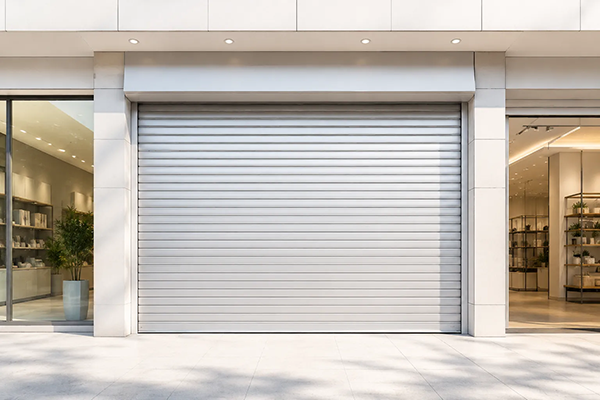
Aluminum can provide a cleaner and lighter visual appearance, which makes aluminum roll up doors useful for projects such as:
- Retail service entrances
- Commercial storefronts
- Shopping facilities
- Office service areas
- Architectural openings
- Commercial storage areas
Various finishes and colors may be available depending on the manufacturer and product system.
Steel doors can also be powder-coated or finished in project-specific colors, but their use is commonly associated with a more functional industrial appearance.
For a warehouse loading door this may not matter. For a public-facing commercial entrance, it can become an important selection factor.
This is why specifying commercial roll up doors should involve more than opening dimensions. Architects and buyers may also need to consider finish, surrounding façade materials and how visible the door is when closed.
5. Motor and Operating Requirements
Material affects the curtain weight, and curtain weight affects the operating system.
A motorized rolling door typically combines:
- Curtain
- Shaft or barrel
- Motor
- Brake
- Guide rails
- Control panel
- Limit system
- Activation devices
- Safety devices
For both aluminum and steel doors, the drive should be selected after the curtain configuration is known.
Aluminum Door Motor Considerations
Because aluminum curtains are generally lighter, they may reduce the required lifting load compared with a similar steel construction.
This can be beneficial for certain commercial or medium-duty applications.
Steel Door Motor Considerations
A steel curtain is generally heavier, particularly as the opening becomes larger.
Motorized steel roll up doors may therefore require:
- Higher lifting capacity
- Stronger shaft support
- Appropriate braking
- More substantial structural brackets
But material is still only one input.
A small steel door may require a much lighter drive system than a very large aluminum door.
For this reason, buyers should avoid choosing an operator based only on statements such as “suitable for a 4-meter-wide door.”
Opening height, curtain weight and expected operating cycles must also be considered.
6. Maintenance and Expected Service Life
It is tempting to ask whether aluminum or steel “lasts longer.”
In practice, there is no reliable universal answer.
Service life depends on:
- Door design
- Material quality
- Operating cycles
- Installation quality
- Environment
- Maintenance
- Wind exposure
- Impact damage
- Motor and control condition
Maintaining Aluminum Roller Shutters
Routine checks should include:
- Curtain alignment
- Guide condition
- Bottom bar
- Fasteners
- Shaft and bearings
- Operator
- Limit switches
- Controls
- Safety devices
- Surface damage
Aluminum can be particularly useful in humid conditions because corrosion management is generally less demanding than with exposed steel.
Maintaining Rolling Steel Doors
The same mechanical components should be inspected, but steel curtains also require attention to the protective surface.
For rolling steel doors, check for:
- Damaged galvanizing
- Scratched coating
- Rust
- Bent slats
- Guide damage
- Abnormal noise
- Uneven curtain movement
Any repeated stopping, unusual vibration or uneven movement should be investigated rather than simply reset and ignored.
What Usually Matters More Than Material?
A correctly specified, correctly installed and properly maintained door generally matters more than selecting a material based on an assumed lifespan.
7. Aluminum vs Steel Roll-Up Door Cost
Price is important, but comparing only material prices can lead to the wrong conclusion.
When buyers compare steel roll up door prices with aluminum doors, they should confirm whether the quotations describe the same performance requirements.
Two doors with identical opening dimensions can have very different costs.
Main Factors Affecting Roll-Up Door Cost
Opening Size
Larger doors require more curtain material and can also affect:
- Shaft size
- Guide strength
- Motor capacity
- Support structure
- Packaging
Slat Material and Thickness
Aluminum alloy, steel grade, material thickness and slat profile all influence material cost and structural performance.
Surface Finish
Galvanizing, powder coating and custom finishes can change the price.
Operation Method
Options may include:
- Manual push-up
- Chain hoist
- Motorized operation
A motorized system also requires controls, electrical components and an emergency operating arrangement.
Safety Devices
Depending on the project, options may include:
- Photocells
- Safety bottom edges
- Emergency stops
- Warning devices
- Motor brakes
Environmental Requirements
Wind exposure, outdoor installation, corrosion conditions and temperature can all change the recommended construction.
Quantity and Shipping
Export packaging, order volume and destination also contribute to total project cost.
For these reasons, a useful quotation should describe the complete door configuration—not only provide a price per square meter.
8. Best Applications for Aluminum Roll-Up Doors
Aluminum is worth considering when the project requires a combination of low weight, corrosion resistance and appearance.
Typical applications include:
Commercial Entrances
Commercial buildings often place greater importance on appearance than heavy industrial facilities.
An aluminum shutter can provide compact overhead storage while maintaining a cleaner architectural appearance.
Retail and Storefront Applications
For service entrances, stock areas and selected storefront openings, aluminum can provide controlled access without requiring swing-door clearance.
Humid Environments
Where moisture exposure is an important concern, aluminum’s corrosion characteristics can reduce dependence on protective coatings.
Light-to-Medium Industrial Openings
Workshops and storage areas can also use aluminum where maximum heavy-duty security is not the primary requirement.
That does not mean aluminum is limited to small doors. Larger openings are possible, but the curtain profile, guides, shaft and wind requirements must be reviewed for the specific system.
9. Best Applications for Steel Roll-Up Doors
Steel is commonly selected where industrial durability and physical security are higher priorities.
Warehouses and Distribution Centers
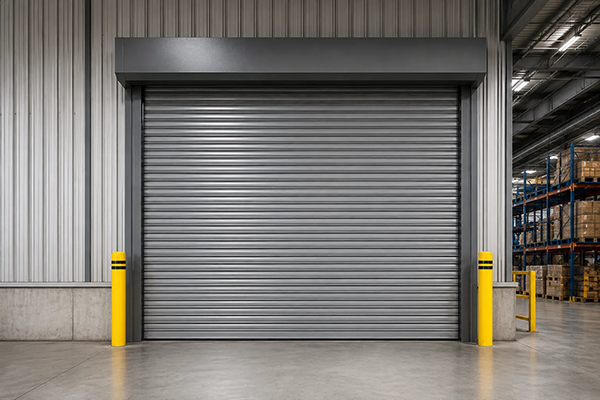
A warehouse roll up door can provide vertically opening access without occupying internal floor space.
For receiving, dispatch and storage entrances, steel construction is commonly selected for its industrial characteristics.
Manufacturing Plants
Factories often require doors that can withstand frequent daily use and demanding working environments.
Industrial steel roll up doors are therefore commonly considered for production buildings, workshops and restricted-access areas.
Loading and Service Entrances
Rolling steel systems work well where delivery vehicles or service teams require controlled access.
Motorized operation can be combined with suitable controls and safety devices.
Security-Focused Openings
Where physical protection is a higher priority than low curtain weight or architectural appearance, steel is often the more practical starting point.
Again, the security specification should include the guides, locks, anchoring and supporting structure—not simply the curtain material.
10. Which Should You Choose: Aluminum or Steel?
The easiest way to make an initial selection is to start with your highest-priority project requirements.
Consider Aluminum Roll-Up Doors When:
- Lower curtain weight is important
- Corrosion resistance is a major concern
- Architectural appearance matters
- The door is used in a commercial environment
- Humidity or moisture exposure is expected
- Heavy-duty physical security is not the primary design requirement
Consider Steel Roll-Up Doors When:
- Security is a major priority
- The door serves a warehouse or factory
- Industrial durability is important
- A heavier-duty curtain construction is preferred
- The opening serves a restricted-access area
- Industrial appearance is acceptable
Ask for Engineering Review When:
Material selection alone is not enough if your project involves:
- An unusually large opening
- High wind exposure
- Frequent operating cycles
- Outdoor coastal installation
- Special corrosion conditions
- Specific thermal-performance requirements
- Fire-rating requirements
- Integration with access control or automation
- Limited headroom or sideroom
A standard aluminum or steel roller shutter should also not be described as fire-rated simply because of its material. Fire-rated openings require a specifically designed, tested and appropriately certified door system.
11. What Information Should You Give a Manufacturer Before Ordering?
Whether you are buying aluminum or steel, providing better project information usually leads to a more useful recommendation and quotation.
Before requesting a quote, prepare the following information:
Opening Dimensions
Provide the structural opening width and height rather than an estimated door size.
Quantity
If multiple doors have different dimensions, a door schedule is useful.
Application
Explain whether the opening is used for:
- Warehouse access
- Factory production
- Commercial service access
- Retail
- Loading
- Storage
- Equipment access
Installation Environment
Tell the supplier whether the door will be:
- Indoors
- Outdoors
- Partially exposed
- Installed in a humid environment
- Exposed to wind, dust or salt air
Operation Method
Specify whether you prefer:
- Manual operation
- Chain hoist
- Motorized operation
If you are unsure, ask the manufacturer to recommend the operation method based on size and use.
Operating Frequency
A door opening several times per week and one opening dozens of times per hour have very different duty requirements.
Power Supply
For motorized doors, provide the available local voltage, phase and frequency.
Security Requirements
Explain whether the door provides general access control or protects a security-sensitive opening.
Safety and Control Requirements
Possible requirements may include:
- Push-button control
- Remote control
- Key switch
- Access control
- Photocells
- Safety edge
- Emergency stop
- Manual operation during power failure
Providing these details allows the curtain, guides, shaft, motor and controls to be reviewed as a complete system.
Final Verdict: Aluminum or Steel?
When comparing aluminum roll-up doors vs steel roll-up doors, the right answer depends on what the entrance needs to do.
Choose aluminum when lower curtain weight, corrosion resistance and appearance are important.
Choose steel when industrial strength, security and heavy-duty construction are higher priorities.
But do not make the final decision from material alone.
A reliable rolling door should be specified around:
- Opening dimensions
- Slat profile and thickness
- Guide construction
- Curtain weight
- Structural support
- Wind exposure
- Operating frequency
- Motor capacity
- Safety requirements
- Installation environment
A properly engineered aluminum door can be the better solution for one project, while a galvanized steel roll up door may be clearly more suitable for another.
If you are comparing the two materials for a commercial or industrial project, send the opening size, application, quantity, installation environment and operating requirements to the manufacturer before finalizing the specification.
Frequently Asked Questions
Are aluminum roll-up doors better than steel roll-up doors?
Neither material is universally better. Aluminum is generally preferred when lower weight, corrosion resistance and appearance are important. Steel is commonly selected when strength, security and heavy-duty industrial use are higher priorities. Door size, environment, operating frequency and structural design should also be considered.
Are steel roll-up doors stronger than aluminum doors?
Steel generally provides higher strength for comparable material sections, which is one reason steel roller shutter doors are widely used in industrial and security-focused applications. However, actual door strength also depends on slat profile, material thickness, guides, reinforcements, anchoring and the complete structural design.
Do aluminum roller shutters rust?
Aluminum does not rust in the same way as carbon steel. It naturally forms a protective oxide layer that helps resist corrosion. However, aluminum roller shutters can still experience surface deterioration or galvanic corrosion under certain environmental conditions, so material compatibility and exposure should still be reviewed.
Are galvanized steel roll-up doors corrosion resistant?
Yes, galvanizing provides a protective zinc coating that improves corrosion resistance. However, galvanized steel roll up doors are not maintenance-free. Damaged coatings, exposed steel and aggressive environments can still lead to corrosion over time.
Which roll-up door is better for a warehouse?
Steel is commonly selected for warehouse and industrial entrances because security and robust construction are often key priorities. However, an aluminum storage roll up door may also be appropriate where corrosion resistance or reduced curtain weight is more important. The final choice should consider opening size, traffic, wind exposure and security requirements.
Which is more expensive, aluminum or steel roll-up doors?
There is no universal answer because complete door cost depends on size, slat profile, material thickness, finish, motor, controls, safety devices, quantity and shipping. When comparing aluminum and steel roll up door prices, make sure the quotations cover equivalent door specifications.
Can both aluminum and steel roll-up doors be motorized?
Yes. Both materials can be used with motorized rolling-door systems. The operator must be matched to the actual curtain weight, dimensions, shaft configuration and operating frequency. Motor capacity should not be selected from door width alone.
Are aluminum or steel roll-up doors suitable for outdoor use?
Both can be configured for outdoor applications. Aluminum is attractive for corrosion-sensitive environments, while galvanized and properly coated steel is widely used outdoors. Wind exposure, drainage, guide construction, coating, motor protection and supporting structure should be reviewed before confirming either option.


