
Choosing the right roller shutter doors for retail stores involves more than selecting a strong metal curtain. A retail entrance has to protect the premises after business hours while also fitting the storefront design, operating reliably every day, and meeting the practical requirements of employees, customers, and property management.
A shopping mall fashion store, a street-facing electronics shop, and a jewelry store may all use roller shutters, but they do not necessarily need the same door.
For most retail projects, the decision comes down to five questions:
- How much physical security does the opening require?
- Should merchandise remain visible after the store closes?
- Is the shutter installed indoors or exposed to outdoor weather?
- How frequently will the door open and close?
- Is manual or motorized operation more appropriate?
There is therefore no single shutter that is best for every retail application. Aluminum, steel, perforated, motorized, and insulated shutters each solve different problems.
This guide explains how to compare the main options and choose a practical solution for your retail project.
Contents
- 1 What Should Retail Stores Look for in a Roller Shutter Door?
- 2 Best Roller Shutter Doors for Retail Stores: 5 Options Compared
- 2.1 1. Aluminum Roller Shutter Doors — Best Overall for Many Retail Storefronts
- 2.2 2. Perforated or See-Through Roller Shutters — Best for Shopping Malls and Display Stores
- 2.3 3. Steel Roller Shutter Doors — Best for Security-Focused Retail Applications
- 2.4 4. Motorized Roller Shutter Doors — Best for Convenient Daily Operation
- 2.5 5. Insulated Roller Shutter Doors — Best When Thermal Separation Matters
- 3 Aluminum vs. Steel Roller Shutters for Retail Stores
- 4 Which Roller Shutter Is Best for Your Type of Retail Store?
- 5 Quick Retail Roller Shutter Selection Table
- 6 How to Choose the Right Roller Shutter for a Retail Project
- 6.1 Step 1: Identify Where the Door Will Be Installed
- 6.2 Step 2: Define the Security Requirement
- 6.3 Step 3: Decide Whether Storefront Visibility Matters
- 6.4 Step 4: Choose Aluminum or Steel
- 6.5 Step 5: Select Manual or Motorized Operation
- 6.6 Step 6: Determine Controls and Safety Features
- 6.7 Step 7: Confirm Opening Dimensions and Site Conditions
- 7 Common Mistakes When Choosing Storefront Shutters
- 8 How Much Do Retail Roller Shutter Doors Cost?
- 9 FAQ: Roller Shutter Doors for Retail Stores
- 9.1 What is the best roller shutter for a retail store?
- 9.2 Are aluminum roller shutters secure enough for shops?
- 9.3 Are steel roller shutters better than aluminum shutters?
- 9.4 What is the best roller shutter for a shopping mall store?
- 9.5 Can customers still see the storefront when the shutter is closed?
- 9.6 Should a retail shutter be manual or electric?
- 9.7 What safety features should an electric shop shutter have?
- 9.8 Are roller shutters suitable for exterior retail stores?
- 9.9 How much does a retail roller shutter cost?
- 10 Final Recommendation
What Should Retail Stores Look for in a Roller Shutter Door?
Before comparing individual shutter types, start with the requirements of the opening itself.
1. Security Level
Security is usually the first reason retailers install storefront shutters.
However, the security of a roller shutter depends on more than the curtain material. The complete door system includes the curtain or slats, guide rails, bottom bar, locking arrangement, barrel assembly, mounting method, controls, and supporting building structure.
A typical shopping mall store may need a practical barrier against unauthorized access, while a jewelry store or electronics retailer may require a more security-focused design.
For higher-risk openings, commercial security shutters or steel security configurations are usually more appropriate than selecting a door mainly for appearance.
2. Storefront Visibility
Some stores still want customers to see the products inside after the entrance has been secured.
This is particularly important for:
- Fashion retailers
- Jewelry displays
- Electronics stores
- Automobile showrooms
- Premium retail brands
- Shopping mall stores
A solid curtain completely blocks the storefront. A perforated or open-visibility design can provide a physical barrier while maintaining a degree of visual connection between the store and the shopping area.
This makes visibility one of the biggest differences between a standard security shutter and a shutter designed specifically for a retail storefront.
3. Appearance
Retail entrances are part of the customer-facing architecture.
A shutter that works perfectly for a warehouse may look too industrial for a shopping mall or luxury storefront.
Color, slat profile, finish, hood design, guide dimensions, and overall integration with the facade should therefore be considered during product selection.
Aluminum roller shutters are commonly considered when appearance, lower curtain weight, and corrosion resistance are important project requirements.
4. Operating Frequency
A small shop that opens in the morning and closes once at night has different operating requirements from a supermarket service entrance that may be used repeatedly throughout the day.
Operating frequency affects the selection of:
- Door construction
- Operator or motor
- Control method
- Safety devices
- Maintenance plan
Do not select a motor based only on the width of the opening. Curtain weight, door height, operating frequency, electrical supply, and other project conditions also need to be considered.
5. Indoor vs. Outdoor Installation
A shutter installed inside a climate-controlled shopping center is protected from most weather exposure.
A street-facing store can be exposed to:
- Rain
- Humidity
- Dust
- Temperature changes
- Wind
- Coastal or corrosive environments
For an exterior entrance, materials and surface treatment become more important. Aluminum can offer an advantage where corrosion resistance is a priority, while steel shutters may require an appropriate galvanized or coated finish for the installation environment.
6. Manual vs. Motorized Operation
Small, lightweight shutters may be suitable for manual operation.
For larger entrances, heavier curtains, or frequently operated stores, an electric roller shutter door can make daily operation easier.
Motorization can also support different control methods, such as push buttons, key switches, remote controls, or access-control integration.
Motorized operation should be treated as an operating method rather than a separate curtain material. An electric retail shutter can use aluminum, steel, or another compatible curtain construction.
Best Roller Shutter Doors for Retail Stores: 5 Options Compared
The following five configurations cover most common retail applications.
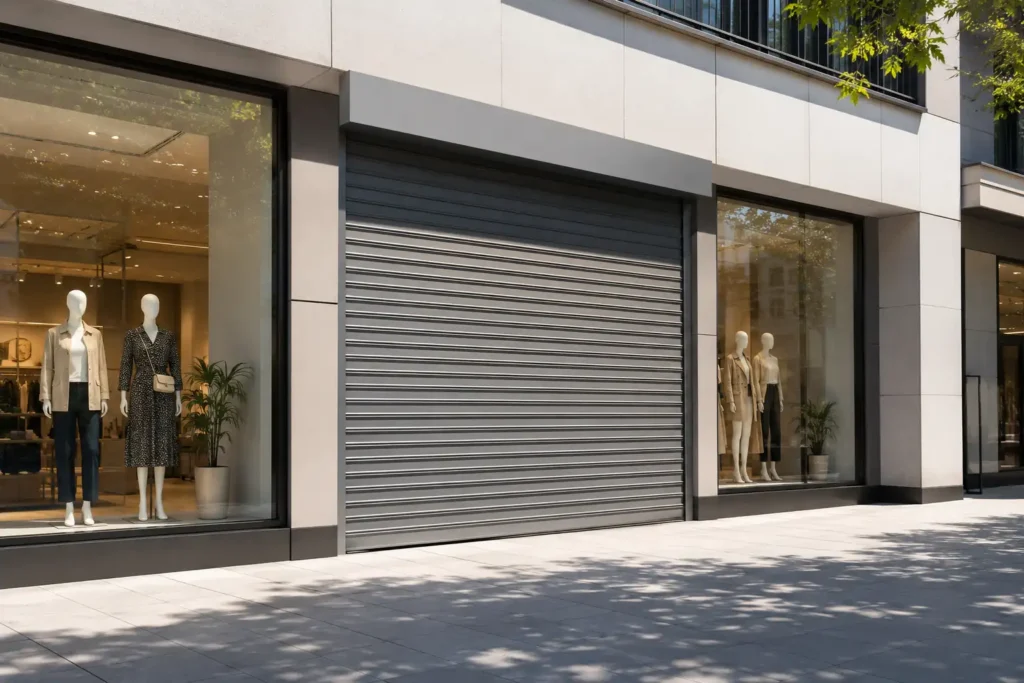
1. Aluminum Roller Shutter Doors — Best Overall for Many Retail Storefronts
For many standard retail entrances, aluminum roller shutter doors offer a useful balance between appearance, corrosion resistance, curtain weight, and security.
Compared with heavier steel constructions, aluminum can make it easier to create a cleaner architectural appearance while keeping the curtain relatively lightweight.
Typical applications include:
- Shopping mall stores
- Fashion stores
- Restaurants and cafés
- Interior retail entrances
- Commercial storefronts
- Showrooms
Aluminum shutters can also be supplied with different finishes and colors to better coordinate with the storefront facade.
They are especially useful when the project prioritizes:
Appearance: The shutter needs to integrate with a commercial interior or facade.
Corrosion resistance: The entrance is in a humid or exposed environment.
Lower curtain weight: The project benefits from a lighter curtain assembly.
Customization: Color, slat design, controls, or other details need to match the project.
However, an aluminum shutter should not automatically be described as suitable for every security application. For stores with unusually high security requirements, the complete shutter structure should be evaluated rather than choosing the material alone.
Best for: shopping malls, general retail stores, boutiques, showrooms, restaurants, and architectural storefronts.
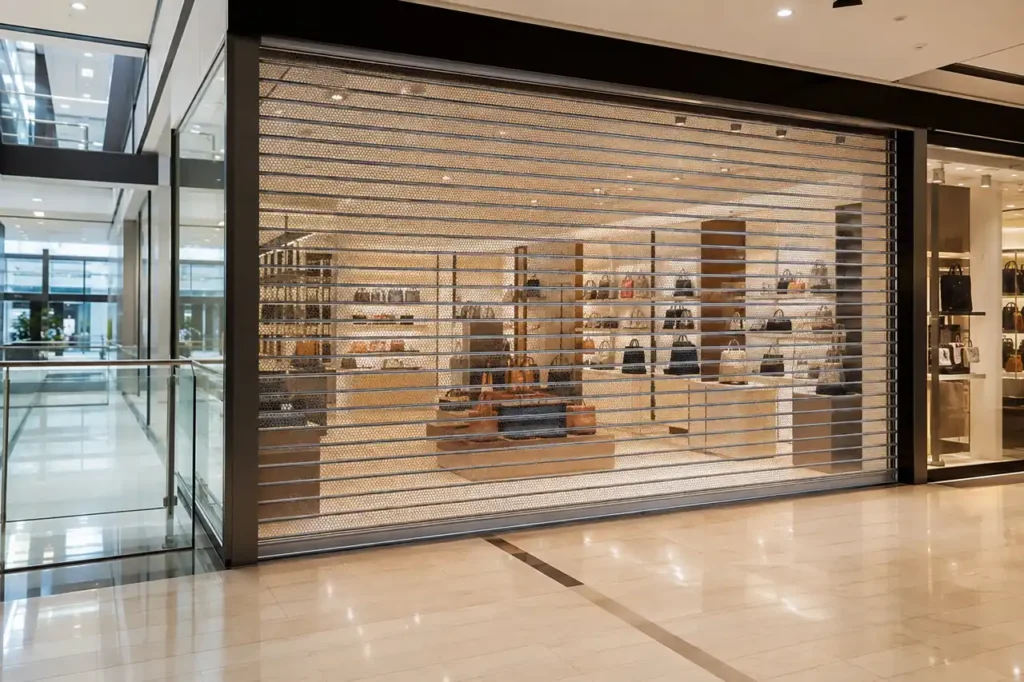
2. Perforated or See-Through Roller Shutters — Best for Shopping Malls and Display Stores
For many mall retailers, completely hiding the storefront after closing is undesirable.
A perforated roller shutter can allow some visibility through the curtain while creating a barrier across the opening.
This is useful when merchandise displays remain part of the shopping center environment after business hours.
Typical applications include:
- Fashion stores
- Jewelry displays
- Electronics retailers
- Cosmetic stores
- Showrooms
- Mall kiosks or shopfronts
A perforated shutter can help balance two competing retail requirements:
The store needs to be closed, but the storefront should remain visually accessible.
This is why see-through designs can be particularly useful for retail shop roller shutters installed inside shopping centers.
Visibility, however, should not be confused with a specific security rating. The level of protection still depends on the curtain construction, guide rails, locking system, mounting details, and other components.
Stores carrying high-value merchandise should therefore evaluate the complete security requirement before deciding that visibility is the main priority.
Best for: indoor shopping malls and stores where after-hours product visibility matters.
3. Steel Roller Shutter Doors — Best for Security-Focused Retail Applications
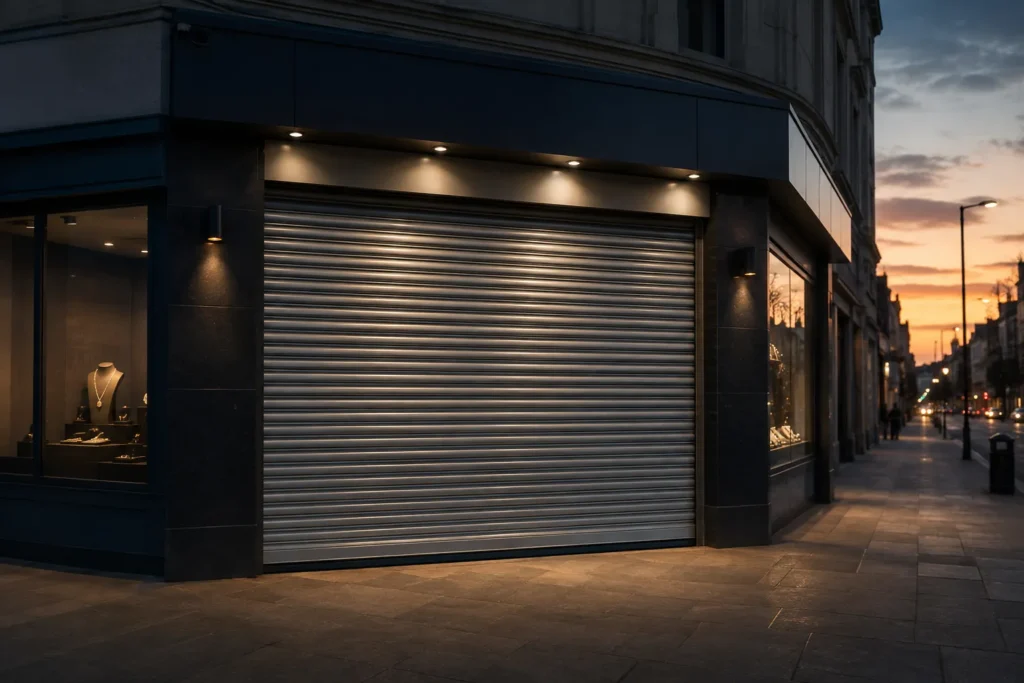
Where physical protection is the main priority, steel roll up doors and rolling steel shutters are often the more suitable starting point.
Steel curtains are commonly used for commercial and industrial openings where robust construction is more important than minimizing curtain weight.
Retail applications may include:
- Street-facing shops
- Jewelry stores
- Electronics stores
- Pharmacies
- Stock rooms
- Service entrances
- High-value merchandise areas
A commercial rolling steel door can be particularly useful for a rear entrance or stock area where appearance is less important than security and durability.
For customer-facing storefronts, the design may need more attention to finish and architectural integration.
High-security projects should also evaluate more than the steel curtain itself. Important factors include:
- Slat construction
- Guide rail design
- Bottom bar
- Locking arrangement
- Fasteners and fixing method
- Supporting structure
- Operator and controls
- Emergency operation
Simply changing from aluminum to steel does not automatically create a certified high-security door.
If a project has a specific security standard or insurer requirement, that requirement should be identified before the shutter is engineered.
Best for: street-facing retail, high-value stores, back-of-house areas, stock rooms, and security-focused commercial openings.
4. Motorized Roller Shutter Doors — Best for Convenient Daily Operation
A motorized roll up door is often a better option when employees need to operate a retail shutter regularly or when the curtain is too large or heavy for convenient manual operation.
Common control options may include:
- Wall-mounted push button
- Key switch
- Remote control
- Access-control interface
- Building control integration
An electric roller shutter door can reduce manual handling and make opening or closing a large storefront more practical.
Motorized operation is especially useful for:
- Large shop entrances
- Supermarkets
- Service areas
- Delivery entrances
- Frequently accessed stock areas
- Heavy steel shutters
For safety, an electric shutter may also require suitable protective devices depending on its operating method, door design, and local requirements.
Possible safety features can include photoelectric sensors, safety edges, emergency-stop controls, warning devices, or manual emergency operation.
The exact configuration should be determined according to the project rather than treating every motorized shutter as having the same safety system.
It is also useful to distinguish between electric and fully automatic operation.
An electric shutter may simply open when a person presses a button. A more automated system may receive commands from access control, sensors, or another building system.
Best for: larger retail entrances, heavier shutters, frequent operation, and projects requiring convenient controlled access.
5. Insulated Roller Shutter Doors — Best When Thermal Separation Matters
Insulation is not necessary for every retail store.
A shutter installed inside a shopping mall usually does not need the same thermal performance as an exterior entrance separating an air-conditioned interior from outdoor conditions.
An insulated shutter becomes more relevant for:
- Exterior retail entrances
- Climate-controlled stores
- Supermarket service areas
- Temperature-sensitive stock rooms
- Locations with significant indoor/outdoor temperature differences
Insulated curtain designs can help reduce heat transfer through the door area compared with non-insulated single-skin curtains.
However, insulation should be treated as a project requirement rather than an automatic upgrade.
If a storefront is located entirely inside a conditioned mall, spending more on an insulated curtain may provide little practical benefit.
Best for: exterior or climate-sensitive retail openings where thermal performance is an actual project requirement.
Aluminum vs. Steel Roller Shutters for Retail Stores
Aluminum and steel are two of the most common material choices for commercial roll up doors, but neither is universally better.
| Factor | Aluminum Roller Shutter | Steel Roller Shutter |
|---|---|---|
| Curtain weight | Generally lighter | Generally heavier |
| Corrosion resistance | Strong advantage in suitable aluminum systems | Depends heavily on galvanizing, coating and environment |
| Security | Suitable for many retail applications depending on construction | Often preferred for security-focused applications |
| Appearance | Well suited to architectural storefronts | Often has a more industrial character |
| Color/finish options | Good customization potential | Good with suitable coating systems |
| Motorization | Compatible with motorized operation | Compatible; operator must match curtain load |
| Typical retail use | Malls, boutiques, showrooms, storefronts | Street shops, high-security areas, stock rooms |
| Cost | Project-dependent | Project-dependent |
The important point is that material is only one part of the specification.
A lightweight aluminum shutter with appropriate guides and controls may be ideal for a fashion store, while a heavier steel roll up security door may make more sense for a street-facing electronics retailer.
The correct choice depends on the opening rather than a simple aluminum-versus-steel rule.
Which Roller Shutter Is Best for Your Type of Retail Store?
A faster way to narrow the options is to start with the type of store.
Shopping Mall Stores
Recommended starting point: Aluminum or perforated retail shutter.
Mall stores usually prioritize:
- Appearance
- Storefront visibility
- Compact installation
- Reliable daily operation
- Integration with the shopping center design
A perforated aluminum shutter can be particularly useful when the store wants merchandise to remain visible after closing.
Street-Facing Retail Stores
Recommended starting point: Solid aluminum or steel security shutter.
Street-facing entrances are exposed directly to the outdoor environment and may face greater after-hours security risks.
Consider:
- Security level
- Weather exposure
- Corrosion
- Wind conditions
- Locking
- Motorization
- Emergency operation
The exact material should depend on the balance between security and architectural appearance.
Jewelry and High-Value Retail
Recommended starting point: Security-focused steel or engineered security shutter.
For jewelry and other high-value stores, do not select the door based only on the word “steel.”
The entire opening should be considered, including the curtain, guides, locks, mounting, supporting structure, controls, and any applicable security requirements.
A store may also use a transparent or display-oriented internal barrier in combination with another security layer depending on the overall security strategy.
Fashion and Luxury Stores
Recommended starting point: Architectural aluminum or perforated shutter.
These stores often place greater emphasis on:
- Storefront aesthetics
- Visibility
- Clean architectural integration
- Customized colors and finishes
The shutter should protect the opening without making the storefront look unnecessarily industrial.
Supermarkets and Convenience Stores
The correct solution depends heavily on the entrance.
For the customer-facing entrance, aluminum or a security shutter may work well.
For stock rooms and delivery entrances, a steel or electric roll up door may be more practical because appearance is less important and operational requirements may be higher.
Back-of-House and Stock Rooms
Recommended starting point: Steel or motorized commercial shutter.
For non-customer-facing areas, priorities normally shift toward:
- Security
- Durability
- Practical operation
- Access control
- Maintenance
- Cost efficiency
This is where rolling steel doors can be particularly effective.
Quick Retail Roller Shutter Selection Table
| Retail Application | Suggested Starting Point | Main Priority |
| Mall fashion store | Perforated aluminum shutter | Visibility + appearance |
| Luxury storefront | Aluminum roller shutter | Architecture + finish |
| Street-facing shop | Aluminum or steel security shutter | Security + weather resistance |
| Jewelry store | Security-focused steel shutter | Physical protection |
| Electronics retailer | Steel or security shutter | After-hours security |
| Supermarket entrance | Motorized commercial shutter | Convenient operation |
| Stock room | Rolling steel door | Security + practicality |
| Exterior conditioned store | Insulated shutter | Thermal separation |
| Frequently operated service entrance | Motorized shutter | Operating convenience |
Use this table as a starting point, not as a final specification. Opening dimensions and site conditions can change the appropriate configuration.
How to Choose the Right Roller Shutter for a Retail Project
A practical specification process can be completed in seven steps.
Step 1: Identify Where the Door Will Be Installed
Is it:
- Inside a shopping mall?
- On an exterior storefront?
- At a loading or service entrance?
- Inside a stock room?
This immediately helps determine whether appearance, weather resistance, or heavy-duty construction should receive greater priority.
Step 2: Define the Security Requirement
Ask what the shutter actually needs to protect.
A fashion store inside a controlled shopping mall may have very different requirements from a street-facing jewelry retailer.
Do not use vague terms such as “high security” without defining what the project expects the door to achieve.
Step 3: Decide Whether Storefront Visibility Matters
If customers should still see merchandise after closing, consider a perforated or see-through curtain.
If privacy and maximum visual closure are preferred, a solid curtain is usually more appropriate.
Step 4: Choose Aluminum or Steel
Choose based on the project priorities.
Consider aluminum when lower curtain weight, architectural appearance, and corrosion resistance are important.
Consider steel when robust construction and security are the primary objectives.
Step 5: Select Manual or Motorized Operation
Consider:
- Opening size
- Curtain weight
- Operating frequency
- Staff use
- Power supply
- Access-control requirements
Larger or frequently used openings are more likely to benefit from motorization.
Step 6: Determine Controls and Safety Features
Depending on the door and operating method, the system may require:
- Push-button control
- Key switch
- Remote control
- Access-control integration
- Photoelectric sensor
- Safety edge
- Emergency stop
- Manual emergency operation
- Warning device
The correct safety arrangement should be confirmed for the specific installation and local requirements.
Step 7: Confirm Opening Dimensions and Site Conditions
Before requesting a quotation, prepare:
- Opening width
- Opening height
- Available headroom
- Available sideroom
- Installation position
- Indoor or outdoor environment
- Quantity
- Local voltage and frequency
- Required operation method
- Security requirements
- Project location
Providing these details makes it much easier for a manufacturer to recommend an appropriate shutter rather than quoting a generic configuration.
Common Mistakes When Choosing Storefront Shutters
Mistake 1: Choosing Only by Price
A low initial door price does not necessarily mean a lower total project cost.
Incorrect motor sizing, poor corrosion resistance, unsuitable controls, or difficult maintenance can create additional costs later.
Compare the complete configuration, not just the curtain price.
Mistake 2: Assuming Steel Is Always the Best Choice
Steel is an excellent material for many security-focused applications, but a heavy industrial-style shutter may be unnecessary for an interior mall boutique.
The best door is the one that matches the actual project requirements.
Mistake 3: Ignoring Storefront Visibility
Installing a completely solid shutter can reduce the visibility of displays after business hours.
For stores where the display continues to contribute to customer engagement, a perforated design may provide a better balance.
Mistake 4: Selecting the Motor Only by Door Width
Door width is only one input.
Motor or operator selection should also consider curtain weight, door height, operating frequency, electrical supply, and the complete door design.
Mistake 5: Assuming Every Roller Shutter Is Fire-Rated or Certified High-Security
A standard roller shutter is not automatically a fire-rated door simply because it uses steel.
Fire-rated shutters require an appropriate product design, testing, certification, controls, and installation method.
The same principle applies to specific security, wind-load, or other performance claims.
If your project requires certified performance, identify the required standard before product selection.
How Much Do Retail Roller Shutter Doors Cost?
There is no meaningful single price for a custom retail roller shutter.
The cost normally depends on factors such as:
- Opening width and height
- Aluminum or steel curtain
- Solid or perforated construction
- Curtain thickness and profile
- Surface finish
- Manual or motorized operation
- Motor capacity
- Control method
- Safety devices
- Installation requirements
- Required performance
- Quantity
- Shipping destination
For this reason, comparing commercial roll-up door prices without comparing specifications can be misleading.
A useful quotation should identify what configuration is included so that different offers can be compared on the same basis.
FAQ: Roller Shutter Doors for Retail Stores
What is the best roller shutter for a retail store?
There is no single best option for every store. Aluminum shutters are well suited to many architectural storefronts, perforated shutters work well where merchandise visibility matters, and steel shutters are commonly selected for security-focused applications. Motorized operation is useful for larger or frequently operated entrances. The correct choice depends on security, visibility, location, opening size, and operating frequency.
Are aluminum roller shutters secure enough for shops?
Aluminum roller shutters can provide suitable protection for many retail applications, but security should be evaluated using the complete door construction rather than curtain material alone. Guide rails, bottom bar, locking, fasteners, controls, and supporting structure all influence the final result.
Are steel roller shutters better than aluminum shutters?
Not necessarily. Steel is often preferred where robust construction and security are priorities. Aluminum can be a better choice where lower weight, corrosion resistance, appearance, and architectural integration matter more. The application should determine the material.
What is the best roller shutter for a shopping mall store?
For many indoor mall stores, an aluminum or perforated shutter is a practical starting point. A perforated design can maintain merchandise visibility while the entrance is closed. Higher-security stores may require a more security-focused configuration.
Can customers still see the storefront when the shutter is closed?
Yes, if the door uses a perforated or other visibility-oriented curtain design. The level of visibility varies with the curtain construction, so it should be confirmed during product selection.
Should a retail shutter be manual or electric?
Small and lightweight shutters may be practical to operate manually. Larger, heavier, or frequently used doors usually benefit more from electric operation. The motor should be selected according to the complete door specification and expected operating conditions.
What safety features should an electric shop shutter have?
The required features depend on the door design and local requirements. Possible options include photoelectric sensors, safety edges, emergency-stop controls, warning devices, and manual emergency operation. Safety devices should be specified as part of the complete door system.
Are roller shutters suitable for exterior retail stores?
Yes, but exterior installations require additional consideration of corrosion, rain, wind exposure, surface treatment, supporting structure, and environmental conditions. The manufacturer should know that the shutter will be installed outdoors before recommending the configuration.
How much does a retail roller shutter cost?
Price depends on opening size, curtain material, design, motorization, controls, safety devices, finish, quantity, and shipping requirements. Providing accurate project information is the best way to obtain a meaningful quotation.
Final Recommendation
The best roller shutter doors for retail stores are not determined by one material or one product name.
For many standard storefronts, an aluminum roller shutter provides a practical balance of appearance, corrosion resistance, and daily usability.
For mall stores that need after-hours display visibility, a perforated roller shutter may be the better choice.
For street-facing shops, stock rooms, and high-security applications, steel roll up doors or security-focused rolling shutters deserve stronger consideration.
And for large or frequently operated entrances, a motorized roll up door can make daily operation significantly more practical.
The most reliable selection process is to match the shutter to the actual opening, security requirement, operating frequency, installation environment, and storefront design.
Need Help Selecting a Roller Shutter for Your Retail Project?
Send us the following information:
- Retail store type
- Opening width × height
- Quantity
- Indoor or outdoor installation
- Storefront visibility requirement
- Security requirement
- Manual or motorized operation
- Project country
- Local voltage and frequency
Based on these details, we can evaluate the opening requirements and recommend a suitable roller shutter configuration for your project.


