
Choosing an aluminum roller shutter for a commercial building involves much more than matching a door to an opening. A shutter used at a retail storefront may need to balance security and appearance, while a shutter at a warehouse service entrance may need to handle larger dimensions, frequent operation, wind exposure, and integration with access controls.
For building owners, contractors, architects, facility managers, and procurement teams, the best choice is therefore not simply the strongest or lowest-priced door. The right aluminum roller shutter is the one whose curtain, guides, shaft, operator, controls, safety devices, and installation method are selected as one system for the actual operating conditions.
This guide explains the main factors to evaluate before specifying aluminum roller shutters for commercial buildings, including application, opening size, security, operating frequency, insulation, environmental exposure, automation, safety, installation, and lifecycle cost.
Contents
- 1 1. Start With the Commercial Building Application
- 2 2. Choose the Right Aluminum Roller Shutter for the Opening Size
- 3 3. Determine the Required Security Level
- 4 4. Consider How Often the Door Will Operate
- 5 5. Decide Whether You Need an Insulated Roll Up Door
- 6 6. Evaluate Wind Load and Environmental Conditions
- 7 7. Choose Between Manual and Motorized Operation
- 8 8. Do Not Ignore Safety Devices
- 9 9. Check Roll Up Door Installation Conditions Before Ordering
- 10 10. Compare Total Cost, Not Just the Door Price
- 11 11. Aluminum vs. Steel: Which Is Better for Commercial Buildings?
- 12 12. Commercial Aluminum Roller Shutter Selection Checklist
- 13 13. Common Mistakes When Choosing Commercial Roll Up Doors
- 14 Frequently Asked Questions
- 14.1 Are Aluminum Roller Shutters Suitable for Commercial Buildings?
- 14.2 Are Aluminum Roller Shutters Secure?
- 14.3 Are Aluminum Roll Up Doors Suitable for Large Openings?
- 14.4 Do Commercial Roll Up Doors Need Insulation?
- 14.5 What Affects Commercial Roll Up Doors Prices?
- 14.6 What Information Should I Provide Before Ordering a Commercial Roller Shutter?
- 15 Conclusion
1. Start With the Commercial Building Application
Before comparing slat profiles or motor sizes, identify where the door will be installed and what it must do every day. This step helps narrow down the correct aluminum roller shutter configuration before detailed engineering begins.
Storefronts and Retail Entrances
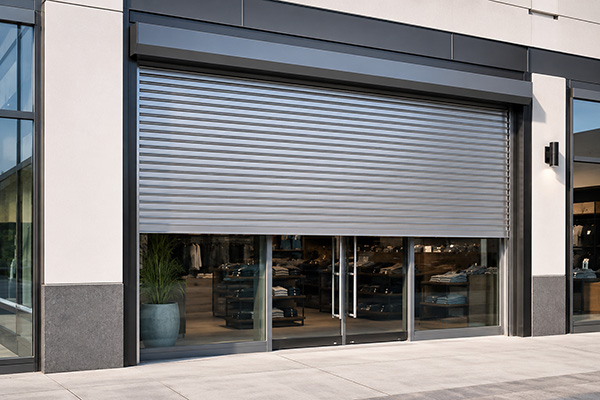
For retail stores, showrooms, kiosks, and shopping-center units, storefront roll up doors often need to provide after-hours security without making the entrance look excessively industrial.
Typical priorities include:
- a clean architectural appearance;
- compact headroom and side-room requirements;
- corrosion-resistant finishes;
- suitable security after business hours;
- smooth daily operation; and
- optional perforated, punched, or vision sections when visibility or ventilation is required.
Roll up shop doors may use different curtain designs depending on whether the owner wants a closed barrier, partial visibility, or airflow. The correct choice should consider both security and the desired storefront appearance rather than treating every retail entrance the same.
Commercial Service Entrances
Commercial service doors at restaurants, hotels, office buildings, supermarkets, and mixed-use properties usually prioritize reliability and controlled access. These commercial roll up doors may open several times per day for deliveries, staff movement, waste handling, or service vehicles.
In these applications, operating frequency, motor duty, safety devices, control method, and ease of maintenance can be more important than decorative appearance alone.
Warehouses and Storage Areas
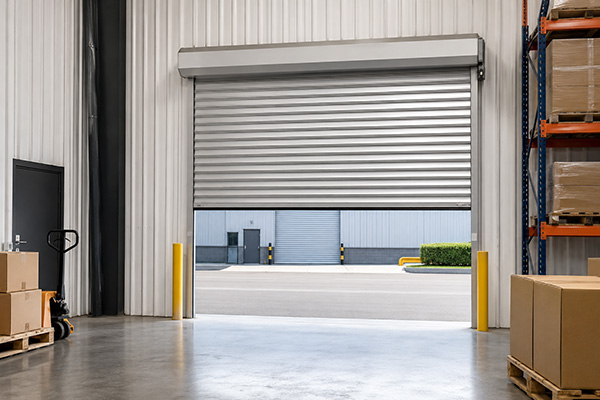
A warehouse roll up door may serve receiving areas, storage rooms, loading zones, or internal partitions. Larger openings require more careful consideration of curtain weight, shaft deflection, guide rail dimensions, structural fixing, and motor capacity.
For an aluminum roller shutter installed on an exterior warehouse opening, wind exposure should also be evaluated. Door width by itself is not enough to determine whether a standard curtain and guide system will perform reliably.
2. Choose the Right Aluminum Roller Shutter for the Opening Size
Opening dimensions are one of the first pieces of information a supplier will request, but width and height should never be evaluated in isolation.
As an aluminum roller shutter becomes wider or taller, several system variables can change:
- total curtain weight;
- slat profile and material thickness;
- rolling diameter;
- barrel or shaft size;
- bearing and support requirements;
- guide rail depth and engagement;
- motor torque; and
- fixing requirements.
A wide door exposed to wind may require a different design from an equally wide door installed inside a building. Similarly, a tall door with frequent operating cycles may require different operator and shaft considerations from a rarely used shutter of the same dimensions.
For this reason, professional selection should consider opening size together with curtain weight, wind load, operating frequency, supporting structure, and installation conditions.
3. Determine the Required Security Level
Security requirements vary significantly between commercial properties. A shutter protecting a back-of-house utility room does not necessarily need the same design as one protecting a jewelry store, electronics shop, or restricted storage area.
When evaluating roll up security doors or security roller shutters, consider the complete assembly rather than only the curtain material.
Important elements can include:
- slat profile and thickness;
- guide rail engagement;
- bottom bar design;
- locking method;
- motor brake;
- anti-lift provisions;
- access-control method; and
- strength of the wall or supporting structure.
An aluminum roller shutter can provide an effective physical barrier for many commercial applications, but the required security performance should be defined before the door is specified.
Where a project has formal forced-entry, insurance, or security-rating requirements, the complete tested or specified system should be matched to those requirements rather than relying on general marketing descriptions.
4. Consider How Often the Door Will Operate
Operating frequency is one of the most commonly overlooked selection factors.
A commercial roller door that opens twice a day has a very different duty requirement from one serving a parking entrance, busy service corridor, or logistics area.
For low-frequency applications, a standard operator may be sufficient. For moderate or higher operating frequencies, the designer should evaluate:
- motor duty cycle;
- motor temperature and protection;
- brake performance;
- bearing durability;
- shaft and curtain wear;
- control logic; and
- planned maintenance intervals.
Do not select the motor only from the door dimensions. Two commercial roll up doors of identical size may need different operators because one cycles five times per day while the other cycles dozens of times.
If the expected daily cycles are known, provide them during the quotation stage. This allows the door supplier to evaluate the aluminum roller shutter as an operating system rather than simply a fabricated curtain.
5. Decide Whether You Need an Insulated Roll Up Door
Not every commercial opening requires insulation. Adding thermal performance where it is unnecessary may increase cost and curtain weight without providing a meaningful operational benefit.
An insulated roll up door is more relevant when the opening separates spaces with different temperature conditions, such as:
- air-conditioned warehouses;
- temperature-controlled back-of-house rooms;
- exterior openings in hot or cold climates;
- facilities where HVAC energy loss is a concern; or
- spaces that require improved thermal separation.
By contrast, a standard single-skin aluminum roller shutter may be suitable for indoor partitions, non-conditioned storage areas, or applications where security and access control are more important than thermal performance.
If insulation is required, ask how the manufacturer defines the insulated construction and what thermal data is available for the proposed curtain system. Do not assume that all insulated roll up doors provide the same thermal performance simply because they use double-wall slats or an insulated core.
6. Evaluate Wind Load and Environmental Conditions
An exterior aluminum roller shutter must be selected for the environment around the opening, not only for the building type.
Wind-Exposed Openings
Wind pressure can place substantial load on a large shutter curtain. Relevant factors include opening width and height, building location, exposure, guide rail engagement, curtain reinforcement, and structural anchoring.
For projects in exposed locations, ask the supplier to evaluate the required wind resistance instead of assuming that a standard commercial roll up door is suitable for every exterior opening.
Coastal and Corrosive Environments
Aluminum offers good corrosion resistance, which is one reason aluminum roll up doors are attractive for many commercial buildings. However, the complete door is not made only from aluminum.
Fasteners, shafts, bearings, brackets, motors, control enclosures, electrical connections, and surface finishes may all respond differently to moisture, salt, chemicals, or cleaning agents.
For coastal or corrosive sites, specify the environmental conditions at the design stage so that materials, coatings, hardware, and electrical protection can be considered across the entire aluminum roller shutter system.
7. Choose Between Manual and Motorized Operation
Manual operation can be practical for smaller shutters that are used infrequently. It keeps the control system simple and may be suitable for certain internal service openings or small commercial counters.
For larger openings or regular commercial use, motorized operation is usually more convenient. A motorized aluminum roller shutter can also integrate with different control methods, including:
- wall-mounted push buttons;
- key switches;
- remote controls;
- access-control systems;
- building control interfaces; and
- selected sensors or interlocks.
The control method should match the actual traffic flow. A staff-only service door may benefit from a key switch or access-control interface, while a frequently used logistics entrance may need a different operating sequence.
For powered doors, the motor, brake, controls, limit settings, and emergency operating method should be evaluated together.
8. Do Not Ignore Safety Devices
Safety is especially important when an aluminum roller shutter is motorized and operates around people, vehicles, carts, or goods.
Depending on the door design, operating mode, risk assessment, and local requirements, safety provisions may include:
- safety photocells;
- a monitored bottom safety edge;
- emergency-stop controls;
- motor braking;
- obstruction detection;
- warning devices; and
- manual emergency operation.
A photocell and a safety edge do not perform exactly the same function, and the appropriate protection depends on the application. Safety devices should therefore be selected as part of the door’s control strategy rather than added as an afterthought.
Where the project is subject to specific local safety standards, building codes, or machinery requirements, the final aluminum roller shutter configuration should be reviewed against those applicable requirements.
Important Note About Fire-Rated Openings
A standard aluminum roller shutter should not automatically be treated as a fire-rated door.
If the building design requires a certified fire-resistance rating, smoke-control performance, or an opening protective recognized by local building regulations, the project should specify a purpose-designed and appropriately tested fire-rated door system.
Do not substitute a standard commercial shutter simply because it closes the opening.
9. Check Roll Up Door Installation Conditions Before Ordering
Good roll up door installation starts long before the door arrives on site.
The supplier should receive enough information to understand not only the clear opening but also the space and structure around it. Before ordering, verify:
- clear opening width;
- clear opening height;
- available headroom;
- available side room;
- wall or supporting structure;
- mounting surface;
- internal or external installation;
- floor condition;
- power supply;
- cable routing;
- access for installation and maintenance; and
- surrounding equipment or obstructions.
For custom aluminum roller shutters, providing only “width × height” can create avoidable problems. Installation photographs, drawings, wall-material information, and site constraints can help the manufacturer confirm whether the proposed guides, brackets, hood, motor, and controls can be installed as intended.
For retrofit projects, also check existing lintels, columns, ceiling services, signs, pipes, ducts, and other equipment that may interfere with the roll-up area.
10. Compare Total Cost, Not Just the Door Price
Commercial roll-up doors prices can vary significantly because commercial shutters are rarely identical once dimensions and specifications are considered.
The price of an aluminum roller shutter may be influenced by:
- opening dimensions;
- slat profile;
- material thickness;
- surface finish;
- shaft and support design;
- motor specification;
- controls;
- safety devices;
- wind-resistance requirements;
- hood or enclosure;
- locking system;
- quantity;
- packaging and freight; and
- installation requirements.
This is why comparing two roll up door prices without comparing the specifications can be misleading.
A lower initial price may not provide the lowest lifecycle cost if the system is underspecified for the operating frequency, environmental exposure, or maintenance conditions. For commercial projects, compare equivalent scope and performance requirements before comparing final price.
11. Aluminum vs. Steel: Which Is Better for Commercial Buildings?
Aluminum and steel rolling doors can both be appropriate, but they serve different priorities.
Aluminum roller shutters are often selected where low curtain weight, corrosion resistance, appearance, and a range of surface finishes are valuable. They can work well for retail entrances, commercial service areas, counters, storage areas, and many general-purpose commercial openings.
Steel roll up doors and rolling steel doors are commonly considered where heavy-duty strength, impact resistance, or specific industrial requirements are the dominant priorities.
The decision should not be reduced to “aluminum is better” or “steel is stronger.” The better material is the one that satisfies the project’s security, dimensions, operating frequency, environment, architectural, and maintenance requirements.
For some commercial openings, an aluminum roller shutter provides the right balance of weight, appearance, corrosion resistance, and operation. For other demanding industrial or security applications, a steel system may be more appropriate.
12. Commercial Aluminum Roller Shutter Selection Checklist
Before requesting a quotation, confirm the following information:
- Building and application type — retail, office, hotel, warehouse, service entrance, storage area, or another use.
- Clear opening size — width and height.
- Installation position — indoor, outdoor, face-mounted, or within the opening.
- Expected operating cycles — approximate openings per day.
- Security requirement — basic closure, restricted access, or enhanced protection.
- Wind exposure — especially for large exterior openings.
- Insulation requirement — whether the opening separates conditioned spaces.
- Visibility or ventilation requirement — solid, perforated, punched, or vision sections.
- Operation method — manual or motorized.
- Control method — push button, remote, key switch, access control, or other interface.
- Safety requirements — photocells, safety edge, emergency stop, or other protection.
- Finish and color — anodized, coated, or project-specific finish where available.
- Power supply — voltage, phase, and frequency for motorized systems.
- Site conditions — headroom, side room, wall structure, obstructions, and installation access.
Sending this information at the beginning allows the manufacturer to recommend an aluminum roller shutter configuration based on real project conditions instead of making assumptions.
13. Common Mistakes When Choosing Commercial Roll Up Doors
Mistake 1: Choosing Only by Price
The cheapest quotation may use a different curtain, motor, guide, control system, or safety scope. Compare specifications before comparing price.
Mistake 2: Ignoring Operating Frequency
A door used repeatedly throughout the day needs to be evaluated differently from one that opens only occasionally.
Mistake 3: Selecting the Motor Only by Door Size
Door dimensions matter, but curtain weight, operating cycles, balance, control method, and environmental conditions also influence operator selection.
Mistake 4: Ignoring Wind Exposure
A large exterior aluminum roller shutter may require stronger guides, reinforced components, or a project-specific wind-resistance design.
Mistake 5: Ordering Before Checking Installation Conditions
Insufficient headroom, weak supporting surfaces, pipes, ceilings, signage, or electrical limitations can all affect the final door design.

Frequently Asked Questions
Are Aluminum Roller Shutters Suitable for Commercial Buildings?
Yes. Aluminum roller shutters can be used for many commercial applications, including storefronts, service entrances, storage areas, counters, and selected warehouse openings.
Suitability depends on opening size, security requirements, operating frequency, wind exposure, and the complete door specification.
Are Aluminum Roller Shutters Secure?
They can provide effective physical security when the curtain, guide rails, bottom bar, locking method, motor brake, controls, and supporting structure are appropriately specified.
Projects with formal security ratings should use a system designed or tested for the required performance.
Are Aluminum Roll Up Doors Suitable for Large Openings?
They can be, but large openings require engineering attention.
The manufacturer should evaluate curtain weight, slat design, shaft size, guide rails, wind exposure, supports, and operator capacity rather than selecting the door from width and height alone.
Do Commercial Roll Up Doors Need Insulation?
Not always.
An insulated roll up door is useful when thermal separation matters, but a non-insulated shutter may be more appropriate for simple security, interior partitions, or non-conditioned spaces.
What Affects Commercial Roll Up Doors Prices?
Commercial roll up doors prices depend on dimensions, curtain construction, material thickness, finish, motor, safety devices, controls, wind requirements, accessories, quantity, freight, and installation conditions.
Compare quotations based on equivalent specifications rather than headline price alone.
What Information Should I Provide Before Ordering a Commercial Roller Shutter?
Provide opening dimensions, application, indoor or outdoor location, approximate daily cycles, site photos or drawings, wall structure, power supply, control requirements, safety requirements, wind exposure, finish preferences, and any insulation or visibility requirements.
The more complete the project information, the easier it is to select the correct aluminum roller shutter before production begins.
Conclusion
Choosing the right aluminum roller shutter for a commercial building is a system-selection process, not a simple material choice.
Start with the application, then evaluate opening size, security, operating frequency, insulation, wind exposure, environment, automation, safety, installation conditions, and lifecycle cost.
A well-specified aluminum roller shutter should match how the building actually operates. That means the curtain, guide rails, shaft, motor, controls, safety devices, and supporting structure must work together under the same project conditions.
If you are planning a commercial project, send us your opening dimensions, application, installation photos or drawings, expected operating frequency, and control requirements. Our team can use this information to help evaluate a suitable aluminum roller shutter configuration for your project.


