
An electric roller shutter door should be equipped with more than a motor, a remote control, and basic travel limits. As the curtain closes, it can create crushing, impact, shearing, and entrapment hazards for employees, visitors, vehicles, and stored goods. A failure in the suspension, transmission, brake, control circuit, or power supply may create a different type of risk.
For that reason, a safe system normally uses several protective measures together. These may include photoelectric sensors, a bottom safety edge, anti-drop protection, a motor brake, travel limits, emergency controls, manual operation, electrical protection, and a monitored safety circuit.
There is no universal package that is correct for every project. The final safety specification should reflect the electric roller shutter door size and weight, operating speed, control method, traffic pattern, user group, frequency of operation, surrounding structure, and the rules that apply at the installation location.
A warehouse opening used by forklifts may require a different combination from a small retail shutter operated only by a trained employee using a hold-to-run control.This guide explains what each device does, which risks it can and cannot control, and what buyers should confirm before ordering an electric roller shutter door.
Contents
- 1 Why Does an Electric Roller Shutter Door Need Multiple Safety Devices?
- 2 Essential Safety Devices for an Electric Roller Shutter Door
- 2.1 1. Photoelectric Sensors or a Safety Light Curtain
- 2.2 2. Bottom Safety Edge
- 2.3 3. Anti-Drop or Fall-Arrest Device
- 2.4 4. Motor Brake or Holding Brake
- 2.5 5. Upper, Lower, and Final Travel Limits
- 2.6 6. Emergency Stop and Safe Operating Controls
- 2.7 7. Automatic Roller Door Manual Release or Emergency Hand Chain
- 2.8 8. Motor Overload and Electrical Protection
- 2.9 9. Monitored Safety Circuit and Fail-Safe Response
- 2.10 10. Warning Light and Audible Alarm
- 3 Which Safety Devices Are Essential and Which Are Optional?
- 4 How to Select Safety Devices for Different Applications
- 5 Safety Standards Buyers Should Know
- 6 How to Test Electric Roller Shutter Door Safety Devices
- 6.1 1. Complete a Visual Inspection
- 6.2 2. Test Every Photoelectric Beam
- 6.3 3. Test the Bottom Safety Edge
- 6.4 4. Verify the Sensor-Fault Response
- 6.5 5. Test the Emergency Stop
- 6.6 6. Check the Travel Limits
- 6.7 7. Check for Curtain Drift
- 6.8 8. Test Warnings and Interlocks
- 6.9 9. Test Emergency Manual Operation
- 6.10 10. Listen for Abnormal Noise
- 6.11 11. Record the Results
- 7 Questions to Ask an Electric Roller Shutter Door Supplier
- 8 Common Specification Mistakes
- 9 Frequently Asked Questions
- 9.1 Does Every Electric Roller Shutter Door Need a Photo Eye?
- 9.2 Is a Safety Edge Better Than a Photoelectric Sensor?
- 9.3 What Is an Anti-Drop Device?
- 9.4 Can an Electric Roller Shutter Door Be Opened During a Power Failure?
- 9.5 How Often Should Safety Devices Be Tested?
- 9.6 Can a Faulty Safety Sensor Be Bypassed Temporarily?
- 10 Conclusion
Why Does an Electric Roller Shutter Door Need Multiple Safety Devices?
An electric roller shutter door has several potential failure or contact scenarios:
- A person, pallet, vehicle, or piece of equipment may remain in the closing path.
- An operator may activate the electric roller shutter door from a remote position without a clear view of the opening.
- A photo eye may be dirty, misaligned, damaged, or disconnected.
- A curtain may continue past its intended open or closed position if the limit system is incorrect.
- A motor or gearbox may overheat if the curtain jams.
- A brake or suspension component may fail, allowing unintended downward movement.
- A power failure may leave the opening inaccessible.
- A warning light may be visible, but a distracted worker may still enter the danger zone.
These electric roller shutter door risks cannot be managed by one sensor alone. HSE guidance emphasizes that powered-door safety depends on how switches, sensors, safety devices, controllers, motors, mechanical structures, and installation conditions work together—not simply on whether individual components are present.
A well-specified electric roller shutter door therefore uses layers of protection. The electric roller shutter door should be evaluated as one integrated machine rather than a collection of unrelated accessories.
One device should detect an obstacle before contact, another may respond after contact, and a separate mechanical system should address a possible fall or uncontrolled descent.
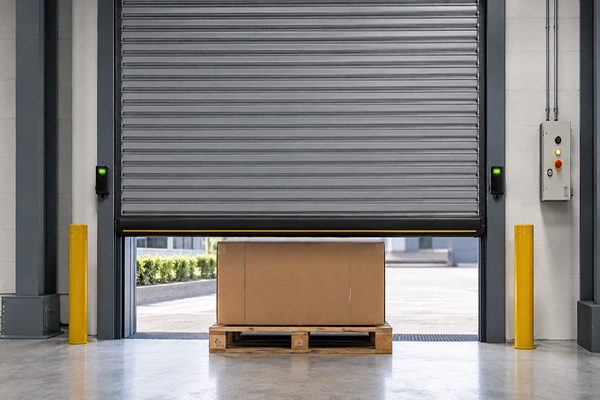
Essential Safety Devices for an Electric Roller Shutter Door
1. Photoelectric Sensors or a Safety Light Curtain
Photoelectric sensors, often called photo eyes, create an invisible beam across the electric roller shutter door opening. If a person, vehicle, or object interrupts the beam while the electric roller shutter door is closing, the controller should stop the movement or reverse the curtain according to the verified system design.
A single-beam photo eye can provide basic protection near floor level. A multi-beam safety light curtain covers a taller detection area and may be better suited to busy industrial openings, mixed pedestrian and vehicle traffic, or loads with irregular shapes.
This is non-contact protection: it is intended to detect an obstruction before the moving bottom rail touches it. It is particularly important when the electric roller shutter door can close from a remote control, timer, loop detector, access-control signal, or another starting impulse rather than a continuously held button.
For commercial door operators covered by ANSI/CAN/UL 325, UL explains that an external entrapment-protection device, such as a photoelectric system or sensing edge, is required at the floor-level entrapment zone when the door can close by a control other than constant pressure. The operator must also monitor the external device; if the device fails, closing is restricted to constant-pressure operation.
A photo eye should not be treated as the only protection for every electric roller shutter door. Its mounting height, coverage, alignment, environmental resistance, controller compatibility, and fault response all matter.
2. Bottom Safety Edge
A bottom safety edge is installed along the lower edge or bottom bar of the electric roller shutter door curtain. When it contacts a person, vehicle, or obstacle, it sends a signal that should stop or reverse the electric roller shutter door.
Depending on the design, the safety edge may use:
- an electrical resistance profile;
- an optical element inside a rubber profile;
- a pneumatic system;
- a wired connection;
- a wireless transmitter.
The correct device must be compatible with the controller and suitable for the width, speed, operating cycles, and environmental exposure of the electric roller shutter door.
The difference between a photo eye and a safety edge is important:
- A photo eye provides non-contact detection before impact.
- A safety edge provides contact-sensitive protection at the moving leading edge.
In a high-traffic industrial opening, using both can provide more complete coverage than either device alone. The photo eye may detect a forklift or worker before contact, while the edge provides a second protective response if an obstruction was not detected by the beam.
The safety edge should be monitored where required by the selected standard and system design. A cut cable, depleted wireless transmitter, short circuit, or disconnected edge should not silently leave an automatic closing function active.
3. Anti-Drop or Fall-Arrest Device
An anti-drop device addresses a different electric roller shutter door hazard. Its purpose is not to detect an object below the electric roller shutter door; it is intended to prevent dangerous downward movement if a critical suspension, transmission, or supporting component fails.
Depending on the construction, the protection may act on the:
- barrel;
- shaft;
- drive assembly;
- guide arrangement;
- suspension system;
- another mechanical locking point.
The exact design depends on the curtain weight, barrel assembly, drive arrangement, and door type.
HSE guidance on vertically moving powered doors calls for effective measures to detect failure in the means of suspension. It also stresses that a risk assessment must consider the actual environment and users.
For a heavy industrial electric roller shutter door, buyers should ask whether the quoted system includes an independent anti-drop or fall-arrest mechanism, what failure mode activates it, and whether it is correctly rated for the electric roller shutter door weight.
Do not confuse the following components:
- A motor brake holds the curtain during normal stopping.
- An anti-drop device is intended to control a serious mechanical failure.
- A safety edge detects contact at the bottom rail.
- A manual release provides emergency operation during a loss of power or control.
These functions are related to safety, but they are not interchangeable.
4. Motor Brake or Holding Brake
The electric roller door motor should include a suitable brake or holding arrangement where required by the electric roller shutter door design. When the motor stops, the brake helps hold the curtain in position and reduces the risk of gradual downward drift.
Brake selection should account for:
- curtain mass;
- shaft torque;
- drive ratio;
- operating frequency;
- opening height;
- duty cycle;
- operating speed.
A motor that is correctly sized for a small shop shutter may not be suitable for a wide industrial door operating many times per hour.
During commissioning, the technician should check whether the electric roller shutter door remains stable after stopping at different positions. Unusual drift, delayed stopping, brake noise, overheating, or inconsistent holding should be investigated before normal use.
A holding brake is an important part of normal operation, but it should not automatically be described as an independent anti-drop device. The supplier should identify the exact function, rating, and test method for each component.
5. Upper, Lower, and Final Travel Limits
Travel limits tell the controller where the electric roller shutter door should stop in the fully open and fully closed positions.
Correctly adjusted limits help prevent the curtain from:
- over-winding around the barrel;
- unwinding too far;
- pressing excessively against the floor;
- continuing to drive after reaching the intended endpoint;
- placing unnecessary loads on the motor and bottom rail.
Some systems use mechanical limit switches. Others use electronic encoders or integrated position controls. For suitable applications, an independent final limit can provide an additional stop if the normal travel limit fails.
Limit settings should be verified during automatic roller door installation and checked again after work involving the motor, gearbox, barrel, curtain, bottom rail, controller, or drive chain.
Repeated limit drift may indicate more than a programming issue. It can also be associated with:
- mechanical movement;
- a loose drive component;
- an encoder failure;
- a worn chain or coupling;
- incorrect commissioning.
Limit switches are essential operational controls, but they are not entrapment sensors. A correctly adjusted lower limit will not detect a vehicle parked halfway through the opening.
6. Emergency Stop and Safe Operating Controls
An emergency stop can allow a person near the opening to stop hazardous movement quickly. Where the risk assessment calls for one, it should be clearly identified, accessible, correctly wired, and arranged so that the electric roller shutter door does not restart automatically when the button is reset.
The emergency stop is a supplementary protective measure. It does not replace:
- photo eyes;
- a monitored safety edge;
- guarding;
- correct force control;
- mechanical fall protection;
- safe operating procedures.
The person must first recognize the danger and reach the control, so an emergency stop cannot be the primary response to every entrapment risk.
The normal controls also matter. A hold-to-run or constant-pressure-to-close control requires the operator to keep pressing the button while the curtain moves. This method can reduce some remote or unattended closing risks when the operator has a clear view of the opening.
However, the control position, visibility, user behavior, and other hazards must still be assessed.
HSE guidance on work equipment identifies protective devices, emergency stops, energy isolation, markings, and warning devices as common safety measures. It also advises that safeguards should not be removed or defeated.
7. Automatic Roller Door Manual Release or Emergency Hand Chain
An automatic roller door manual release, hand chain, or hand-crank arrangement provides a way to operate the electric roller shutter door when normal electrical power or the automatic roller door opener is unavailable.
The correct emergency method depends on the operator. Some industrial side motors include a hand chain. Other systems use:
- a clutch release;
- a manual crank;
- a gearbox release;
- a backup-power system;
- another manufacturer-specific mechanism.
Instructions should be available near the control point, and only trained personnel should operate the emergency system.
A manual release must not create uncontrolled movement. Releasing a brake or drive on a heavy or unbalanced curtain can create a serious hazard.
The installer should demonstrate the correct procedure and explain:
- whether electrical power must be isolated;
- whether the curtain must be in a particular position;
- how the brake is controlled;
- how the drive is safely re-engaged;
- who is permitted to operate the system.
The automatic roller door manual release is not an anti-drop device. It solves an access and emergency-operation problem; it does not replace mechanical protection against a falling curtain.
8. Motor Overload and Electrical Protection
An electric roller shutter door also requires appropriate electrical protection. The exact arrangement depends on the voltage, phase, motor, controller, local electrical rules, and installation environment.
Commonly considered functions include:
- short-circuit protection;
- overcurrent protection;
- motor thermal-overload protection;
- phase-loss protection for suitable three-phase systems;
- phase-sequence protection;
- a correctly rated isolator or disconnecting means;
- protective earthing;
- control-circuit protection;
- suitable enclosure protection against dust, moisture, or weather;
- secure cable routing;
- protection against physical cable damage.
These measures help reduce risks associated with a jammed curtain, overheated motor, wiring fault, water ingress, missing phase, or electrical failure. They do not detect a person under the electric roller shutter door.
The electric roller door motor, controller, protective devices, and wiring must be designed and installed as a complete system.
An electrical component with a suitable rating can still perform unsafely if it is wired incorrectly or used outside its intended conditions.
9. Monitored Safety Circuit and Fail-Safe Response
A sensor is useful only if the control system responds correctly both when the sensor is activated and when the sensor itself fails.
A monitored safety circuit checks the status or integrity of devices such as photo eyes and safety edges.
If the circuit detects a:
- disconnection;
- short circuit;
- loss of communication;
- damaged cable;
- depleted transmitter;
- incompatible signal;
the electric roller shutter door should enter the safe operating condition defined by the applicable system design. This may disable automatic closing or limit closing to a constant-pressure control.
UL’s published explanation of ANSI/CAN/UL 325 states that commercial operators must continuously monitor external entrapment-protection devices and restrict closing to constant-pressure operation when the device is not working. It should not be easy to bypass or defeat the monitoring function.
For European and UK-oriented projects, the safety-related control architecture, protective devices, force limitation, and fault behavior should be assessed as a combined system. HSE specifically advises monitoring and checking safety functions before movement where the technology permits.
This is why buyers should ask for:
- the compatible sensor model;
- the controller input type;
- the wiring diagram;
- the expected fault response;
- the commissioning procedure;
- the fault-code list.
It is not enough to ask whether a “safety sensor” is included with the electric roller shutter door.
10. Warning Light and Audible Alarm
A flashing light or audible alarm can warn nearby people that an electric roller shutter door is about to move or is currently moving.
These devices are especially useful in:
- noisy factories;
- loading areas;
- blind corners;
- vehicle routes;
- shared pedestrian and forklift areas;
- openings activated automatically.
The warning may start before movement and continue during the cycle. In a traffic-control system, red and green lights may also indicate whether the opening is clear for a vehicle to pass.
Warnings are application-dependent and should be selected according to the users and environment. A light may be ineffective in bright outdoor conditions, while a buzzer may be difficult to hear in a noisy production area.
Most importantly, a warning device does not prevent contact. It should support—not replace—obstacle detection, safe controls, guarding, training, and traffic management.
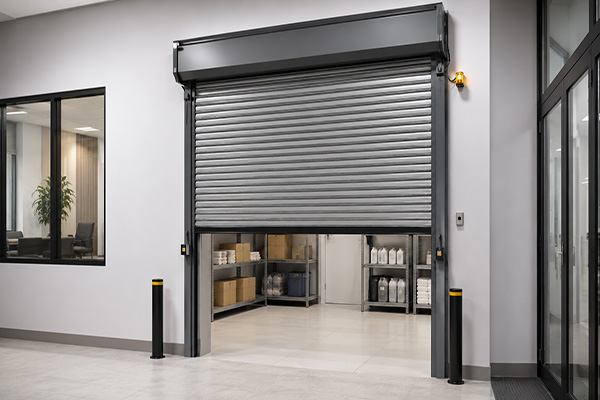
Which Safety Devices Are Essential and Which Are Optional?
The correct classification depends on the project, but the following table is a useful specification starting point.
| Safety device | Main function | Typical specification position |
| Photo eye or safety light curtain | Non-contact obstacle detection | Core for many automatic, impulse, timer, loop, or remote-closing systems |
| Bottom safety edge | Contact-sensitive stop or reversal | Strongly recommended; required in some system designs |
| Anti-drop or fall-arrest device | Controls dangerous descent after mechanical failure | Core consideration for vertically moving and heavy doors |
| Motor holding brake | Holds the curtain in normal stopping conditions | Basic drive-system function where required |
| Normal and final limits | Prevent excessive travel | Basic operational protection |
| Emergency stop | Allows rapid manual stopping | Risk-assessment dependent |
| Manual release or hand chain | Provides operation during power or control failure | Strongly recommended for many industrial applications |
| Thermal and electrical protection | Protects the motor, wiring, and controls | Basic system requirement |
| Monitored safety circuit | Detects faults in protective devices | Core where required by the selected standard and control method |
| Warning light or buzzer | Alerts nearby users before or during movement | Application-dependent |
| Fire-alarm interface | Coordinates a tested fire-door sequence | Fire-rated systems only |
This table should not be used as a substitute for a project-specific risk assessment.
A motorized safety roll up door is safe only when the selected components are compatible, correctly installed, commissioned, documented, maintained, and appropriate for the site.
How to Select Safety Devices for Different Applications
Warehouse and Logistics Center
Industrial electric roller shutter doors in logistics facilities may be exposed to forklifts, pallet trucks, tall loads, reversing vehicles, impatient drivers, and frequent cycles.
A suitable package may include:
- a safety light curtain or multiple photo eyes;
- a monitored bottom safety edge;
- anti-drop protection;
- a motor brake and correctly set limits;
- warning lights;
- an audible pre-movement signal;
- emergency stops at suitable positions;
- traffic lights or vehicle-detection interlocks;
- guards around accessible drive and pinch points;
- documented inspection and maintenance.
The controls should be positioned so that users understand when the opening is safe. Vehicle detection should not be assumed to detect pedestrians unless the selected technology and risk assessment confirm that function.
Factory or Manufacturing Facility
A factory electric roller shutter door may operate near machinery, conveyors, storage racks, production dust, washdown areas, or restricted zones.
In addition to entrapment protection, the design should consider:
- enclosure rating;
- cable protection;
- lockable electrical isolation;
- access control;
- production-line interlocking;
- hazardous or wet environmental conditions;
- maintenance access.
Where the electric roller shutter door is part of a machine sequence or safety interlock, the control system requires a more detailed engineering assessment.
A standard remote control alone is not an adequate safety strategy.
Retail or Commercial Opening
Electric roll up doors commercial buyers use for storefronts may cycle less frequently, but they are often close to staff, customers, displays, and public walkways.
Photoelectric protection, a bottom edge, anti-drop protection, secure controls, and safe manual operation should be considered.
The installer should also verify that the curtain, guides, bottom rail, locks, and control station do not create accessible pinch, shear, or trapping points.
Remote-Controlled or Automatically Closing Door
A motorized roll up door remote control is an operating device, not a safety device. If the operator cannot clearly see the entire opening, remote closing can increase risk.
The specification should define:
- which protective devices cover the closing zone;
- whether those devices are monitored;
- what happens when a device fails;
- whether a warning is given before movement;
- whether automatic closing is cancelled after repeated obstruction;
- where emergency controls are located.
For commercial operators within the scope described by UL, closing by a remote, timer, or loop rather than constant pressure triggers the need for external entrapment protection at the floor-level zone.
Fire-Rated Rolling Shutter
A fire-rated shutter is not simply a standard electric roller shutter door with an alarm cable added.
The following must be treated as parts of a complete tested or certified system:
- curtain;
- guides;
- release mechanism;
- operator;
- closing sequence;
- alarm interface;
- temperature response;
- obstruction response;
- egress considerations;
- inspection requirements;
- listing or certification.
UL 325 covers electric operators and includes specific categories for fire-door operators, while active fire-alarm functionality is addressed separately.
Do not apply a general industrial-door safety package to a fire shutter without confirming the approved system design and the requirements of the authority having jurisdiction.
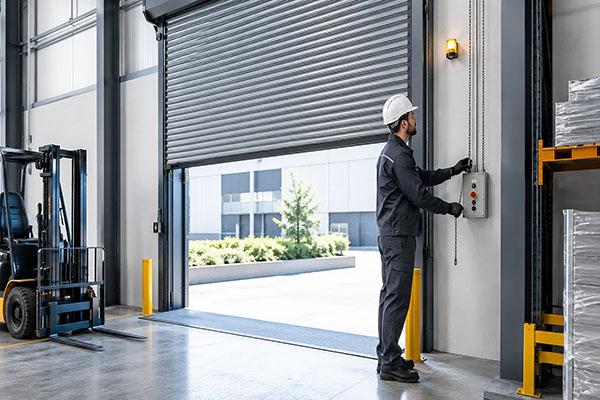
Safety Standards Buyers Should Know
United States and Canada
ANSI/CAN/UL 325 covers electric operators and systems for doors and other opening-and-closing appliances.
UL states that the standard addresses hazards including:
- fire;
- electric shock;
- casualty;
- entrapment.
It is used for product certification in both the United States and Canada.
For a commercial electric roller shutter door, buyers should confirm:
- the exact operator certification;
- compatible external entrapment devices;
- installation instructions;
- restrictions or conditions of use;
- required control modes;
- testing and commissioning procedures.
Avoid vague claims such as “OSHA-certified door.”
OSHA stated in a 2002 interpretation that there was no single specific OSHA standard for overhead doors, although general-industry or construction requirements may apply depending on the work and circumstances.
Local building, fire, electrical, workplace, and product-listing requirements may impose additional obligations. The supplier, installer, employer, designer, and authority having jurisdiction may each have different responsibilities.
European and UK Markets
BS EN 12453:2017+A1:2021 is listed by BSI as current and covers the safety in use of power-operated industrial, commercial, and garage doors, including vertically moving commercial rolling shutters.
BS EN 12604:2017+A1:2020 addresses mechanical aspects. Protective-device requirements are also addressed by EN 12978:2024.
Standards are not a replacement for risk assessment.
HSE guidance stresses the need to consider:
- the unique environment;
- the intended users;
- vulnerable persons;
- foreseeable misuse;
- force limitation;
- safety-function monitoring;
- failure of suspension systems;
- ongoing inspection and maintenance.
When requesting a quotation, state the destination country and intended use so that the supplier can identify the relevant standard, documentation, and configuration.
Final compliance should be confirmed for the actual electric roller shutter door installation.
How to Test Electric Roller Shutter Door Safety Devices
Safety devices should be tested at commissioning and then inspected and maintained according to the manufacturer’s instructions, risk assessment, operating frequency, environment, and applicable requirements.
HSE notes that powered-door safety must be maintained over time and that wear, weather, debris, wiring damage, and component compatibility can affect performance.
A practical functional check may include the following steps.
1. Complete a Visual Inspection
Inspect the:
- guides;
- curtain;
- bottom rail;
- fasteners;
- drive assembly;
- motor;
- control cables;
- accessible guards;
- safety-device wiring.
Look for physical damage, loose components, corrosion, unusual wear, or obstructions.
2. Test Every Photoelectric Beam
Interrupt each beam during a controlled closing cycle and confirm the specified stop or reversal.
Do not assume that one successful test confirms every sensor or every detection zone.
3. Test the Bottom Safety Edge
Activate the bottom edge using the manufacturer-approved test method.
Do not use a person’s body to test the contact response of an electric roller shutter door.
4. Verify the Sensor-Fault Response
Confirm what happens if a monitored sensor is disconnected or reports a fault.
This test should follow the manufacturer’s commissioning procedure. Do not bridge terminals or bypass the safety circuit.
5. Test the Emergency Stop
Confirm that the emergency stop halts the hazardous movement and that restarting requires the intended reset procedure.
6. Check the Travel Limits
Verify the fully open and fully closed positions. Confirm that the curtain does not over-travel, press excessively against the floor, or continue driving after reaching its limit.
7. Check for Curtain Drift
Stop the electric roller shutter door at intermediate positions and observe whether it remains stable.
Downward drift may indicate brake, drive, balance, or mechanical problems.
8. Test Warnings and Interlocks
Check the:
- warning light;
- audible alarm;
- traffic signal;
- access-control interface;
- vehicle detector;
- related interlocks.
9. Test Emergency Manual Operation
Verify the automatic roller door manual release or hand-chain procedure using trained personnel and the manufacturer’s instructions.
10. Listen for Abnormal Noise
Listen for unusual sounds from the:
- brake;
- bearings;
- guides;
- drive chain;
- gearbox;
- shaft;
- motor.
11. Record the Results
Record:
- test date;
- test method;
- result;
- identified defect;
- corrective action;
- responsible person;
- next inspection date.
Never stand beneath an electric roller shutter door while testing a suspected fall-arrest problem.
Do not tape over a photo eye, disable a safety edge, bridge safety terminals, or continue automatic operation with a known safety fault.
If an automatic roller door is not working, the cause may be a correctly detected safety fault rather than a failed motor.
The following should be checked by a competent technician:
- controller fault code;
- sensor alignment;
- safety-edge circuit;
- travel limits;
- motor brake;
- power supply;
- drive condition;
curtain movement.
Questions to Ask an Electric Roller Shutter Door Supplier
Before ordering, ask the supplier to answer these questions in writing:
- Which entrapment-protection devices are included in the quoted electric roller shutter door?
- Are the photo eyes and bottom safety edge monitored by the controller?
- What does the electric roller shutter door do if a sensor cable is cut or a wireless edge loses communication?
- Is an independent anti-drop device included?
- How is the anti-drop device rated?
- What type of motor brake is supplied?
- Are normal and final travel limits provided?
- What emergency stop, isolator, hand chain, or manual release is included?
- Which motorized roll up door parts are standard, optional, or supplied by others?
- Which operator and protective-device standards apply to the destination market?
- Can the supplier provide certificates and test reports?
- Are wiring diagrams and installation instructions included?
- Is a commissioning checklist provided?
- Is the system suitable for the opening size and curtain weight?
- What is the permitted number of cycles per hour?
- Is the system suitable for the expected traffic type?
- What wind, dust, moisture, and temperature conditions are permitted?
- Who completes the final site risk assessment?
- Who signs the commissioning record?
- What motorized roller shutters service maintenance tasks are required?
- What support is available for troubleshooting or motorized roll up door repair?
A professional supplier should explain the limitations of each device instead of promising that one sensor makes every application safe.
Common Specification Mistakes
Avoid these common errors when purchasing or upgrading an electric roller shutter door:
- Treating a remote control as a safety device.
- Assuming one photo eye covers every possible obstruction.
- Calling the motor brake an independent anti-drop device without verification.
- Confusing an automatic roller door manual release with fall protection.
- Adding a safety edge without monitoring its circuit.
- Allowing automatic closing to continue after a sensor fault.
- Using a warning light as the only protection in a busy opening.
- Ignoring accessible pinch points around guides, shafts, gears, chains, and brackets.
- Failing to reassess the system after changing the motor, controller, speed, curtain, or operating method.
- Using a standard industrial configuration for a fire-rated opening.
- Selecting an electric roller door motor only by power rating instead of torque, brake, duty cycle, door balance, and system compatibility.
- Skipping preventive inspection until electric roller shutter door problems stop production.
Good safety starts with design, but it depends on correct installation, commissioning, user training, inspection, and maintenance throughout the electric roller shutter door’s service life.
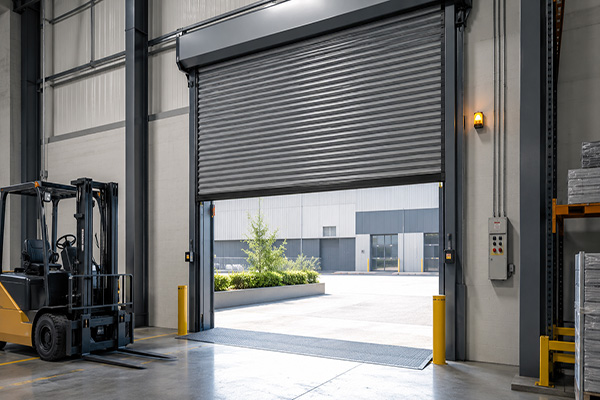
Frequently Asked Questions
Does Every Electric Roller Shutter Door Need a Photo Eye?
Not every electric roller shutter door has the same legal or technical requirement.
The answer depends on:
- the control method;
- visibility from the control position;
- user access;
- applicable standards;
- the site risk assessment.
However, a door that can close from a remote, timer, loop detector, or other impulse control commonly requires external entrapment protection.
For commercial operators described by UL 325 guidance, a photoelectric system or sensing edge is required at the floor-level entrapment zone when closing is not controlled by constant pressure.
Is a Safety Edge Better Than a Photoelectric Sensor?
They perform different functions.
A photoelectric sensor detects an obstruction without contact. A safety edge responds when the moving bottom rail touches an obstruction.
For many industrial applications, the best solution is a compatible and monitored combination rather than choosing only one.
What Is an Anti-Drop Device?
An anti-drop device is a mechanical protective measure intended to prevent or control dangerous downward movement after a failure in the suspension, drive, or supporting system.
The exact mechanism varies by electric roller shutter door design. It should be rated and documented for the specific curtain and shaft assembly.
Can an Electric Roller Shutter Door Be Opened During a Power Failure?
Many systems provide a:
- hand chain;
- manual crank;
- clutch release;
- gearbox release;
- backup-power option.
The correct method depends on the operator.
Users should follow the manufacturer’s instructions because releasing a brake or drive incorrectly may allow unexpected movement.
How Often Should Safety Devices Be Tested?
There is no single interval that is correct for every electric roller shutter door.
Follow the manufacturer’s instructions and applicable local requirements, then adjust the inspection plan according to:
- traffic;
- operating cycles;
- environment;
- door condition;
- identified risk;
- previous faults.
Busy logistics doors and harsh environments normally justify more frequent checks than a low-cycle opening.
Can a Faulty Safety Sensor Be Bypassed Temporarily?
A known safety-device fault should not be bypassed to restore ordinary automatic closing.
Isolate or restrict the electric roller shutter door as required by the manufacturer’s fault procedure and arrange competent inspection.
HSE advises never removing safeguards, and UL guidance requires monitored commercial systems to restrict closing when external entrapment protection is not working.
Conclusion
A safe electric roller shutter door is not defined by one accessory.
The complete system should address:
- entrapment;
- impact;
- uncontrolled descent;
- excessive travel;
- electrical faults;
- emergency stopping;
- power failure;
- foreseeable misuse;
- long-term wear.
For many projects, the key layers include non-contact detection, a bottom safety edge, mechanical anti-drop protection, a suitable motor brake, accurate limits, safe controls, emergency manual operation, electrical protection, monitored fault response, and warning devices where the environment requires them.
Before requesting a quotation, provide:
- opening width and height;
- curtain material;
- estimated curtain weight;
- expected operating frequency;
- control method;
- pedestrian and vehicle traffic;
- installation environment;
- destination country;
- access-control requirements;
- fire-related requirements;
- site photos or drawings.
This information allows the manufacturer and installer to recommend an electric roller shutter door and safety package that can be evaluated for the real site—not just selected from a generic accessories list.
Need help specifying a motorized safety roll up door for a warehouse, factory, storefront, or logistics entrance?Send us your opening size, expected cycles, control method, site photos, and project location. Our technical team can help define the electric roller shutter door, operator, protective devices, documentation, and commissioning requirements.


