
Food Grade Fast Doors are no longer an optional upgrade in modern poultry slaughter and rough processing zones; they are an essential physical barrier required to pass rigorous hygiene audits like HACCP and BRC. In the “wet zones” filled with blood, raw meat scraps, animal fat, and the daily onslaught of high-pressure foam cleaning, traditional sliding doors or standard roller shutters completely fail. This article dives deep into the real pain points of poultry segmentation workshops and reveals how upgrading your facility doors can save you thousands of dollars in energy and compliance costs annually.
Contents
- 1 The Extreme Environment of Rough Processing Zones: Why Ordinary Doors Fail
- 2 The 5 Deadly Cross-Contamination Risks in Poultry Rough Processing
- 3 4 Crucial Design Features Every True Food Grade Fast Door Must Have
- 4 Meeting HACCP Standards: Acing Hygiene Audits
- 5 ROI Comparison: Why the Initial Investment Pays Off
- 6 Protect Your Cold Chain and Food Safety Today
- 7 FAQ
- 7.1 Q: How do Food Grade Fast Doors withstand the daily chemical foam washdowns typical in poultry slaughter zones?
- 7.2 Q: How exactly do these doors physically block airborne pathogens (like Salmonella) from moving from the slaughter line to the clean segmentation rooms?
- 7.3 Q: The scalding and bleeding areas experience extreme humidity. Can these doors help manage moisture and prevent condensation dripping on raw meat?
The Extreme Environment of Rough Processing Zones: Why Ordinary Doors Fail
The poultry slaughter line—spanning from receiving and stunning to bleeding, scalding, and defeathering—is arguably the most demanding environment in any food processing plant. It is a highly corrosive, high-humidity wet zone. Using standard industrial doors in these waterproof doors for wet zones applications leads to three major failures:
Motor Short Circuits: Daily CIP (Clean-in-Place) procedures involve high-pressure washdowns with hot water and strong alkaline foams, easily penetrating standard motor housings.
Severe Corrosion: Poultry blood, combined with harsh chemical sanitizers, rapidly corrodes standard galvanized steel tracks and hardware.
Bacterial Breeding Grounds: Ordinary brush seals and frame crevices trap organic matter, creating the perfect breeding ground for foodborne pathogens like Salmonella and Campylobacter.
The 5 Deadly Cross-Contamination Risks in Poultry Rough Processing
Before addressing the solutions, we must identify how standard industrial doors fail to protect your facility. In a poultry slaughter and rough processing zone, cross-contamination typically occurs through these five deadly pathways:
1. Airborne Pathogen Drift (Aerosol Contamination)
The scalding, defeathering, and high-pressure washing processes generate massive amounts of aerosols and water droplets carrying Salmonella and Campylobacter. Slow-moving or poorly sealed doors allow these contaminated air currents to drift freely from the dirty slaughter zone into the downstream clean segmentation areas.
2. Physical Cross-Contact (Touch Contamination)
In the wet zone, workers’ gloves and equipment are constantly coated in raw poultry fluids, fat, and blood. When workers are forced to manually open sliding or swing doors, they transfer these biological hazards directly onto the door handles, cross-contaminating every person and batch of meat that passes through afterward.
3. Biofilm Buildup in Structural Crevices
Ordinary doors rely on weather-stripping or brush seals that are highly porous. In a slaughterhouse, these brushes act like sponges, absorbing blood, meat scraps, and bone dust. Over time, they form untouchable biofilms—persistent bacterial colonies that cannot be removed by standard cleaning chemicals.
4. Contaminated Condensation Dripping
When a slow-operating door stays open too long, the hot, humid air from the scalding area collides with the chilled air of the rough processing room. This massive temperature clash creates severe condensation on ceilings and door frames. These water droplets mix with airborne bacteria and can drip directly onto the exposed raw poultry below.
5. Incomplete Sanitation Cycles (Washdown Evasion)
Standard door motors and control boxes are not completely waterproof. Because high-pressure washing (up to 80°C/176°F) will short-circuit standard equipment, sanitation crews often intentionally avoid thoroughly spraying the doors. This forced “washdown evasion” leaves dangerous organic residues to rot overnight.
4 Crucial Design Features Every True Food Grade Fast Door Must Have
To survive the rough processing area and protect the downstream clean zones, authentic Food Grade Fast Doors must be engineered from the ground up for extreme sanitization.
1. Crevice-Free Design and IP69K Waterproofing
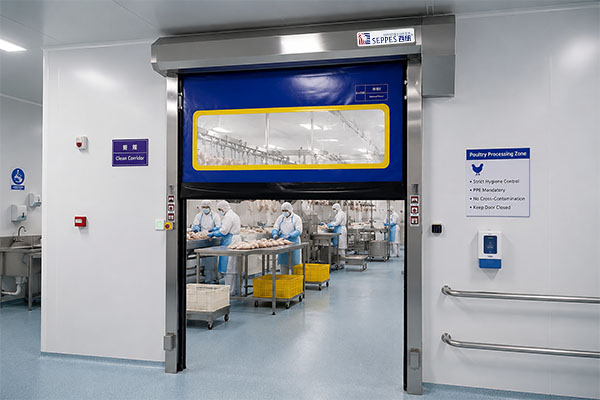
You cannot rely on traditional brush seals in a slaughterhouse. Authentic poultry slaughter washdown doors utilize FDA-approved smooth TPU curtains and fully enclosed, sloped motor hoods that prevent water pooling. The control boxes and drive motors must carry an IP69K rating, allowing workers to spray them directly with high-pressure, high-temperature water without fear of electrical failure.
2. Touchless Activation to Eliminate Cross-Contact
In the rough processing zone, workers’ hands, gloves, and equipment are constantly covered in raw meat, blood, and animal fat. Traditional doors that require manual operation force physical interaction, instantly transferring foodborne pathogens onto the door handles or panels. Food Grade Fast Doors overcome this by integrating advanced touchless activation systems, such as IP69K-rated radar sensors, magnetic loops, or hygienic touchless wave switches. This hands-free operation completely eliminates the risk of physical cross-contact contamination, ensuring that raw material handlers can move safely and efficiently through the wet zones without spreading bacteria.
3. Combating Severe Corrosion with Stainless Steel
Because of the highly corrosive nature of animal processing, these IP69K anti-corrosion industrial doors completely abandon galvanized steel. Heavy-duty 304 or 316L stainless steel frames and seamless tracks are mandatory. This allows for aggressive daily foam washdowns without rusting, ensuring decades of reliable operation.
4. Second-Level Opening to Prevent Cross-Contamination
Speed is safety. When raw poultry transitions from the slaughter area to the cold storage or cleanroom, the doors must open and close in a fraction of a second. High-speed doors preventing cross-contamination minimize the air exchange time between the dirty washdown area and the hygienic clean zones, effectively blocking flies, airborne bacteria, and odors.
Meeting HACCP Standards: Acing Hygiene Audits
From the perspective of a Quality Assurance (QA) manager, every facility upgrade must justify its role in food safety compliance. Utilizing HACCP compliant cleanroom doors directly addresses critical control points.
During unannounced FDA, USDA, or GFSI inspections, auditors meticulously check door frames for hidden biofilms and mold. Because Food Grade Fast Doors feature wash-down-ready, gapless profiles and non-porous curtains, they eliminate hygiene dead zones, allowing your facility to consistently achieve high audit scores and avoid catastrophic operational shutdowns.
ROI Comparison: Why the Initial Investment Pays Off
Upgrading to high-speed doors for meat processing may require a higher initial capital expenditure, but the long-term Return on Investment (ROI) is undeniable.
| Feature | Ordinary Industrial Doors | Food Grade Fast Doors |
| Washdown Capability | Fails under high-pressure water | Withstands IP69K direct washdown |
| Corrosion Resistance | Rusts within 6-12 months | 304/316L Stainless Steel lasts years |
| Sealing System | Brush seals trap meat & bacteria | Smooth, crevice-free FDA materials |
| Operation Method | Requires manual contact (High contamination risk) | Touchless automated entry (Zero physical contact) |
| Audit Compliance | High risk of QA failure | Built for HACCP / BRC standards |
Protect Your Cold Chain and Food Safety Today
The dividing line between a rough processing wet zone and your high-hygiene packaging area is your facility’s most critical defense barrier. Do not let subpar doors become the weak link that causes energy waste or product recalls.
If you are designing a new poultry processing plant or upgrading an existing slaughter facility to meet modern hygiene standards, investing in reliable Food Grade Fast Doors is the smartest operational decision you can make. Protect your cold chain, eliminate cross-contamination risks, and streamline your washdown processes starting today.
FAQ
Q: How do Food Grade Fast Doors withstand the daily chemical foam washdowns typical in poultry slaughter zones?
A: Unlike standard industrial doors that rust or short-circuit, true Food Grade Fast Doors are built specifically for harsh Clean-in-Place (CIP) environments. The frames and tracks are constructed from heavy-duty 304 or 316L stainless steel that naturally resists highly corrosive alkaline and acidic cleaning foams used in meat processing. Furthermore, the IP69K-rated drive motors and control enclosures are hermetically sealed, allowing your sanitation crew to wash them directly with high-pressure, high-temperature water (up to 80°C/176°F) every single day without risking electrical failure or downtime.
Q: How exactly do these doors physically block airborne pathogens (like Salmonella) from moving from the slaughter line to the clean segmentation rooms?
A: The slaughtering, scalding, and defeathering zones generate a massive volume of airborne droplets, aerosols, and odors that can carry severe foodborne bacteria. Food Grade Fast Doors mitigate this cross-contamination risk through exceptional air-tightness and rapid operation. By utilizing FDA-approved smooth TPU curtains with tightly sealed side-guides and operating at speeds up to 2.0 m/s, they drastically minimize the air exchange window between the “dirty” wet zone and the “clean” processing zones. This rapid physical barrier traps airborne contaminants and contaminated humidity exactly where they belong.
Q: The scalding and bleeding areas experience extreme humidity. Can these doors help manage moisture and prevent condensation dripping on raw meat?
A: Yes. The sharp temperature and humidity gradients between the hot scalding areas and the chilled rough processing rooms often cause severe condensation on ceilings and doorways, which can drip and contaminate raw poultry carcasses. By maintaining strict environmental separation, Food Grade Fast Doors prevent humid, hot air from rushing into the colder segmentation zones. Additionally, the non-porous, smooth curtain materials are specifically designed to shed water rapidly, preventing stagnant moisture buildup and eliminating the mold and bacterial biofilms that frequently develop on standard porous door curtains.


