
Contents
- 1 Introduction
- 2 Core Logic of Pressure Management: Static Sealing vs. Dynamic Isolation
- 3 Scenario 1: Selection Advice for Personnel Airlocks (PAL)
- 4 Scenario 2: Selection Advice for Material and AGV Aisles (MAL)
- 5 Hermetic Sliding Door vs. Cleanroom Rapid Door
- 6 Case Study: MAL Selection Correction at a Pharma Giant
- 7 FAQ
Introduction
In GMP facility design, airlocks are central to maintaining pressure differentials between areas of different cleanliness levels and preventing cross-contamination. However, facing the distinct flows of personnel (PAL) and materials/AGVs (MAL), engineering teams often encounter confusion in door selection. The cleanroom rapid door and the hermetic sliding door each have their physical advantages; the wrong choice not only affects logistics efficiency but also leads to a surge in HVAC energy consumption. This article will deeply compare their technical characteristics to provide a scientific selection strategy for your aisles.
Core Logic of Pressure Management: Static Sealing vs. Dynamic Isolation
1. The Demand for Static Sealing:
Hermetic sliding doors primarily rely on a descending compression mechanism at the end of the closing cycle to achieve near-zero air leakage when closed. They are suitable for core areas with very low opening frequencies that require absolute maintenance of static pressure.
2. The Demand for Dynamic Isolation:
In actual production, pressure loss occurs mainly during the moment the door is open. The cleanroom rapid door, with ultra-fast opening and closing speeds of 1.5m/s – 2.0m/s, minimizes the exposure time of the doorway. In high-frequency traffic scenarios, its ability to protect the pressure cascade is actually superior to a slow-opening hermetic door.
Scenario 1: Selection Advice for Personnel Airlocks (PAL)
Flow Characteristics: Moderate traffic frequency; smaller door openings (typically 1000mm x 2100mm); personnel are required to pause in the airlock for activities such as hand washing or gowning.
Recommendation: Hermetic Sliding Door.
Technical Analysis: Medical-grade hermetic sliding doors offer excellent sound insulation, providing a quieter working environment for staff. The descending track design ensures a tight seal against the floor, which not only provides superior airtightness but also effectively prevents the infiltration of micro-dust from footwear.
Pharma Application: Ideal for Personnel Airlocks (PAL), labs, and surgery rooms where traffic is steady but not continuous, and extreme static containment is required.
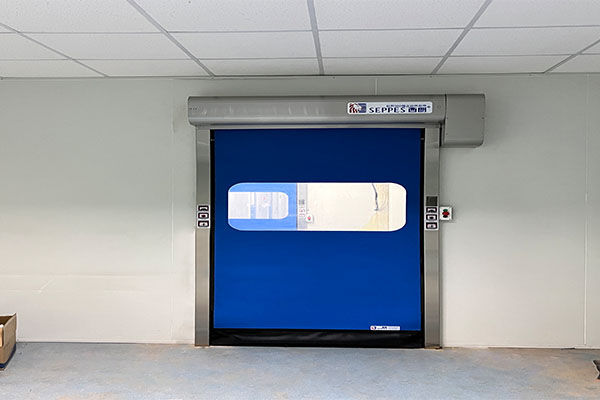
Scenario 2: Selection Advice for Material and AGV Aisles (MAL)
Flow Characteristics: Extremely high traffic frequency (hundreds of cycles daily); larger door openings (needs to accommodate forklifts or IBC totes); requires rapid, non-stop passage.
Recommendation: Cleanroom Rapid Door (Zipper-style).
Technical Analysis: In high-frequency material transit, speed is the lifeline of contamination control. The cleanroom rapid door can seamlessly integrate with radar or AGV systems to achieve an “open upon approach, close instantly after passage” operation. Compared to hermetic doors that require over 10 seconds per cycle, it can reduce air loss by more than 80%.
Pharma Application: Essential for Material Airlocks (MAL) and AGV passages where minimizing the open-door duration is critical to preventing air turbulence and dust migration.
Hermetic Sliding Door vs. Cleanroom Rapid Door
| Dimension | Hermetic Sliding Door | Cleanroom Rapid Door | Compliance Advice |
| Sealing Method | Descending compression, extreme static air-tightness. | Zipper tracks, all-around seal, excellent dynamic isolation. | PALs prioritize static sealing; MALs prioritize isolation speed |
| Opening Speed | Slow, ~0.2 – 0.4 m/s | Extremely fast, up to 1.5 – 2.0 m/s | Drastically minimizes the loss window for clean or cold air |
| Space Usage | Requires significant side-room for sliding. | Vertical roll-up, occupies minimal side-room. | Ideal for narrow Material Airlock (MAL) layouts |
| Safety | Rigid, basic safety sensors. | Flexible curtain + self-repairing function. | Offers higher fault tolerance for frequent AGV and forklift traffic |
Case Study: MAL Selection Correction at a Pharma Giant
- Background: A global pharma company installed heavy hermetic sliding doors in its Material Airlock (MAL) for entering Grade D zones. However, during peak production, slow door speeds caused frequent pressure alarms, compromising Environmental Monitoring (EM) data stability.
- Solution: The engineering department replaced the MAL doors with cleanroom rapid doors featuring interlocking logic.
Results: Logistics efficiency improved by 40%. Because doorway exposure time was cut by 70%, pressure fluctuations during peak hours vanished, reducing alarm rates to zero.
Choosing pharma doors? Compare cleanroom rapid doors vs airtight sliding doors based on traffic and pressure control to find the best GMP-compliant solution.
FAQ
Q1: Can a cleanroom rapid door meet ISO Class 4/5 standards?
Yes. High-quality zipper-style rapid doors have minimal leakage rates under 50 Pa of positive or negative pressure, fully complying with ISO 14644-1 requirements for high-grade cleanrooms.
Q2: Why are rapid doors not recommended for PAL (Personnel Airlocks)?
PAL spaces are limited, and staff need time for disinfection or gowning. The airflow turbulence (piston effect) generated by rapid doors is uncomfortable in small spaces. Hermetic sliding doors offer superior sound insulation and ground-level sealing for personnel buffers.


