
Contents
- 1 Introduction
- 2 Two Core Crises in 2-8°C Pharma Cold Rooms: Thermal Bridging and Energy Loss
- 3 Solving the Puzzle: Core Technologies of Cold Storage High Speed Doors
- 4 Comparison Table: Traditional Sliding Doors vs. Insulated High Speed Doors
- 5 Case Study: How a Vaccine Hub Cut Energy by 25% and Eliminated Condensation
- 6 Conclusion
- 7 FAQ for Pharma Cold Room Doors
Introduction
In pharmaceutical cold chain logistics, 2-8°C constant temperature cold rooms are the “heart” for storing vaccines, biologics, and blood products. However, frequent forklift traffic often causes severe temperature and humidity fluctuations between the cold room and the buffer zone. Traditional cold room doors open slowly, leading to massive energy loss, and the condensation and icing on their surfaces can cause slippery floors and microbial contamination risks. As the core equipment of the cold chain defense line, a premium cold storage high speed door, with its unique insulated curtain, smart heating system, and ultra-high airtightness, has become the ultimate solution to completely solve cold loss and ensure passage of GDP (Good Distribution Practice) audits.
Two Core Crises in 2-8°C Pharma Cold Rooms: Thermal Bridging and Energy Loss
1. Energy Loss from High-frequency Openings
When forklifts pass through, a traditional heavy sliding cold door typically takes 15-20 seconds to complete an open-close cycle. Every extra second it remains open means massive amounts of cold air spill out from the bottom while hot, humid air rushes in from the top. This forces the HVAC refrigeration system into overload, causing energy bills to soar and temperatures near the doorway to exceed limits.
2. Condensation, Icing & Thermal Bridging
When relatively warm and humid air from the buffer zone (usually 15-25°C) hits the freezing surface of the cold room door, moisture rapidly condenses into water droplets or even frost. In pharmaceutical facilities, standing water is an absolute taboo—it is a breeding ground for mold and bacteria, and a high-risk red line that leads to GSP/GDP unannounced inspection failures.
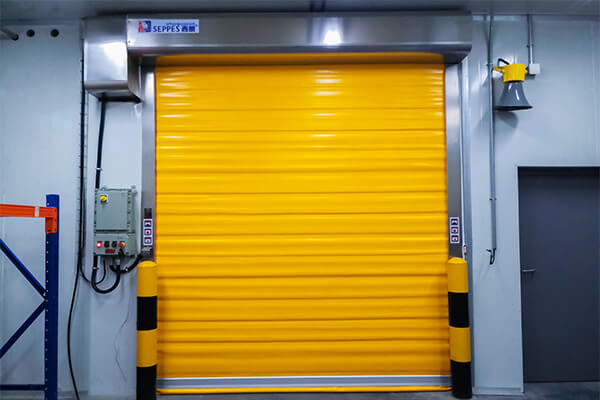
Solving the Puzzle: Core Technologies of Cold Storage High Speed Doors
To combat extreme cold and heat exchanges, a cold storage high speed door integrates three hardcore technologies:
1. Multi-layer Insulated Curtain: Cutting off Heat Conduction
- Technical Analysis: Abandoning highly conductive single-layer PVC, professional cold room doors use a “sandwich” multi-layer composite structure (filled with 10mm-20mm high-density eco-friendly aerogel or insulation foam).
- Core Function: The extremely high R-value effectively cuts off the indoor-outdoor thermal bridge, ensuring the door’s outer surface temperature remains above the ambient dew point, preventing condensation at its physical source.
2. Smart Heating System: No More Freezing or Jamming
- Technical Analysis: Smart thermostatic heating cables are built into the extreme cold contact points of the door (e.g., inside the side guide rails, motor hood, and bottom sealing edge).
- Core Function: Even in -20°C deep freeze environments or 2-8°C buffer zones with extreme temperature differences, the heating system quickly evaporates attached moisture, preventing condensate from freezing and jamming the curtain, ensuring smooth logistics.
3. Ultimate Zipper Tracks: Locking in Cold Air
- Technical Analysis: Utilizing a seamless zipper track design, the curtain edges are tightly locked within the guides, completely discarding leaky brush seals.
- Core Function: Forms a 360-degree omnidirectional airtight barrier. Combined with an ultra-fast opening speed of up to 2.0 m/s, it instantly “chokes” the opening after a forklift passes, minimizing air convection and drastically reducing the compressor’s cooling load.
Comparison Table: Traditional Sliding Doors vs. Insulated High Speed Doors
In pharma cold room planning, understanding the pros and cons of both is crucial:
| Dimension | Heavy Cold Room Sliding Doors | Cold Storage High Speed Door | Pharma Application Advice |
| Opening Speed | Very slow, ~0.2 – 0.4 m/s | Extremely fast, up to 1.5 – 2.0 m/s | Minimizes open time, preventing temperature spike alarms |
| Anti-condensation | Thick panels, but slow speeds cause slippery iced floors. | Insulated curtain + thermostatic track heating system. | Heating system eliminates hazardous standing water around doorways. |
| Sealing & Logistics | Easily damaged by impact, no auto-reset. | Zipper structure for 100% seal, self-repairing after impact. | Perfectly maintains 2-8°C during high-frequency forklift traffic |
Best Pactice: Traditional sliding doors provide “nighttime static insulation” (locked after hours), while cold storage high speed doors handle “daytime dynamic insulation” for high-frequency traffic. Combining both (installing one on each side of the doorway) is the ultimate compliance solution for pharma cold chains.
Case Study: How a Vaccine Hub Cut Energy by 25% and Eliminated Condensation
- Background: An international vaccine distribution center (strictly controlled at 2-8°C) suffered from severe standing water in its 20°C airlock corridor. Traditional industrial doors were slow and poorly insulated, allowing hot air to rush in and cause slippery condensation. Forklifts had skidded and damaged racks. During the annual Temperature Mapping, the doorway area frequently hovered near the 8°C limit.
- Solution: The engineering director upgraded all high-frequency passages to cold storage high speed doors with heated tracks and multi-layer composite curtains, enabling radar sensors and double-door interlocking logic.
- Measurable Results: In the first week post-upgrade, doorway and floor condensation was 100% eliminated. Because cold air loss was completely cut off, the refrigeration unit’s running and defrosting frequencies dropped significantly, cutting overall cold room energy consumption by 25%. The hub easily passed the EU GDP unannounced inspection with perfect temperature control charts.
Conclusion
In the strict context of the Pharma Cold Chain, a failure in temperature control often equals product spoilage. A cold room needs not just a powerful refrigeration heart, but a perfect barrier to lock in the cold.A professional cold storage high speed door, through its four-dimensional protection of “insulation, heating, speed, and airtightness,” completely eradicates the floor icing and temperature alarms caused by thermal bridging and cold loss. We advise QA and engineering teams to integrate this defense line early in the planning phase to provide the highest level of compliant protection for your vaccines and high-value biologic assets.
FAQ for Pharma Cold Room Doors
Q1: Do 2-8°C cold rooms need heated curtains, or are heated tracks enough?
For 2-8°C chill cold rooms, the temperature delta isn’t as extreme as in deep freezers (-20°C). Generally, using a high-R-value multi-layer insulated curtain paired with thermostatic heating in the guide rails and bottom edge is perfectly sufficient to prevent condensation. Full-curtain heating is unnecessary, thus saving electricity while keeping frost at bay.
Q2: Can insulated high-speed doors completely replace traditional heavy sliding cold doors?
It depends on traffic frequency. For long-term storage opened twice a day, sliding doors suffice. But for highly active hubs and vaccine dispatch areas, high-speed doors are mandatory. The current pharma standard is a “dual-door system”: heavy doors for extreme overnight locking, and cold storage high speed doors for dynamic thermal isolation during daytime operations.
Q3: Will this door trap personnel inside the cold room during a sudden power outage?
Absolutely not. All compliant cold room doors come standard with an emergency manual release mechanism or a UPS backup power supply. During an outage, employees simply pull the release lever to easily lift the curtain, ensuring the life safety escape route remains completely unobstructed.


