
Contents
- 1 Introduction
- 2 Pain Points of Powder Diffusion in OSD and GMP Compliance Challenges
- 3 Solving Powder Diffusion: 3 Core Mechanisms of Zipper High Speed Doors
- 4 Traditional Doors vs. Zipper High Speed Doors
- 5 Layout Strategies for Zipper High Speed Doors in Core OSD Processes
- 6 Case Study: How a CDMO Reduced Airlock Particles by 90%?
- 7 Conclusion
- 8 FAQ for OSD Door Selection
Introduction
In the production of Oral Solid Dosage (OSD) forms, processes like tableting, capsule filling, and blending generate significant amounts of fine dust. Locking this dust strictly within the production room is crucial to preventing cross-contamination. Traditional rigid doors or standard industrial doors with brush seals cannot effectively block the penetration of powder particles. As a standard for modern pharmaceutical facilities, the zipper high speed door stands out due to its exceptional fully enclosed sealing. This article will deeply explore its core mechanisms for dust containment and detail the best layout strategies in tableting rooms, coating rooms, and airlocks.
Pain Points of Powder Diffusion in OSD and GMP Compliance Challenges
High-frequency Logistics & Pressure Loss: IBCs (Intermediate Bulk Containers) frequently enter and exit tableting and capsule filling rooms. Every door opening causes severe fluctuations in the airlock pressure differential (∆P), and the instantaneous airflow turbulence easily carries suspended drug dust out of the core zone, contaminating the corridors.
Static Adsorption & Cross-contamination: Pharmaceutical powders easily generate static electricity via air friction, heavily adsorbing onto walls, equipment, and traditional doors. EU GMP and FDA strictly crack down on cross-contamination during multi-product concurrent production in the same facility. Dust escape and door residues are the main reasons for Environmental Monitoring (EM) failures and audit rejections.
Solving Powder Diffusion: 3 Core Mechanisms of Zipper High Speed Doors
1. Ultimate Airtightness Locks Dust and Pressure
Technical Analysis: Abandoning leaky brush seals, the zipper track structure seamlessly nests the door curtain into the guide rails. Even under the high-intensity negative or positive pressure control of tableting rooms, it ensures an air leakage rate close to zero, physically and completely blocking dust from escaping via air convection.
2. Anti-static Curtains Reject Powder Adsorption
Technical Analysis: Addressing the pain point of powder adsorption, the door is equipped with FDA-compliant low-surface-resistance, anti-static soft curtains. The curtain generates no static charge during high-speed lifting, completely preventing toxic or active pharmaceutical ingredient (API) powders from adhering to the door surface.
3. Transparent Vision Panels Ensure Safety
Technical Analysis: Forklifts frequently navigate within OSD workshops. Configuring large, high-transmittance vision panels in the upper-middle part of the curtain allows operators to monitor the status of tableting/coating machines without opening the door, and prevents physical collision accidents caused by blind spots.
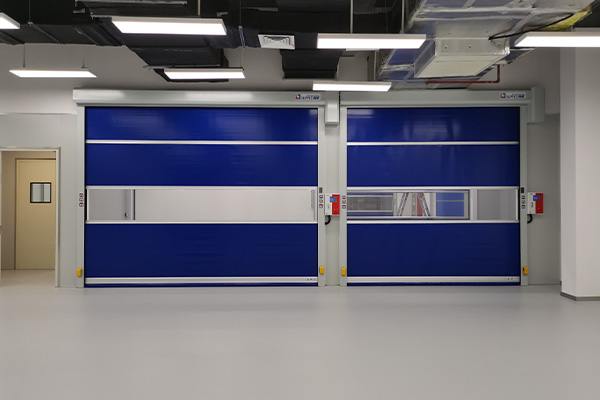
Traditional Doors vs. Zipper High Speed Doors
To intuitively demonstrate the selection differences for OSD workshops, please refer to the following core parameter comparison:
| Dimension | Traditional High-Speed Doors | Zipper High Speed Door | OSD Compliance Impact |
| Sealing | Brush seals, large gaps. | Seamless zipper track, absolute sealing. | Maintains airlock pressure and contains dust leakage |
| Anti-static | Standard PVC, highly static-prone. | Dedicated anti-static, low-dust curtain. | Prevents powder adsorption and eliminates cross-contamination |
| Visual Safety | No/small windows, blocked vision. | Panoramic high-transmittance vision panels. | Allows closed-door inspection and reduces collision risks. |
| Cleanability | Complex structure, easily hides dust. | 304 SS flush design, washable. | Wipe-to-clean design easily passes FDA/GMP validation. |
Layout Strategies for Zipper High Speed Doors in Core OSD Processes
1. Tableting & Capsule Filling Rooms
Focus: High-frequency interlocking to prevent escape. This is the “hardest-hit area” with the highest dust generation. It is recommended to configure a double-door PLC interlocking system in the airlocks to ensure that if one door is not closed, the other is absolutely locked, preventing dust-laden air from penetrating directly into public corridors.
2. Coating & Preparation Rooms
Focus: Heat/moisture resistance and cleanability. The coating process involves not only dust but also high humidity and organic solvents. The door frames here must be made of 304/316L stainless steel with sloped waterproof hoods, facilitating frequent washdowns with high-pressure water jets or detergents for Cleaning Validation.
Case Study: How a CDMO Reduced Airlock Particles by 90%?
- Background: A renowned CDMO faced severe challenges during multi-product OSD concurrent production: the airlock outside the tableting room frequently failed Environmental Monitoring (EM) with excessive dust particles (exceeding Class D standards), and slow door response caused constant HVAC pressure alarms.
- Solution: The engineering team upgraded all passages to a zipper high speed door interlocking system equipped with anti-static curtains and panoramic vision panels.
- Measurable Results: After 30 days of operation, data showed the number of airborne particles in the airlock plummeted by 90%; the negative pressure in the tableting room stabilized at -15 Pa, with zero pressure alarms. The enterprise ultimately passed client audits with zero defects due to the extremely low risk of environmental cross-contamination.
Conclusion
In Oral Solid Dosage (OSD) workshops, the line of defense for dust containment often collapses at an unqualified door. From tableting to coating rooms, powder diffusion brings not only a drop in cleanliness but also an immeasurable cost of cross-contamination.Investing in a zipper high speed door featuring ultra-high airtightness, anti-static soft curtains, and visualized interlocking can physically contain dust at its source. This is not only a necessary measure to ensure OSD processes comply with GMP regulations, but also a wise choice to enhance pharmaceutical production safety and product yield.
FAQ for OSD Door Selection
Q1: Do the zipper tracks of these doors accumulate pharmaceutical dust easily?
No. High-quality zipper tracks are made of self-lubricating polymer materials with smooth internal structures and no right-angle dead legs. The high-speed up-and-down movement of the curtain actually creates a self-cleaning effect, making it extremely difficult for powder to accumulate.
Q2: Can interlocking high-speed doors be used in explosion-proof zones with flammable powders?
Yes, but they must be custom-built. If the workshop contains high concentrations of flammable organic solvents or ultra-fine chemical dust (e.g., Zone 21/22), it is mandatory to configure ATEX-certified explosion-proof motors and control boxes to completely eliminate the risk of electrical sparks.
Q3: Can the material of the transparent vision panel withstand wiping with chlorine-based cleaners?
Absolutely. Dedicated medical-grade vision panels are made of corrosion-resistant, thickened, high-transmittance PVC. They are not only scratch-resistant and anti-static but can also withstand daily wiping with 70% Isopropyl Alcohol (IPA) or chlorine-based disinfectants over the long term without yellowing or becoming brittle.


