
The aluminum roller shutter door manufacturing process involves much more than assembling aluminum slats and adding a motor. From project engineering and material preparation to component fabrication, assembly, quality inspection and final testing, every stage can affect how smoothly and reliably the finished door operates.
For commercial and industrial projects, an aluminum roller shutter is often manufactured according to the actual opening dimensions, application, operating method and installation conditions. This is especially important for warehouses, retail entrances, service areas, factories and other projects where standard off-the-shelf dimensions may not be suitable.
In this guide, we explain how an aluminum roll up door moves from project requirements to a finished door ready for shipment.
Contents
- 1 How Is an Aluminum Roller Shutter Door Manufactured?
- 2 Step 1: Project Requirements and Custom Door Engineering
- 3 Step 2: Aluminum Material Inspection and Preparation
- 4 Step 3: Manufacturing the Aluminum Roller Shutter Curtain
- 5 Step 4: Surface Treatment and Color Finishing
- 6 Step 5: Fabricating the Other Door Components
- 7 Step 6: Curtain and Mechanical Assembly
- 8 Step 7: Motor, Control and Safety System Integration
- 9 Step 8: Quality Inspection During Manufacturing
- 10 Step 9: Functional and Safety Testing
- 11 Step 10: Protective Packaging for Overseas Shipping
- 12 What Determines the Quality of an Aluminum Roller Shutter Door?
- 13 What Should Buyers Look for in a Roll Up Door Manufacturer?
- 14 Aluminum Roller Shutter Manufacturing for Commercial and Industrial Projects
- 15 Frequently Asked Questions
- 15.1 How are aluminum roller shutter doors manufactured?
- 15.2 Are aluminum roll up doors available in custom sizes?
- 15.3 What components are included in an aluminum roller shutter door?
- 15.4 How are motorized roller shutter doors tested before shipment?
- 15.5 How long does it take to manufacture a custom aluminum roll up door?
- 15.6 What information should I provide to a roll up door manufacturer?
- 16 From Raw Material to a Finished Aluminum Roller Shutter Door
- 17 Need a Custom Aluminum Roller Shutter Door?
How Is an Aluminum Roller Shutter Door Manufactured?
A typical manufacturing workflow can be summarized as:
Project Engineering → Material Preparation → Curtain Processing → Surface Finishing → Component Fabrication → Mechanical Assembly → Motor & Control Integration → Quality Inspection → Functional Testing → Packaging
The exact process can vary according to the door design and project specifications. A manually operated shutter, for example, will not require the same electrical integration as a motorized system.
Likewise, commercial roll up doors and industrial roll up doors may require different dimensions, control methods, safety devices or operating configurations depending on how and where they will be used.
The following sections explain each manufacturing stage in more detail.
Step 1: Project Requirements and Custom Door Engineering
Before production begins, the manufacturer first needs to understand the project.
Unlike consumer products manufactured in one fixed size, many custom roll up doors are produced according to the dimensions and operating conditions of a specific opening.
Typical information required before engineering includes:
- Opening width
- Opening height
- Door quantity
- Building application
- Indoor or outdoor installation
- Manual or motorized operation
- Local voltage and frequency
- Required control method
- Safety requirements
- Surface finish and color
- Available headroom and side room
- Installation and supporting structure conditions
These details determine more than just the final dimensions.
For example, the size and application of the door can influence the curtain configuration, guide rail design, shaft and operator selection, mounting arrangement and control system.
This is why a custom roll up door should normally begin with project-specific engineering rather than simply cutting a standard door to a different size.
For overseas projects, drawings and technical specifications can also help both the manufacturer and buyer confirm the configuration before production begins.
Step 2: Aluminum Material Inspection and Preparation
Once the door configuration has been confirmed, the next stage is material preparation.
The aluminum slats or profiles used for an aluminum roller shutter need to match the required door design and dimensions. Before further processing, the material should be checked for factors such as:
- Correct profile or slat specification
- Required dimensions
- Surface condition
- Straightness
- Visible defects or damage
- Batch consistency
Material consistency matters because the curtain is formed by connecting multiple slats together.
If individual profiles vary significantly in shape or dimensions, those differences can affect how the finished curtain aligns with the guide rails and how smoothly it travels during opening and closing.
The material preparation stage therefore provides the foundation for the following fabrication and assembly processes.
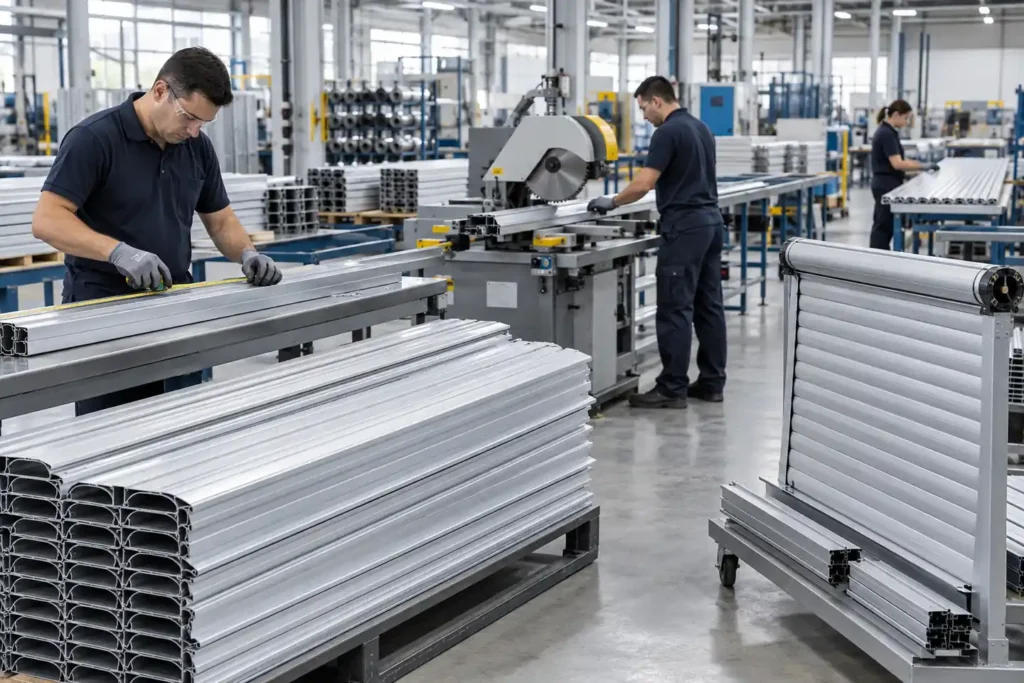
Step 3: Manufacturing the Aluminum Roller Shutter Curtain
The curtain is one of the main structural parts of an aluminum roll up door.
Depending on the product design, aluminum profiles or slats are processed to the required dimensions and prepared for assembly into a complete curtain.
Typical operations may include:
- Measuring and cutting profiles
- Preparing curtain slats
- Processing connection points
- Installing required end components
- Checking profile dimensions
- Preparing the bottom section
Once prepared, the individual slats are connected to create the rolling curtain.
The connection between the slats must allow the curtain to roll around the barrel while remaining properly aligned as it moves through the side guides.
This is one of the reasons manufacturing accuracy is important.
Poor profile preparation or inconsistent assembly may contribute to:
- Uneven curtain movement
- Increased friction
- Excessive operating noise
- Poor alignment with the guides
- Irregular rolling around the barrel
- Increased wear over time
For aluminum roller shutters used on larger commercial openings, these details become particularly important because small dimensional differences can accumulate across the width of the complete curtain.
Step 4: Surface Treatment and Color Finishing
Aluminum components may receive an appropriate surface finish according to the selected door specification.
Depending on the product and project requirements, finishing options may include factory-applied coatings or other suitable aluminum surface treatments.
This stage can serve both functional and architectural purposes.
Customers may select a finish to:
- Match the building facade
- Coordinate with doors and windows
- Improve appearance
- Provide an appropriate surface for the installation environment
When custom colors are available, the buyer should normally confirm the required color before production.
After finishing, components should be visually inspected for obvious surface defects before they move to final assembly.
For export orders, protecting finished surfaces during subsequent handling and packaging is also important because scratches and impact damage may occur if components are not properly protected.
Step 5: Fabricating the Other Door Components
An aluminum roller shutter door is a complete system, not just an aluminum curtain.
Other components must be prepared to match the door dimensions and selected configuration.
Depending on the design, these can include:
- Side guide rails
- Bottom bar
- Barrel or shaft
- Brackets
- Hood or cover
- Seals
- Fasteners
- Operator mounting components
- Control accessories
Each component performs a different function.
Guide Rails
The guide rails keep the curtain aligned as it moves vertically.
Their dimensions and position need to match the curtain and installation arrangement.
Bottom Bar
The bottom bar provides the lower finishing section of the curtain and can also be integrated with sealing or safety components depending on the door configuration.
Barrel or Shaft Assembly
The curtain coils around the upper barrel or shaft when the door opens.
This component must be matched to the door size and operating system.
Hood
Where included, the hood protects or encloses the upper rolling area and helps create a cleaner finished installation.
Preparing these components accurately is essential before mechanical assembly begins.
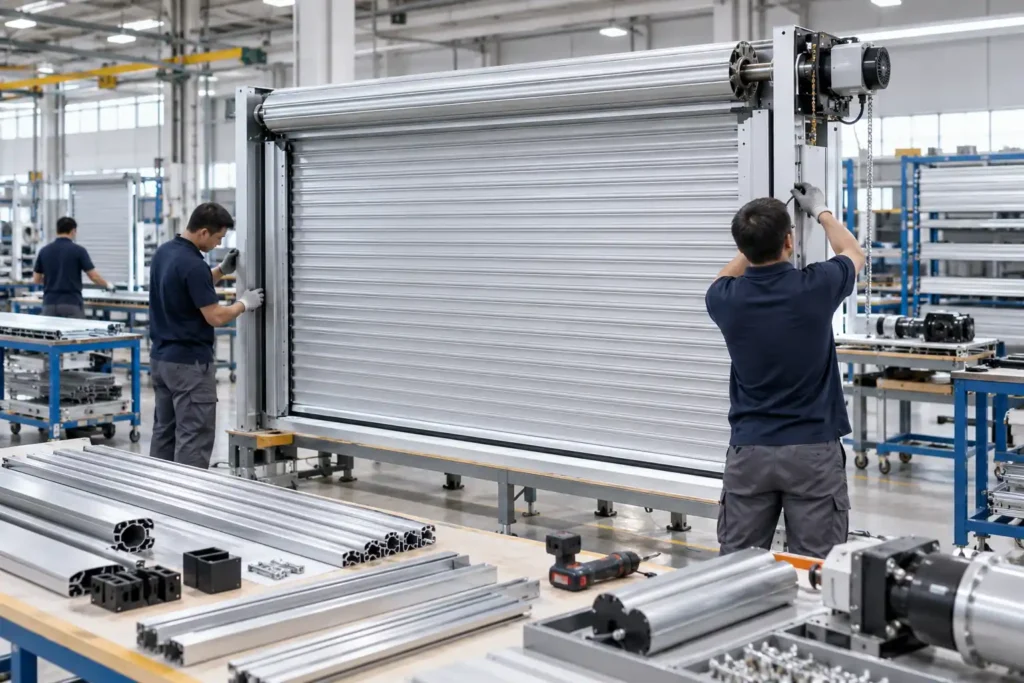
Step 6: Curtain and Mechanical Assembly
After the major components have been prepared, the door system moves into mechanical assembly.
At this stage, the curtain, bottom bar, barrel or shaft, brackets and other related components are assembled or matched according to the production configuration.
Important checks can include:
- Curtain alignment
- Slat connection
- Bottom bar positioning
- Guide compatibility
- Shaft or barrel alignment
- Bracket positioning
- Mechanical clearances
The objective is to ensure that the curtain can travel vertically without unnecessary resistance and roll correctly at the top of the opening.
A coiling door depends on the relationship between several moving components. Even if each individual component meets its required dimensions, poor alignment during assembly can still affect overall operation.
This makes mechanical alignment an important part of manufacturing roll up doors, particularly for larger or project-specific openings.
Step 7: Motor, Control and Safety System Integration
For a motorized aluminum roll up door, the next stage is integrating the operator and control system.
The actual configuration depends on project requirements.
Possible components can include:
- Door operator or motor
- Control box
- Push-button station
- Remote control
- Limit controls
- Photoelectric sensors
- Safety edge
- Warning device
- Access control interface
- Manual or emergency operation mechanism
Not every door requires every component listed above.
A warehouse door with frequent vehicle traffic, for example, may have different control and safety requirements from a small commercial service opening.
For this reason, electrical and safety components should be selected according to the actual application rather than treated as universal standard equipment.
During assembly, wiring, operator installation and control settings should also be checked against the selected configuration.
Step 8: Quality Inspection During Manufacturing
Quality control should take place throughout production rather than only after the door has been completely assembled.
Different inspection points can focus on different parts of the finished system.
Dimensional Inspection
Dimensions of the curtain, guide rails, bottom bar and related components should be checked against the production requirements.
For a custom roll up door, this is especially important because the finished door needs to correspond to a specific project opening.
Material and Component Inspection
Components should be checked to confirm that the correct items have been prepared for the order.
Surface Inspection
Visible aluminum components and finished surfaces can be inspected for scratches, coating defects, deformation or other obvious problems.
Assembly Inspection
The manufacturer can check whether major mechanical components are correctly matched and assembled.
Electrical Inspection
For motorized doors, electrical connections, control components and operator functions should be checked according to the selected system.
A professional roll up door manufacturer should be able to explain what is inspected during production rather than relying only on general statements such as “strict quality control.”
Step 9: Functional and Safety Testing
After assembly and electrical integration, functional testing helps confirm whether the finished door operates as intended.
Depending on the door configuration, testing can include:
- Opening and closing operation
- Curtain movement
- Guide alignment
- Upper and lower stopping positions
- Motor response
- Control button response
- Remote control response
- Abnormal noise or friction
- Safety sensor response
- Emergency or manual operation
The objective is not simply to check whether the door moves.
Testing should help identify issues such as misalignment, incorrect limits, irregular curtain travel or control problems before the product is shipped to the customer.
If safety devices are included in the project, their functions should also be checked as part of the relevant test procedure.
This stage is particularly important for motorized commercial roll up doors because many installation problems become more difficult and expensive to correct after the equipment has already arrived at the project site.
Step 10: Protective Packaging for Overseas Shipping
Manufacturing does not end when the door passes its final inspection.
For international projects, packaging is also part of preparing the product for delivery.
A complete roller shutter door may contain long metal components, electrical parts and finished surfaces that require different types of protection.
Components that may need separate protection include:
- Aluminum curtain
- Guide rails
- Hood components
- Shaft and mechanical assemblies
- Motor or operator
- Control box
- Sensors
- Hardware and accessories
Appropriate wrapping and reinforcement can help reduce the risk of scratches, deformation and impact damage during loading and transportation.
Accessories should also be clearly identified so that the installation team can determine which components belong to each door.
For projects involving multiple aluminum roll up doors, organized component identification and packing lists can make site handling considerably easier.
Export packaging should therefore be considered part of the complete manufacturing and delivery process rather than an afterthought.
What Determines the Quality of an Aluminum Roller Shutter Door?
Two doors can look similar from the outside but perform differently over time.
The quality of an aluminum roller shutter depends on the complete system and manufacturing process, including:
1. Aluminum Profile Quality
Consistent profiles help maintain curtain alignment and stable operation.
2. Processing Accuracy
Correct cutting and preparation help the curtain, guides and other components work together properly.
3. Guide Rail Alignment
The curtain should travel through the guides without unnecessary resistance.
4. Surface Finishing
The finish should meet the project requirements and be protected during manufacturing and shipping.
5. Operator Selection
A motorized door needs an operator matched to the door configuration and intended application.
6. Safety Configuration
Safety equipment should reflect the actual operating environment and project requirements.
7. Assembly Accuracy
Correct mechanical alignment affects movement, noise and long-term wear.
8. Quality Inspection
Problems are easier to correct during production than after installation.
9. Functional Testing
Testing before shipment can identify operational or control issues before the door reaches the jobsite.
For buyers comparing roller door manufacturers, looking at the complete production and inspection process can therefore be more useful than comparing appearance alone.
What Should Buyers Look for in a Roll Up Door Manufacturer?
Choosing the right roll up door manufacturer is especially important when purchasing customized doors for commercial or industrial projects.
Before placing an order, consider whether the manufacturer can provide the following support.
Custom Engineering
A capable supplier should be able to manufacture according to the actual opening dimensions and project conditions rather than offering only fixed standard sizes.
Clear Technical Specifications
The buyer should be able to understand the curtain, guide, operating system, control method and available options.
Drawings and Project Confirmation
For customized projects, technical drawings help both sides confirm important dimensions and configurations before manufacturing begins.
Manufacturing and Inspection Procedures
Ask how the door is fabricated, assembled and inspected.
Experienced roll up door manufacturers should be able to explain their production process clearly.
Functional Testing
Confirm whether the door’s mechanical and electrical functions are checked before delivery.
Export Packaging
Long guide rails, finished aluminum surfaces and electrical components require suitable packaging for international transportation.
Installation Support
For overseas projects, drawings, manuals and remote technical support can help the local installation team understand the supplied system.
A buyer sourcing multiple industrial roll up doors should evaluate all of these factors rather than making a decision based only on the initial purchase price.
Aluminum Roller Shutter Manufacturing for Commercial and Industrial Projects
The manufacturing process may also need to reflect the application of the door.
Retail and Commercial Entrances
For retail applications, appearance, color, available headroom, security and daily operating requirements may be important considerations.
Warehouses and Logistics Areas
Warehouse doors may require attention to opening dimensions, operating frequency, safety sensors and vehicle traffic conditions.
Manufacturing Facilities
Industrial facilities may need door configurations that fit production areas, material movement routes or restricted-access openings.
Service and Back-of-House Entrances
A compact aluminum roll up door can provide vertical opening where swing-door clearance is limited.
This is why commercial roll up doors and industrial roll up doors should be engineered according to how the opening will actually be used.
Frequently Asked Questions
How are aluminum roller shutter doors manufactured?
The process usually begins with project engineering and material preparation. Aluminum profiles and other components are then processed to the required dimensions, followed by curtain assembly, component fabrication, mechanical assembly, motor and control integration where required, quality inspection, functional testing and final packaging.
The exact process depends on the door design and project configuration.
Are aluminum roll up doors available in custom sizes?
Yes. Custom roll up doors can be produced according to project opening dimensions, subject to the manufacturer’s product design and engineering limits.
Providing accurate opening width, opening height and installation conditions is important before production begins.
What components are included in an aluminum roller shutter door?
A typical system can include the rolling curtain, guide rails, bottom bar, barrel or shaft, brackets and associated hardware.
Motorized versions may also include an operator, control box and selected control or safety devices.
The exact supply scope should be confirmed before ordering.
How are motorized roller shutter doors tested before shipment?
Depending on the product configuration, testing can cover opening and closing operation, travel limits, curtain movement, motor operation, control response and the function of specified safety devices.
Testing requirements can vary according to the door and project.
How long does it take to manufacture a custom aluminum roll up door?
Production lead time depends on factors such as door size, quantity, configuration, selected finish, motor and control requirements and current production scheduling.
For an accurate lead time, buyers should provide complete project information and request confirmation from the manufacturer.
What information should I provide to a roll up door manufacturer?
For an efficient quotation and technical review, prepare:
- Opening width and height
- Quantity
- Application
- Project country
- Indoor or outdoor installation
- Manual or motorized operation
- Local voltage and frequency
- Required control or safety features
- Preferred finish or color
- Required delivery schedule
- Drawings or project specifications, if available
Providing this information helps the manufacturer recommend a more appropriate configuration.
From Raw Material to a Finished Aluminum Roller Shutter Door
The aluminum roller shutter door manufacturing process is a coordinated sequence of engineering, material preparation, component processing, assembly, inspection and testing.
The quality of the finished product does not depend on one component alone. Curtain accuracy, guide alignment, operator selection, control configuration, assembly quality and final testing all contribute to how the door performs after installation.
For buyers sourcing an aluminum roller shutter, understanding this process makes it easier to compare suppliers and ask better technical questions before placing an order.
A reliable manufacturer should not simply supply a finished door. It should also be able to explain how the product is engineered, manufactured, inspected, tested and prepared for delivery.
Need a Custom Aluminum Roller Shutter Door?
If you are planning a commercial or industrial project, send us your opening width and height, quantity, application, project location and operating requirements.
Our team can review the available information and recommend a suitable aluminum roll up door configuration for your project.


