
Contents
- 1 Introduction
- 2 The Devastating Impact of Pests on Modern Warehousing: Why Pest Control Doors Are Crucial?
- 3 The Fatal Weaknesses of Traditional Industrial Doors in Pest and Bird Control
- 4 Aluminum High Speed Door: How to Forge an Indestructible Physical Defense Line?
- 5 Quick Selection Table: Warehouse Bird and Pest Control Door Assessment
- 6 Bird and Rodent Control in a Large Agricultural Export Warehouse
- 7 Conclusion
- 8 FAQ on Warehouse Pest and Rodent Control Rapid Doors
Introduction
Imagine a seagull flying into your food distribution center, or rodents sneaking into the temperature-controlled packaging workshop at night. What follows is not only the contamination and scrapping of high-value inventory but also severe sanitary violation fines. Why do warehouses attract birds and pests so easily? Because traditional industrial doors open so slowly that, for the convenience of frequent forklift traffic, they are often left open for long periods—essentially rolling out the red carpet for pests.
To completely cut off this physical intrusion route, investing in a professional Aluminum High Speed Door is an inevitable choice for modern warehousing. This article deeply analyzes how this rigid rapid door prevents flying birds via “radar-triggered ultra-fast operation” and stops rodents with its “sturdy metal armor,” becoming the most powerful physical defense for modern warehouses.
The Devastating Impact of Pests on Modern Warehousing: Why Pest Control Doors Are Crucial?
In regions with robust ecological protection like North America, Europe, and Australia, pest threats to warehousing are often devastating:
1. Inventory Contamination and Costly Scrappage
Bird droppings are highly corrosive and carry dozens of pathogens (like Salmonella). Once birds nest or excrete above warehouse racks, the palletized goods below face direct contamination, leading to the forced scrapping of entire product batches.
2. Fatal Audit Failure Risks
During international food safety audits like FDA, BRC, or HACCP, failing to establish an effective “Pest Exclusion Barrier” is a critical violation that can result in massive point deductions or even the direct revocation of production or warehousing licenses.
3. Hidden Facility Damage
Rodents not only chew through food packaging but also gnaw on internal communication cables and electrical wires, creating a major hidden danger for unexpected warehouse fires.
The Fatal Weaknesses of Traditional Industrial Doors in Pest and Bird Control
To control pests, many companies try various door solutions, but they are often full of loopholes:
Traditional Roller Shutters:
Too slow (approx. 0.15 m/s). It takes over ten seconds or even half a minute to close after a forklift passes, leaving a “time window” large enough for agile birds to fly in.
Standard PVC Soft High-Speed Doors:
Fast enough to stop birds, but helpless against rodents. Sharp rodent teeth can easily chew large holes through the soft PVC curtain and bottom rubber pads overnight, allowing free entry.
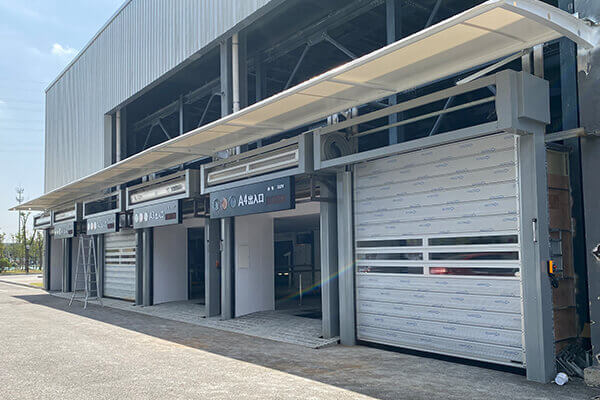
Aluminum High Speed Door: How to Forge an Indestructible Physical Defense Line?
As the flagship product for exterior passageways, the Aluminum High Speed Door perfectly blends “extreme speed” with “heavy armor,” fundamentally locking down pest intrusion routes:
1. Extreme Speed & Microwave Radar: Completely Cutting Off Bird Flight Paths
Technical Analysis: Equipped with industrial-grade Microwave Radar Sensors at the top, the door accurately detects approaching forklifts. It opens at blistering speeds up to 1.5 m/s – 2.5 m/s right before the vehicle arrives.
Bird Control Logic: Once the vehicle passes, the door drops and closes within 1-2 seconds. This seamless “close instantly after passage” rhythm completely eliminates prolonged doorway openings, leaving observant birds with absolutely no time to react and fly in.
2. Chew-Proof Slats: The Absolute Nemesis of Rodents and Pests
Technical Analysis: Discarding easily torn plastic fabrics, the curtain is constructed from interlocking, high-strength double-layer Aluminum Slats up to 40mm thick.
Rodent Control Logic: This metal armor is chew-proof, completely severing any possibility of rodents gnawing through the bottom of the door to enter the warehouse. Additionally, the rigid tracks and seamless hinge structures are smooth, offering no flexible gaps for rodents to climb or leverage.
3. Seamless Fit: EPDM Sealing Blocks Crawling Insects
Technical Analysis: High-density EPDM rubber weather seals are equipped along the side tracks, lintel, and bottom edge.
Pest Control Logic: When closed under pressure, the flexible EPDM bottom perfectly conforms to uneven concrete floors. Tougher and more age-resistant than standard rubber, it effectively blocks ground-crawling insects like cockroaches and ants from intruding through bottom gaps.
Quick Selection Table: Warehouse Bird and Pest Control Door Assessment
| Dimension | Soft PVC High-Speed Door | Aluminum High Speed Door | Audit & Compliance Impact |
| Bird Prevention | Excellent, fast opening | Outstanding, radar minimizes exposure | Cuts airborne contamination, protects top racks. |
| Chew-Proof Rating | Poor, easily chewed overnight | Absolute defense, 40mm metal armor | Completely stops rodents from ruining stock & cables. |
| Bottom Insect Seal | Average, wears easily | Excellent, EPDM high-density fit | Meets HACCP/BRC physical exclusion requirements. |
| Logistics Efficiency | High, supports frequent traffic | Extremely high, 2.0m/s & windproof | Achieves ultimate hygiene without slowing throughput. |
Bird and Rodent Control in a Large Agricultural Export Warehouse
Background:
A grain and nut export hub located at a North American port was plagued by seagulls, pigeons, and port rats. Because forklift loading was extremely frequent, the original metal roller doors were left open permanently. Monthly produce scrappage losses due to bird droppings and rodent contamination reached tens of thousands of dollars, even triggering a severe warning from food health inspectors.
Solution:
The facility director decisively ordered the upgrade of 8 core exterior logistics aisles to Aluminum High Speed Doors equipped with combined “microwave radar + floor loop” sensors.
Measurable Results: Within the first three months post-retrofit, the warehouse bird intrusion rate plummeted by 99%, and night patrols found zero trace of rodents chewing the doors. Thanks to this perfect physical barrier, the warehousing center smoothly passed that year’s BRC International Food Safety Certification with a perfect score (Zero Non-conformances).
Conclusion
When faced with food safety and high-value inventory, dealing with bird and rodent intrusions cannot rely solely on reactive chemicals (like bird repellents or poison baits). Establishing an indestructible “Physical Exclusion Barrier” is the fundamental cure.
Don’t let a single bird or rodent ruin your entire year’s profit and corporate reputation. Investing in a professional-grade Aluminum High Speed Door is not only a powerful tool to enhance forklift transit efficiency but also the most loyal, compliant metal armored guardian protecting your warehouse inventory.
FAQ on Warehouse Pest and Rodent Control Rapid Doors
Q1: Will the top radar sensor mistake a flying bird for a vehicle and open the door automatically?
No. Industrial-grade microwave radars are highly intelligent. Engineers can adjust the radar’s sensitivity and use cross-traffic filtering to specifically ignore small animals or laterally moving objects, ensuring the door only responds to large, forward-approaching forklifts.
Q2: If the bottom EPDM seal of the aluminum high-speed door wears out, is it easy to replace?
Very easy. The bottom seal features a convenient slide-in design. Without needing to dismantle heavy metal slats, maintenance personnel can pull out the old strip and smoothly insert a new one in just minutes, ensuring the bottom pest barrier is always in optimal condition.
Q3: Does this rigid metal door meet HACCP or FDA washdown and hygiene requirements?
Fully compliant. The aluminum slat surfaces are anodized or high-temp powder-coated, making them smooth, non-porous, and resistant to dust and bacteria accumulation. Not only is it rust and corrosion-proof, but it also allows for direct cleaning with a low-pressure water hose and neutral detergents (Washdown capability), perfectly meeting strict Cleaning Validation standards.


