
Food-Grade Cleanroom Fast Doors are no longer just an operational upgrade; they are the ultimate line of defense in ready-to-eat (RTE) food processing. When you are separating raw material handling areas from cooked, RTE zones (like fresh salads, pre-cooked meals, or bento boxes), the stakes are incredibly high. Consumers will eat these products without further heating, meaning there is no final “kill step” for bacteria. A single invisible breach of airborne pathogens from the raw side can lead to fatal outbreaks and catastrophic product recalls.
In this guide, we will explore exactly how specialized high-speed doors for ready-to-eat food processing eliminate aerosol drift, strictly separate raw and cooked zones, and keep your facility fully HACCP compliant.
Contents
- 1 The Hidden Threat: Aerosol Drift Between Raw and RTE Zones
- 2 How Food-Grade Cleanroom Fast Doors Prevent Cross-Contamination
- 3 Meeting HACCP and FDA Standards in RTE Facilities
- 4 Secure Your Production with Proper Isolation Barriers
- 5 FAQ
- 5.1 1. Can standard fast doors be used to separate raw and RTE zones if they open and close quickly?
- 5.2 2. How do these doors handle the harsh daily sanitation routines in raw material processing areas?
- 5.3 3. What is the most effective door configuration for maximum Listeria prevention between a raw zone and a fresh food packaging zone?
The Hidden Threat: Aerosol Drift Between Raw and RTE Zones
While facility managers often focus on visible cross-contamination—such as employees tracking dirt or forklifts moving between zones—the most dangerous threat is entirely invisible: aerosol drift.
During the washing, peeling, or cutting of raw vegetables and meats, microscopic water droplets and dust particles become airborne. These aerosols act as transport vehicles for severe airborne pathogens, making Listeria prevention and E. coli control a nightmare for traditional facilities.
If a standard, slow-moving door is used between a raw preparation room and an RTE packaging room, the 10 to 15 seconds it takes to open and close allows cubic meters of contaminated air to rush into the clean zone due to natural pressure differentials. To combat this, standard industrial doors are vastly insufficient. Facilities require strict airlock door systems for raw and cooked separation to ensure absolute microbiological control.
How Food-Grade Cleanroom Fast Doors Prevent Cross-Contamination
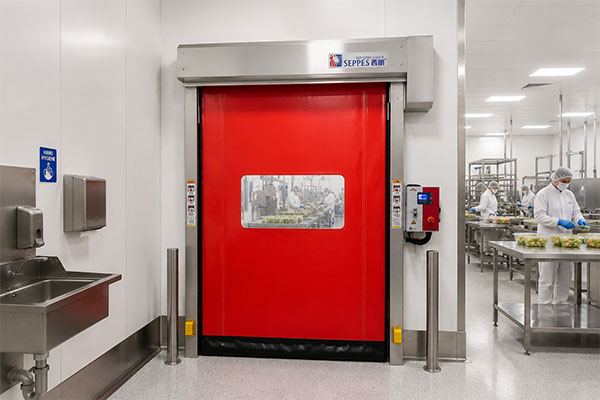
By shifting the focus away from basic logistics and entirely onto sanitary isolation, Food-Grade Cleanroom Fast Doors act as an active, dynamic barrier against biological threats. Here are five ways they secure your RTE environment:
Lightning-Fast Exposure Minimization: Operating at speeds up to 2.0 m/s, these doors reduce the open-door exposure time to mere seconds. This drastically limits the window of opportunity for contaminated air to migrate from the raw area into the highly sensitive RTE zone.
Strict Airlock Interlocking Systems: True isolation requires a buffer. By installing two Food-Grade Cleanroom Fast Doors to create a specialized vestibule, the interlocking system ensures that door “A” cannot open until door “B” is completely sealed. This effectively breaks the air current and stops direct aerosol transfer.
Absolute Positive Pressure Retention: RTE zones must operate as a positive pressure room to push air out and prevent raw-side air from entering. Engineered with superior perimeter sealing, aerosol cross-contamination prevention doors maintain these critical pressure cascades, ensuring the HVAC system performs as designed without expensive energy loss or pressure drops.
Sanitary Design with Zero Dead Angles: Traditional doors feature exposed tracks and bristles that harbor mold, bacteria, and rotting food particles. Sanitary design fast doors for RTE facilities eliminate these risks. They utilize sloped hoods to prevent water and dust pooling, trackless designs, and smooth rubber seals instead of fibrous brushes that shed into food.
IP69K Washdown Ready: Sanitation crews in raw processing zones use harsh chemicals and high-pressure, high-temperature water to clean the environment. Washdown high speed doors for food industry applications are built to withstand intensive daily Clean-in-Place (CIP) and manual washdowns without failing, rusting, or degrading.
Meeting HACCP and FDA Standards in RTE Facilities
Passing a rigorous food safety audit requires more than just clean floors; inspectors heavily scrutinize the physical barriers between raw and cooked environments. Investing in certified Food-Grade Cleanroom Fast Doors provides documented, physical proof of your commitment to food safety.
The Importance of Material Selection
When selecting hygienic high-speed doors for pre-cooked meals, material composition is a strict compliance factor. Standard aluminum or painted steel frames will eventually chip, rust, or corrode under the barrage of industrial sanitizers, creating physical contamination hazards.
True FDA compliant cleanroom roll up doors utilize strictly approved materials:
304/316L Stainless Steel: Used for the entire frame, motor cover, and drum box to ensure maximum corrosion resistance and hygienic cleaning.
Non-Toxic PVC/PU Curtains: FDA-approved fabrics that are resistant to bacterial growth, non-porous, and perfectly smooth to prevent microbial colonization.
These materials ensure absolute HACCP compliance while actively contributing to your facility’s overall sanitary baseline.
Secure Your Production with Proper Isolation Barriers
In the high-stakes world of ready-to-eat foods, you cannot afford to compromise on separation barriers. A slow, difficult-to-clean door is a massive vulnerability that puts consumers—and your entire brand reputation—at risk of fatal contamination.
By upgrading to true Food-Grade Cleanroom Fast Doors, you eliminate aerosol drift, enforce strict pressure differentials, and simplify your daily sanitation processes. Protect your RTE zones with barriers built specifically for the ruthless demands of modern food safety.
FAQ
1. Can standard fast doors be used to separate raw and RTE zones if they open and close quickly?
No. While speed is a critical factor, standard high-speed doors are not designed for absolute microbiological control. They typically use brush seals in the side guides, which are notorious for trapping moisture, bacteria, and food particles. Food-Grade Cleanroom Fast Doors replace these brushes with smooth, FDA-approved rubber seals. More importantly, standard doors cannot effectively hold the positive pressure required in an RTE room, meaning invisible aerosol drift carrying airborne pathogens can still slip through the gaps.
2. How do these doors handle the harsh daily sanitation routines in raw material processing areas?
Raw processing areas (like vegetable washing or meat trimming) require aggressive sanitation. Our doors are explicitly designed for this environment. Featuring an IP69K washdown rating and constructed from heavy-duty 304/316L stainless steel, they can withstand direct blasts from high-pressure, high-temperature water jets and harsh chemical foams. The sanitary design also includes sloped hoods and trackless profiles to ensure there are zero dead angles where water or bacteria could hide during a Clean-in-Place (CIP) process.
3. What is the most effective door configuration for maximum Listeria prevention between a raw zone and a fresh food packaging zone?
The absolute best defense is an airlock door system for raw and cooked separation. This configuration uses two Food-Grade Cleanroom Fast Doors installed a few meters apart to create a vestibule. These doors are electronically interlocked, meaning Door A cannot open until Door B is fully closed and sealed. This system completely breaks the air current, ensuring that zero direct air exchange occurs between the raw side and the RTE side, trapping any contaminated aerosols before they can reach your final product.


