
In the fast-paced environment of food manufacturing, installing a High Speed Spiral Door at the intersection of the outer packaging zone and the finished goods warehouse is a critical operational decision. As products transition from end-of-line packaging and automated palletizing areas into large-scale logistics storage, the physical gateway between these two zones becomes a primary operational node. Unlike the raw processing areas where food safety and intensive washdown capabilities dominate the engineering requirements, the material handling and logistics interface demands a completely different set of performance parameters.
This transition zone experiences an intense volume of forklift traffic and automated guided vehicles (AGVs), making traditional slow-moving industrial doors completely obsolete. For facilities looking to optimize their workflow, understanding the specialized role of advanced entrance systems in this distinct scenario is essential to maximizing daily output and maintaining structural efficiency.
Contents
- 1 The Unique Logistics and Structural Challenges of the Finished Goods Interface
- 2 5 Reasons a High Speed Spiral Door is Crucial for Warehouse Security and Efficiency
- 3 Conclusion
- 4 FAQ
- 4.1 Q1: How do high-speed rigid doors integrate with automated AGV and AMR systems in the palletizing area?
- 4.2 Q2: Why is a rigid spiral door preferred over a traditional PVC rapid door for the finished goods warehouse interface?
- 4.3 Q3: What safety mechanisms are critical for high-speed doors operating in high-traffic packaging and warehouse zones?
The Unique Logistics and Structural Challenges of the Finished Goods Interface
In this specialized segment of the food factory, products have already passed through the cleanroom environments and primary packing stations. They are now fully enclosed within corrugated cardboard boxes, stacked precisely onto heavy pallets, and wrapped securely in protective shrink film. Consequently, the focus pivots entirely toward managing massive traffic volume, mitigating intense cross-winds, preventing security intrusion, and securing climate barriers between the end-of-line packaging room and the expansive warehouse environment.
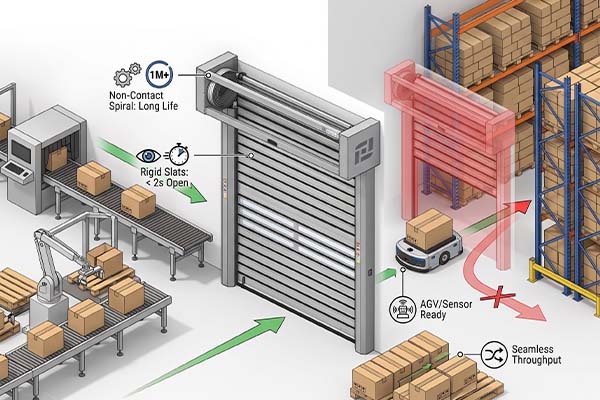
5 Reasons a High Speed Spiral Door is Crucial for Warehouse Security and Efficiency
1. Eliminating Logistics Bottlenecks for Forklifts and AGVs
The final stages of food production rely heavily on automated efficiency, where palletizing robots and automated wrapping machines prepare goods for immediate dispatch. In this high-throughput environment, a primary logistics bottleneck occurs when material handling equipment must pause for slow-opening sectional doors. Implementing a Fast Action Spiral Door directly resolves this delay by delivering opening speeds of up to 2.0 meters per second. This rapid operation is particularly critical for modern facilities utilizing AGV compatible industrial doors.
When an AGV or a high-speed forklift approaches the threshold, advanced activation systems—such as induction loops, radar sensors, or direct PLC interfaces—trigger the normally-closed door to open instantly, allowing vehicles to pass through without decelerating. By maintaining continuous movement, food manufacturers can significantly improve their overall equipment effectiveness (OEE) at the end-of-line packaging phase.
2. Rigid Security Against Intrusion and Damage
Beyond speed, the transition to a finished goods warehouse introduces a vital requirement for physical security and structural durability. Traditional PVC roll-up doors are excellent for internal cleanroom separation, but they offer zero resistance against unauthorized access or accidental impacts in a busy logistics hub. Choosing an Aluminum High Speed Door provides the robust physical barrier necessary to protect high-value completed inventory from security intrusion.
Built with double-walled aluminum slats injected with high-density polyurethane insulation, these doors offer exceptional strength without sacrificing operational velocity. In large finished goods warehouses that connect directly to exterior loading docks, the threat of pest infiltration and unauthorized personnel is a constant concern. A rigid door ensures that when the facility is closed or during low-activity shifts, the perimeter is entirely secure.
3. Superior Wind Load Resistance in Warehouse Openings
Finished goods warehouses are frequently exposed to the outside environment through active shipping docks, creating massive pressure differentials and a phenomenon known as the “chimney effect.” When exterior dock doors are open, powerful cross-winds rush through the warehouse toward the internal packaging and palletizing areas. Under these conditions, standard fabric doors often fail; the wind load causes the curtains to bow, binding them in their tracks and preventing them from closing. This is where a High Performance Rigid Door becomes essential. The solid interlocking aluminum slats are engineered to withstand severe wind resistance, ensuring smooth, unhindered vertical travel even under intense negative pressure.
4. Blocking Thermal Loss Between Production and Storage
In addition to wind resistance, maintaining strict temperature boundaries is a major challenge at the packaging interface. Outer packaging zones are typically climate-controlled for worker comfort and to protect dry cardboard packaging from humidity, while finished goods storage might require refrigeration or ambient temperature maintenance. The insulated core of the rigid slats in a High Speed Spiral Door effectively blocks thermal loss between these distinct zones. By preventing rapid cold or heat escape, facilities can directly lower energy costs and prevent condensation from forming on finished product cartons, which could otherwise compromise packaging integrity.
5. Non-Contact Technology for Million-Cycle Durability
High-volume packaging lines operate on tight schedules where unexpected downtime can disrupt an entire supply chain. Equipment deployed in high speed spiral doors for palletizing areas must be capable of enduring hundreds of thousands of cycles annually with minimal maintenance. The unique engineering of a Rapid Spiral Roller Door addresses this durability requirement through its innovative non-contact spiral guide track. As the door opens, the aluminum slats are guided along a circular spiral path where they roll up cleanly without touching one another. This non-contact technology completely eliminates the face-to-face friction, scratching, and wear that typically degrades standard roll-up doors. By preventing mechanical abrasion, the door preserves its aesthetic appearance and structural integrity over a lifespan exceeding one million cycles.
Conclusion
Optimizing the transition from the outer packaging and palletizing zone to the finished goods storage requires a precise balance of speed, strength, and thermal efficiency. While general factory doors focus on basic partition logic, the high-intensity logistics of the food warehouse demand an advanced solution. Investing in a premium High Speed Spiral Door is a strategic move that directly protects your facility’s OEE, secures valuable inventory, and cuts energy waste. By deploying a rigid, fast-acting barrier tailored specifically to high-frequency transit, food manufacturers can eliminate costly transport bottlenecks and ensure a seamless, secure flow from the production line to the global market.
FAQ
Q1: How do high-speed rigid doors integrate with automated AGV and AMR systems in the palletizing area?
Modern fast-acting doors are equipped with advanced micro-processor control boxes that support seamless integration with automated guided vehicles (AGVs) and autonomous mobile robots (AMRs). Through industrial protocols like Profibus, Modbus, or standard volt-free contacts, the door and the AGV system communicate in real time. The AGV sends an opening request upon approach, our Rapid Spiral Roller Door opens within seconds, and a safety interlocking loop confirms the door is fully raised before the vehicle enters, completely eliminating collisions and stops.
Q2: Why is a rigid spiral door preferred over a traditional PVC rapid door for the finished goods warehouse interface?
While PVC doors are suitable for light internal separation, the finished goods warehouse interface demands high wind resistance, thermal isolation, and security. Fabric doors lack the structural strength to handle the strong air drafts caused by open loading docks, leading to track binding. Additionally, a High Speed Spiral Door offers physical security against theft and accidental heavy forklift impacts, along with superior thermal insulation due to polyurethane-filled slats.
Q3: What safety mechanisms are critical for high-speed doors operating in high-traffic packaging and warehouse zones?
Given the high speed of operation and constant forklift traffic, safety is paramount. The High Performance Rigid Door integrates a multi-point light curtain embedded directly into the side tracks, creating an invisible safety grid up to 2.5 meters high. If a forklift, AGV, or worker breaks any part of this grid while the door is closing, the system instantly reverses to the open position. This is paired with wireless safety edges and visual warning lights to ensure complete protection for personnel and assets.


