
A photograph of a closed crate tells you very little about the door inside. Can the guide rails slide lengthwise? Could a loose bag of brackets reach the painted curtain? The most useful time to review roller shutter export packaging is while the packer can still show you those details and correct them before dispatch.
For an order of aluminum roller shutter doors, start with three questions. How will the curtain travel? What supports the long parts? Where will the operator and loose hardware go? Ask the supplier to identify the package containing each item. The answers will depend on the door configuration, route and handling arrangements.
Contents
- 1 Agree on roller shutter export packaging before the crate is built
- 2 Protect slat faces and interlocking edges
- 3 Check guide rail packing along the full length
- 4 Give the motor and controls separate protection
- 5 Connect the crate labels to the export packing list
- 6 Give the receiving team a record they can use
Agree on roller shutter export packaging before the crate is built
Tell the supplier where the shipment will be unloaded, whether a transfer depot will handle it, and how much room the receiving team has for the longest package. Request the proposed outside dimensions, gross weights and handling information before booking collection. A long crate that fits the freight vehicle can still be awkward to receive through a narrow yard.
The supplier’s shipping and delivery information is a starting point. Put the agreed roller shutter export packaging details in the order. Specify who will provide package data to the forwarder and who will confirm that the destination team can handle the proposed packages. Ask the packer to explain any restrictions on stacking or storage.
Protect slat faces and interlocking edges
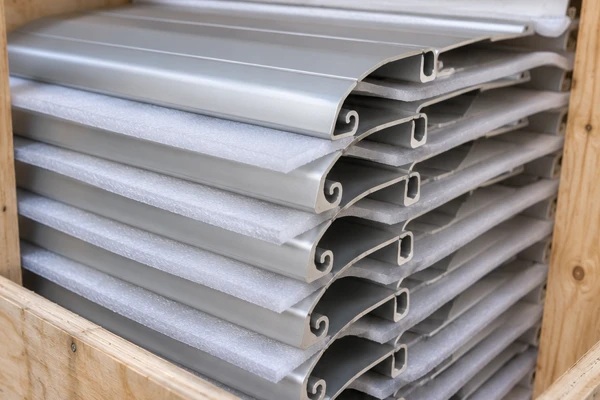
First establish whether the curtain ships assembled around a barrel, as a separate roll, or in sections. A photo of loose profiles answers a different question from a photo of a wrapped roll. For loose coated slats, ask how the packer separates the finished faces and prevents the ends from striking the crate. A clean separator is useful only if it stays in position when the bundle moves.
For an assembled curtain, ask the supplier to identify the intended support points and show how the roll is restrained. Look for hard fittings or exposed fasteners next to the finish. A bracket secured in its own pocket is easier to account for than one tucked inside the wrapping. Ask for one close-up of the shutter slat protection before the last layer goes on.
Check guide rail packing along the full length
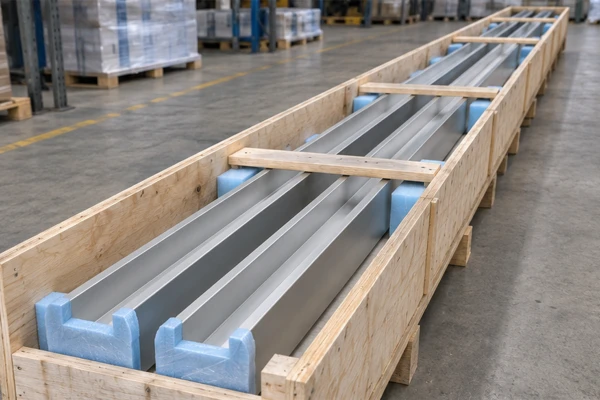
Long guides can look fine in a photograph of their ends while the middle spans an unsupported gap. Request a lengthwise view before the crate is closed. It should show the supports, separation between profiles and protection at both ends. Ask the packer how the guides are restrained against lengthwise travel without squeezing the channel opening.
Keep the opening ID or door mark with each matched pair. If one crate contains rails for several doors, list the IDs and quantities on the packing list. Two rails of similar length may belong to different openings. Marking the bundles before dispatch saves the receiving crew from having to identify them by eye.
Give the motor and controls separate protection
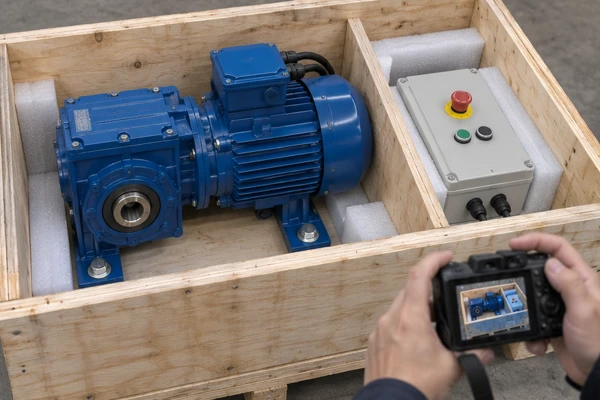
A heavy operator can damage a light control enclosure if both can move into the same space. Ask to see the motor compartment and its restraint before the lid is fitted. Check where the output shaft, cable entries and switches sit relative to the sides. The packer should select supports and restraints suitable for the actual assembly and transport conditions.
For a powered shutter, check whether the motor is attached to the assembly or packed separately. Record the matching door ID either way. Bag small fittings by door or clearly identified common kit, then list where that kit is packed. A photograph showing the open compartment and package number gives the buyer a reference if a carton appears to be missing.
Connect the crate labels to the export packing list
Give each package a unique number and use the same number on the crate labels, photos and export packing list. For example, if crate 2 contains guides for doors D01 and D02 while crate 3 contains their operators, record both door IDs against each package and show the quantities. The receiver can then distinguish a missing crate from a missing part inside a crate.
Request three views of the roller shutter export packaging before dispatch: the components and their identifiers, the open crate with supports and restraints visible, and the closed crate with its readable label. Ask the supplier to send the final list if the packer splits or combines any packages. A photo set tied to yesterday’s crate numbers is difficult to use on the loading dock.
Give the receiving team a record they can use
Send the final package list and photos to the person accepting the delivery. If a case arrives wet, crushed or punctured, have the receiver record the package number and visible condition as soon as it is safe, and follow the carrier’s reporting instructions. Keep the packaging and photographs available for review. For the component checks after arrival, use the roller shutter delivery inspection checklist.
When you ask SEPPES about roller shutter export packaging, include the door schedule, destination, planned freight route and any unloading limits you already know. Ask for a proposed package breakdown and identify which open-crate photos your receiving team needs before dispatch.


