
Choosing the right aluminum roller shutter door manufacturer involves much more than comparing product photos and asking for the lowest price. For commercial and industrial projects, the quality of the manufacturer can directly affect door durability, operation, installation, safety, and long-term maintenance.
Two suppliers may both quote an aluminum roller shutter, but the actual products can differ significantly in aluminum profiles, curtain construction, guide rails, motors, control systems, safety devices, surface finishes, engineering support, and quality control.
This becomes even more important when purchasing aluminum roll up doors for warehouses, retail stores, commercial buildings, factories, or other project-based applications where dimensions and operating requirements are rarely identical.
So how do you evaluate an aluminum roller shutter door manufacturer before placing an order?
The following eight factors will help you compare manufacturers more systematically and reduce purchasing risks.
Contents
- 1 1. Confirm Whether the Supplier Is an Actual Manufacturer
- 2 2. Evaluate the Manufacturer’s Aluminum Roller Shutter Product Capability
- 3 3. Check Aluminum Material and Door Construction
- 4 4. Evaluate Custom Engineering Capability
- 5 5. Review the Motor, Controls, and Safety Options
- 6 6. Verify Quality Control, Testing, and Certification
- 7 7. Compare Roller Shutter Prices Based on the Same Configuration
- 8 8. Evaluate Export Experience, Packaging, Delivery, and After-Sales Support
- 9 Aluminum Roller Shutter Door Manufacturer Checklist
- 10 Red Flags When Choosing a Roller Shutter Manufacturer
- 10.1 1. The supplier cannot provide detailed specifications
- 10.2 2. The quotation is much lower but the configuration is unclear
- 10.3 3. Technical questions receive vague answers
- 10.4 4. Certificates cannot be matched to the quoted product
- 10.5 5. No drawings are confirmed before custom production
- 10.6 6. There is no clear quality-control process
- 10.7 7. Warranty terms are unclear
- 10.8 8. Export packaging is treated as an afterthought
- 11 What Information Should You Send to an Aluminum Roller Shutter Door Manufacturer?
- 12 Frequently Asked Questions
- 12.1 How do I find a reliable aluminum roller shutter door manufacturer?
- 12.2 What should I ask a roll up door manufacturer before ordering?
- 12.3 How much do aluminum roll up doors cost?
- 12.4 Can aluminum roller shutters be custom-made?
- 12.5 What information is needed for a roller shutter quotation?
- 12.6 What is the difference between aluminum and steel roll up doors?
- 12.7 Does a roll up door require professional installation?
- 13 Final Thoughts: Choose the Manufacturer, Not Just the Door
1. Confirm Whether the Supplier Is an Actual Manufacturer
The first step is understanding who will actually manufacture your door.
The roller shutter market includes manufacturers, trading companies, distributors, installers, and resellers. Working with any of these business types is not automatically a problem, but B2B buyers should clearly understand who is responsible for engineering, production, quality control, and after-sales support.
When comparing roller door manufacturers or a potential roll up door supplier, ask for information such as:
- Factory photos and videos
- Production equipment
- Manufacturing processes
- Product assembly areas
- Quality-control procedures
- Testing facilities
- Packaging and loading processes
- Business and factory information
For larger projects, you can also request a live video factory tour or arrange an on-site inspection when appropriate.
A genuine roll up door manufacturer should normally be able to explain how the door is produced rather than simply sending a catalog and price list.
You should also ask who prepares technical drawings, who selects the motor, who performs quality inspections, and who handles technical questions after delivery.
The goal is not simply to find a factory. It is to identify a supplier that understands and controls the product you are buying.
2. Evaluate the Manufacturer’s Aluminum Roller Shutter Product Capability
Not every company selling roller doors specializes in aluminum systems.
Before choosing an aluminum roller shutter door manufacturer, confirm that aluminum roller shutters are part of its regular manufacturing capability rather than an occasional outsourced product.
Depending on your project, manufacturers may offer different curtain and configuration options, such as:
- Solid aluminum slats
- Perforated aluminum slats
- Different slat profiles
- Different guide rail designs
- Powder-coated finishes
- Customized colors
- Manual operation
- Motorized operation
- Remote or push-button controls
- Safety sensors
- Emergency manual operation
The available options vary between manufacturers and models, so specifications should always be confirmed for the exact door being quoted.
This is especially important when purchasing commercial roll up doors or industrial roll up doors. A storefront may prioritize appearance, compact installation, and security, while a warehouse opening may require different structural, motor, and operating considerations.
Ask the manufacturer which aluminum shutter configuration it recommends for your particular application—and why.
A technically capable supplier should be able to explain the difference rather than recommending the same product configuration for every project.
3. Check Aluminum Material and Door Construction
Material quality should be evaluated through specifications, not statements such as “high-quality aluminum.”
Before purchasing aluminum roll up doors, ask the manufacturer to provide detailed information about the curtain and structural components.
Aluminum slats
Important questions include:
- What aluminum material or alloy is used?
- What is the slat profile?
- What is the material thickness?
- Is the slat solid, perforated, or another design?
- What surface treatment is available?
Thickness alone should not be used to judge the complete strength of an aluminum profile. Profile geometry, door dimensions, guide design, and overall system construction also influence performance.
Guide rails
The guide rails control the movement of the curtain and help keep the shutter aligned.
Ask about:
- Guide rail material
- Guide dimensions
- Fixing method
- Sealing options
- Suitability for the proposed door size
- Additional reinforcement when required
For outdoor installations, the manufacturer should also understand the environmental and wind requirements provided for the project.
Barrel and shaft assembly
The barrel and shaft must be selected according to the curtain dimensions, weight, and operating design.
Rather than assuming one shaft specification works for every roller shutter door, ask whether the manufacturer calculates or selects the assembly according to the individual door.
Surface finish
Aluminum is often selected where appearance and corrosion resistance are important.
Available finishes may include options such as powder coating or anodizing, depending on the manufacturer’s capabilities.
For architectural projects, ask whether custom colors are available and whether the manufacturer can provide finish samples or confirmed color references before production.
A reliable aluminum roller shutter door manufacturer should be able to provide these specifications before you approve the order.
4. Evaluate Custom Engineering Capability
Many commercial roller shutter projects cannot be handled effectively with a one-size-fits-all product.
The manufacturer should first understand the actual opening and operating conditions.
Typical information includes:
- Opening width
- Opening height
- Available headroom
- Available sideroom
- Installation position
- Supporting structure
- Indoor or outdoor installation
- Required operating frequency
- Local power supply
- Environmental conditions
- Required control method
This is where the ability to produce custom roll up doors becomes important.
A manufacturer that supports custom projects should be able to review the dimensions and recommend an appropriate configuration instead of simply asking you to choose a standard model from a catalog.
For more complicated projects, ask whether the supplier can provide:
- Shop drawings
- Dimension drawings
- Installation drawings
- Electrical diagrams
- Component specifications
- Mounting details
Accurate roll up door dimensions are especially important before production begins. A relatively small error in opening dimensions, headroom, guide position, or mounting conditions can create problems during installation.
For this reason, the best time to solve dimensional problems is during engineering review—not after the door arrives at the project site.
5. Review the Motor, Controls, and Safety Options
If you need an electric roll up door, do not evaluate only the door curtain.
The motor and control system are also important parts of the complete door system.
Motor selection
Ask your aluminum roller shutter door manufacturer about:
- Motor type
- Rated power
- Compatible door size and weight
- Voltage
- Frequency
- Operating frequency
- Limit control
- Emergency manual operation
Motor selection should match the individual door configuration and expected operating conditions.
An oversized or undersized motor should not be considered a substitute for proper engineering.
Control options
Depending on the project, electric roller shutters may use:
- Push buttons
- Remote controls
- Key switches
- Access-control interfaces
- Other project-specific control methods
Confirm exactly what is included in the quotation.
Safety devices
Depending on the model and application, available safety features may include photocells, safety edges, warning devices, emergency stops, or other protective systems.
Do not assume every manufacturer includes the same safety configuration as standard.
Ask:
Which safety devices are included, which are optional, and which are recommended for my application?
For an automatic roll up door, control and safety requirements should be reviewed as part of the complete system instead of being added as an afterthought.
6. Verify Quality Control, Testing, and Certification
Quality control is another important way to distinguish experienced rolling shutter manufacturers from suppliers that compete mainly on price.
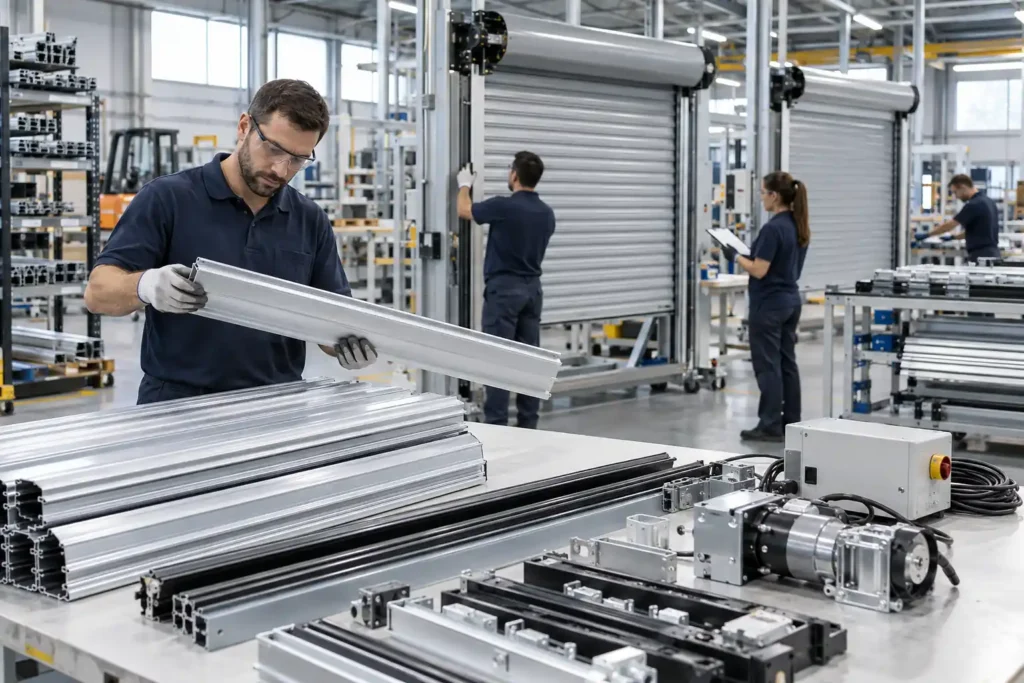
Ask how the door is inspected during production and before shipment.
A quality-control process may include checks such as:
- Incoming material inspection
- Component dimension inspection
- Slat and guide inspection
- Assembly inspection
- Motor and control testing
- Opening and closing test
- Limit-position verification
- Safety-device testing where applicable
- Appearance inspection
- Final packaging inspection
The exact process will depend on the product and manufacturer.
The important question is whether quality control is systematic and documented.
Be careful with certification claims
Certificates should also be checked carefully.
Simply seeing a CE logo, test report, ISO certificate, or other document is not enough to determine whether it applies to the door you are purchasing.
Ask:
- What is the exact certificate or test report?
- Which product does it cover?
- Which model does it cover?
- Which standard was used?
- Who issued the document?
- Is the document currently valid?
For example, a quality-management-system certificate and a product conformity document serve different purposes and should not be treated as the same thing.
If your project has specific regulatory, wind-load, fire, electrical, or safety requirements, provide those requirements to the manufacturer before ordering and request supporting documentation applicable to the proposed product.
A professional aluminum roller shutter door manufacturer should be willing to clarify what its documentation does—and does not—cover.
7. Compare Roller Shutter Prices Based on the Same Configuration
Price matters, but comparing only the final number can be misleading.
Searches for roll up door prices or commercial roll up doors prices may suggest that doors can be compared like standardized products. In reality, project quotations often contain very different configurations.
The price of an aluminum roller shutter can be affected by:
- Door width and height
- Aluminum slat design
- Material specification
- Surface finish
- Guide rail configuration
- Shaft and barrel assembly
- Motor
- Control method
- Safety devices
- Accessories
- Order quantity
- Packaging
- Special engineering requirements
Consider two quotations.
| Item | Supplier A | Supplier B |
|---|---|---|
| Curtain | Basic aluminum profile | Project-specific aluminum profile |
| Operation | Motorized | Motorized |
| Controls | Push button only | Push button + remote |
| Safety devices | Not included | Photocell included |
| Finish | Standard finish | Custom powder coating |
| Drawings | Not specified | Installation drawing included |
| Packaging | Basic packaging | Export-oriented component protection |
Even if Supplier A appears cheaper, the two quotations are not directly comparable.
When evaluating an aluminum roller shutter door manufacturer, create a line-by-line comparison of what is included.
Ask each supplier to clearly list:
- Door configuration
- Included accessories
- Optional items
- Excluded items
- Packaging
- Technical documentation
- Warranty
- Delivery terms
The objective is not simply to select the lowest price. It is to understand what you are paying for.
8. Evaluate Export Experience, Packaging, Delivery, and After-Sales Support
If the shutters will be shipped internationally, manufacturing quality is only part of the purchasing process.
The supplier also needs to prepare the system for transportation, installation, and commissioning at the destination.
Ask your potential roller shutter supplier how overseas orders are handled.
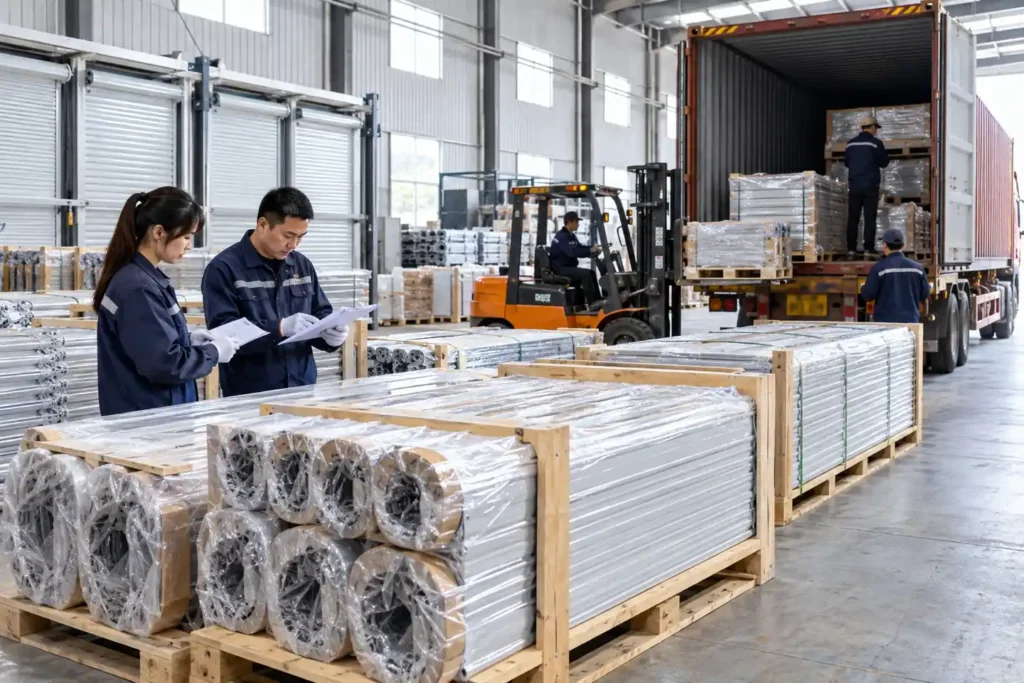
Export packaging
Long components such as guide rails, shafts, hoods, and door curtains should be protected during transport.
Ask how the manufacturer:
- Protects finished surfaces
- Packages long components
- Labels accessories
- Separates electrical components
- Provides packing lists
- Prepares the shipment for container loading
Technical documentation
Before shipment, confirm whether you will receive the documents required for installation and operation.
These may include, depending on the supplier and project:
- Product drawings
- Installation instructions
- Wiring diagrams
- Motor instructions
- Packing lists
- Component identification
- Maintenance guidance
After-sales technical support
Ask what happens if your installer has questions after receiving the door.
Does the manufacturer provide remote installation guidance?
Can it help troubleshoot motor or control issues?
Can replacement components be identified and supplied?
Can technical staff review installation photos or videos?
These questions are particularly important for buyers purchasing directly from an overseas roll up door manufacturer rather than using a local installer.
Aluminum Roller Shutter Door Manufacturer Checklist
Before selecting a supplier, use the following checklist to compare candidates objectively.
| Evaluation Item | What You Should Check |
|---|---|
| Manufacturer status | Who actually manufactures the door? |
| Product capability | Does the factory regularly produce aluminum roller shutters? |
| Aluminum profile | Material, profile design, thickness and finish |
| Door construction | Guides, barrel, shaft, hood and bottom section |
| Customization | Size, color, controls and project-specific options |
| Engineering | Drawings and technical review |
| Motor | Specification, voltage and suitability |
| Controls | Push button, remote and integration options |
| Safety | Included and optional safety devices |
| Quality control | Inspection and pre-shipment testing |
| Documentation | Product-specific certificates and reports |
| Price | Complete configuration rather than unit price alone |
| Packaging | Protection suitable for the shipping method |
| Installation support | Drawings, manuals and technical guidance |
| After-sales support | Troubleshooting and replacement components |
If a potential aluminum roller shutter door manufacturer can answer these points clearly, comparing suppliers becomes much easier.
Red Flags When Choosing a Roller Shutter Manufacturer
Low price alone is not necessarily a warning sign, and a high price does not automatically indicate better quality.
However, several issues should encourage further investigation.
1. The supplier cannot provide detailed specifications
If the quotation only says “aluminum roller shutter” without identifying the curtain, motor, controls, guides, and accessories, you may not know what you are actually buying.
2. The quotation is much lower but the configuration is unclear
Before deciding that one manufacturer is cheaper, check whether important components have simply been excluded.
3. Technical questions receive vague answers
A manufacturer should be able to explain important design decisions or involve an engineer who can.
4. Certificates cannot be matched to the quoted product
Do not rely on certificates that apply to an unrelated product or unknown model.
5. No drawings are confirmed before custom production
For custom roll up doors, dimensions and mounting conditions should be reviewed before manufacturing.
6. There is no clear quality-control process
Ask how the manufacturer verifies the completed door before shipment.
7. Warranty terms are unclear
Confirm what is covered, the warranty period, and how replacement components are handled.
8. Export packaging is treated as an afterthought
Poor packaging can damage an otherwise well-manufactured door before it reaches the site.
These points do not automatically disqualify a supplier, but they indicate areas that should be clarified before placing an order.

What Information Should You Send to an Aluminum Roller Shutter Door Manufacturer?
A detailed inquiry helps the manufacturer provide a more accurate configuration and quotation.
Instead of simply asking:
“What is your aluminum roller shutter price?”
provide as much of the following information as possible:
- Opening width × height
- Quantity
- Application — warehouse, shop, factory, commercial building, etc.
- Indoor or outdoor installation
- Manual or motorized operation
- Local voltage and frequency
- Required color or finish
- Required control method
- Safety requirements
- Environmental or wind requirements, if applicable
- Project country or location
- Expected delivery schedule
- Opening drawings or site photos, if available
Providing these details allows the aluminum roller shutter door manufacturer to recommend a project-specific solution rather than quoting an undefined standard door.
For example, storefront roll up doors may need a different balance between appearance, visibility and security than warehouse roll up doors. Likewise, commercial entrances and industrial openings can have very different operating requirements.
Frequently Asked Questions
How do I find a reliable aluminum roller shutter door manufacturer?
Start by verifying manufacturing capability, reviewing aluminum and structural specifications, checking customization and engineering support, and confirming quality-control procedures. You should also review motor and safety options, applicable documentation, export packaging, installation support, and warranty terms before comparing final prices.
What should I ask a roll up door manufacturer before ordering?
Ask for the complete door specification, including curtain material, slat profile, guides, shaft, motor, controls, safety devices, finish, drawings, testing, packaging, delivery terms, and warranty. For custom projects, also confirm the required opening dimensions and installation conditions.
How much do aluminum roll up doors cost?
There is no single standard price for all aluminum roll up doors. Cost depends on door size, aluminum profile, finish, motor, controls, safety devices, accessories, quantity, and other project requirements. For an accurate comparison, provide the same specification to each supplier and compare like-for-like quotations.
Can aluminum roller shutters be custom-made?
Yes, many manufacturers produce custom roll up doors based on project dimensions and configuration requirements. Available customization may include size, curtain profile, surface finish, motor, control method, safety devices, and other options. The exact capabilities should be confirmed with the manufacturer.
What information is needed for a roller shutter quotation?
At minimum, provide the opening width and height, quantity, application, installation environment, required operation method, and project location. For motorized doors, also provide the local voltage and frequency. Drawings and site photos can help the manufacturer evaluate non-standard projects.
What is the difference between aluminum and steel roll up doors?
Aluminum and steel have different material characteristics and are often selected for different priorities. Aluminum is commonly considered where lower weight, corrosion resistance, or architectural appearance is important, while steel products may be considered where different structural or security requirements apply. The final choice should be based on the complete door design, application, environment, and required performance rather than material alone.
Does a roll up door require professional installation?
Commercial and industrial roller shutter systems should be installed according to the manufacturer’s drawings and instructions. Installation involves structural fixing, curtain alignment, guides, motor setup, electrical connections, limit adjustment, and safety-device commissioning. Incorrect installation can affect operation even when the door itself has been manufactured correctly.
Final Thoughts: Choose the Manufacturer, Not Just the Door
Selecting an aluminum roller shutter door manufacturer should be treated as a technical purchasing decision rather than a simple price comparison.
A suitable manufacturer should be able to explain the complete door system, provide clear specifications, manufacture according to project dimensions, identify appropriate motors and controls, perform quality checks, prepare the system for shipment, and support installation after delivery.
When comparing roller shutter door suppliers, focus on eight areas:
- Manufacturing capability
- Product specialization
- Material and construction
- Custom engineering
- Motors, controls and safety
- Quality control and documentation
- Configuration-based pricing
- Export and after-sales support
The more clearly these details are defined before production, the lower the risk of discovering specification gaps after the door has already been manufactured or delivered.
If you are sourcing aluminum roller shutters for a commercial or industrial project, prepare your opening dimensions, quantity, application, voltage, and required configuration before requesting a quotation. This gives the manufacturer enough information to recommend the right door system and provide a meaningful price comparison.


