
Regular aluminum roller shutter maintenance is one of the simplest ways to keep a shutter operating smoothly and identify developing problems before they cause an unexpected shutdown.
For commercial buildings, retail stores, warehouses, workshops, and other frequently used entrances, a roller shutter is not simply part of the building envelope. It may be opened and closed repeatedly throughout the working day. Dust, debris, loose components, misaligned guides, damaged slats, and motor problems can therefore gradually affect its operation.
A good maintenance routine should focus on more than simply cleaning the curtain. The complete door system—including the aluminum slats, guide rails, bottom bar, fasteners, operator, controls, and safety devices—should be checked at appropriate intervals.
This guide explains how to maintain aluminum roller shutters, what warning signs to watch for, and when routine maintenance should be replaced by professional inspection or repair.
Safety note: Roller shutters contain moving mechanical and electrical components. Disconnect electrical power before carrying out maintenance where required, and do not dismantle the motor, barrel, shaft, brake, spring, or counterbalance system unless you are qualified to service the equipment. Always follow the instructions provided by the door and operator manufacturer.
Contents
- 1 Why Regular Aluminum Roller Shutter Maintenance Matters
- 2 Recommended Aluminum Roller Shutter Maintenance Schedule
- 3 1. Clean the Aluminum Curtain Regularly
- 4 2. Inspect the Roll Up Door Track and Guide Rails
- 5 3. Check the Slats, Bottom Bar, and Fasteners
- 6 4. Lubricate Moving Components Correctly
- 7 5. Motorized Aluminum Roller Shutter Maintenance
- 8 6. Test Safety Devices
- 9 7. Check for Unusual Noise, Vibration, or Uneven Movement
- 10 8. Keep the Area Around the Shutter Clear
- 11 9. Adjust Maintenance for Outdoor and Coastal Installations
- 12 10. When Maintenance Is Not Enough
- 13 Aluminum Roller Shutter Preventive Maintenance Checklist
- 14 Frequently Asked Questions About Aluminum Roller Shutter Maintenance
- 14.1 How often should aluminum roller shutters be maintained?
- 14.2 Do aluminum roller shutters need lubrication?
- 14.3 How do you clean an aluminum roller shutter?
- 14.4 Why is my aluminum roller shutter making noise?
- 14.5 Why does my roll up door keep getting stuck in the tracks?
- 14.6 When should I call a professional roll up door service technician?
- 15 Final Thoughts: Preventive Maintenance Is Better Than Emergency Repair
Why Regular Aluminum Roller Shutter Maintenance Matters
An aluminum roller shutter normally operates by guiding interlocking slats vertically through side guides while the curtain coils around a barrel above the opening. On motorized systems, the operator and control system add further mechanical and electrical components.
Because these parts work together, a relatively small problem in one area can eventually affect the whole door.
For example, debris inside a guide may increase friction. Continued operation can then place additional load on the curtain and drive system. A loose or damaged slat can also affect how evenly the curtain moves through the guides.
Preventive maintenance can help you:
- Keep opening and closing movement smooth
- Identify damaged or deformed slats early
- Prevent debris from accumulating inside tracks and guides
- Detect abnormal motor noise or operating resistance
- Keep safety devices functioning correctly
- Reduce the risk of unexpected operational downtime
- Identify worn rolling door parts before they cause secondary damage
- Maintain the appearance of exposed aluminum surfaces
Maintenance is especially important for aluminum roll up doors installed in locations with heavy traffic, dust, moisture, outdoor exposure, or frequent opening cycles.
Recommended Aluminum Roller Shutter Maintenance Schedule
There is no single maintenance interval that is suitable for every shutter.
A door that operates only a few times per day in a clean indoor environment will have different maintenance requirements from a shutter installed at a busy commercial entrance or exposed warehouse opening.
The following schedule should therefore be treated as a practical starting point rather than a universal rule.
| Frequency | Recommended Checks |
| Daily or during regular operation | Watch for unusual noise, hesitation, uneven movement, or visible damage |
| Monthly | Clean the curtain and guides, check slats, bottom bar, tracks, and visible fasteners |
| Every 3–6 months | Perform a more detailed inspection of mechanical movement, controls, safety devices, and motorized operation |
| Periodically by a qualified technician | Inspect operator, shaft, brake, drive components, electrical connections, and other inaccessible parts |
Maintenance frequency should be adjusted according to:
- Number of operating cycles
- Door size and weight
- Indoor or outdoor installation
- Dust and contamination levels
- Coastal or corrosive environments
- Exposure to rain and weather
- Frequency of vehicle or pedestrian traffic
- Manufacturer recommendations
Doors operating under demanding conditions may require more frequent inspection.
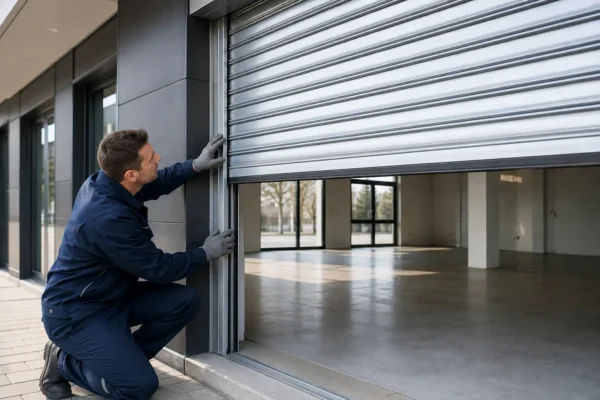
1. Clean the Aluminum Curtain Regularly
Cleaning is one of the most basic parts of aluminum roller shutter maintenance, but it serves more than an aesthetic purpose.
Dust and contamination can build up around the slat joints and edges of the curtain. Outdoor shutters may also collect airborne dirt, moisture, road contaminants, or salt deposits in coastal environments.
How to clean the curtain
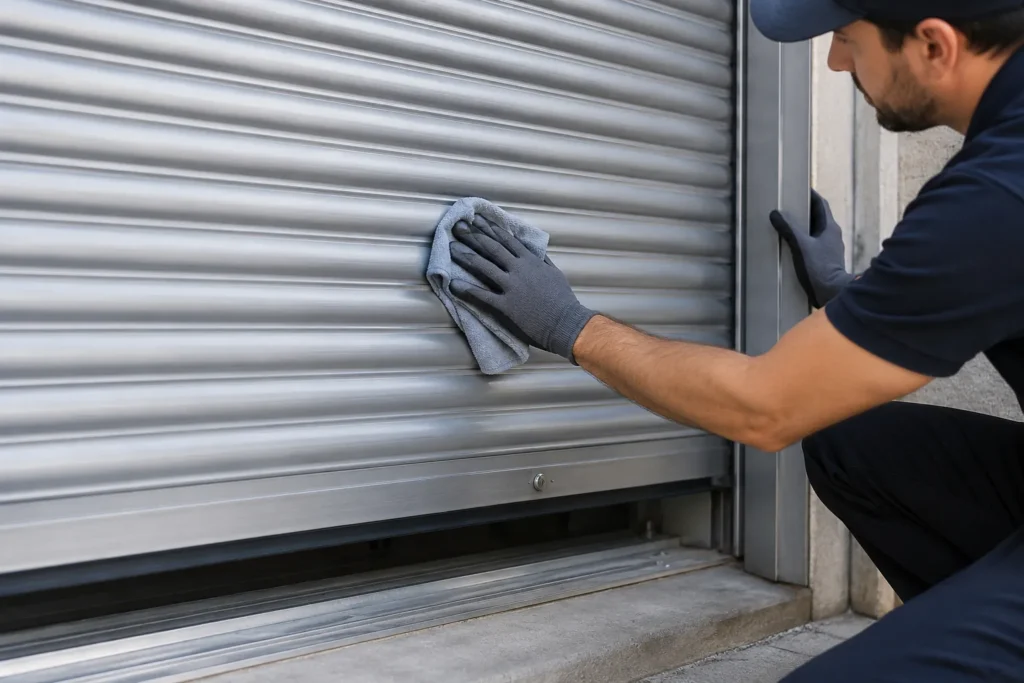
Begin by removing loose dust using a soft brush or cloth.
For more thorough cleaning:
- Close the shutter completely.
- Remove loose dirt from the curtain surface.
- Use clean water with a mild, non-abrasive cleaning solution when necessary.
- Wipe the slats using a soft cloth or sponge.
- Rinse away cleaning residue.
- Allow the surface to dry.
Avoid abrasive pads or aggressive chemicals that may damage the surface finish.
If your aluminum roll up door has a powder-coated, anodized, or specially finished surface, follow the cleaning recommendations for that particular finish.
What to inspect while cleaning
Cleaning is also a good opportunity to look for:
- Bent aluminum slats
- Dents caused by impact
- Scratches or coating damage
- Loose slat connections
- Unusual gaps between slats
- Damaged end locks or side components
- Irregular curtain alignment
A damaged slat does not always mean the entire shutter needs replacing. However, significant deformation should be inspected before the door continues operating.
2. Inspect the Roll Up Door Track and Guide Rails
The side guides are critical to smooth curtain movement.
A roll up door track or rolling door guide that contains debris, is damaged, or has become misaligned can create additional friction as the curtain moves.
For commercial installations, checking the roll up door tracks should therefore be part of routine maintenance.
First, remove debris
Inspect both guides for:
- Dust
- Stones
- Packaging material
- Metal fragments
- Leaves
- Hardened dirt
- Other foreign objects
Even a relatively small obstruction can interfere with door movement.
Clean the guides carefully rather than forcing the shutter to operate through an obstruction.
Check guide condition
After cleaning, inspect the guides for:
- Visible bending
- Loose mounting points
- Impact damage
- Uneven spacing
- Excessive wear
- Damaged guide inserts
- Signs that the curtain is rubbing against one side
Larger commercial roll up door tracks should also be checked where they connect to the supporting building structure.
Watch the shutter while it moves
Operate the door through a complete opening and closing cycle from a safe position.
The curtain should travel through the guides without:
- Jerking
- Excessive vibration
- Scraping
- Severe lateral movement
- Repeated stopping
- Unusual resistance
If the shutter starts to jam, do not repeatedly operate the controls in an attempt to force it through the problem.
Continuing to run a jammed shutter can increase damage to the slats, guides, operator, or other components.
3. Check the Slats, Bottom Bar, and Fasteners
The curtain itself is made up of multiple connected components, so inspecting only the outer surface is not enough.
Look at the aluminum slats as a complete moving curtain.
Pay particular attention to:
Aluminum slats
Check for:
- Bending
- Dents
- Cracks
- Separation
- Uneven connections
- Damage around the ends of individual slats
If several slats are no longer moving evenly through the guides, the cause should be identified before the condition becomes worse.
Bottom bar
The bottom bar should remain straight and move evenly toward the floor or sill.
Check whether it:
- Sits evenly when the door closes
- Has been bent by impact
- Has loose attachments
- Shows excessive wear
- Contains a damaged bottom seal
An uneven bottom bar can sometimes indicate a larger curtain alignment problem.
Fasteners and visible connections
Inspect accessible brackets, bolts, and fasteners.
If a fastener repeatedly becomes loose, simply tightening it may not solve the underlying cause. Excessive vibration or misalignment may need further investigation.
4. Lubricate Moving Components Correctly
Lubrication is commonly associated with shutter maintenance, but applying lubricant everywhere is not good practice.
Different roller shutter designs use different bearing surfaces, guide inserts, drive systems, and components. Some parts require periodic lubrication, while others may be designed to operate dry.
For this reason, lubricant should only be applied to locations specified by the manufacturer.
Do not automatically lubricate the guides
Spraying large quantities of oil into the guide rails can sometimes make the situation worse.
Excess lubricant may collect dust and dirt, creating a contaminated surface that increases resistance over time.
Some guide systems also use low-friction inserts that do not require conventional lubrication.
Instead:
- Clean the guide first.
- Inspect it for damage or obstruction.
- Check the manufacturer’s lubrication instructions.
- Apply only the recommended lubricant and quantity.
Components that may require lubrication
Depending on the shutter design, specified lubrication points may include certain:
- Bearings
- Hinged or moving joints
- Chains
- Drive components
- Mechanical pivots
Never apply lubricant to electrical components, brakes, sensors, or other parts unless specifically instructed.
And do not dismantle a spring, barrel, shaft, or counterbalance mechanism simply to lubricate it. These components can store significant mechanical energy and should be serviced by trained personnel.
5. Motorized Aluminum Roller Shutter Maintenance
A motorized roll up door requires additional checks because the operator, controls, and safety devices are responsible for moving and stopping the curtain correctly.
Regular motorized aluminum roller shutter maintenance does not mean dismantling the operator. For building owners and facility personnel, the most useful routine inspections are usually operational and visual.
Operate the shutter and listen to the roll up door motor.
Listen to the Roll Up Door Motor
Be alert for changes such as:
- Grinding
- Clicking
- Excessive vibration
- Humming without movement
- Sudden changes in motor noise
- Longer operating time than normal
A change in sound does not automatically mean that the motor itself has failed. Increased mechanical resistance elsewhere in the door can also place additional load on the operator.
That is why the entire door should be inspected rather than immediately replacing the motor.
Observe Opening and Closing
A properly operating motorized rolling shutter should generally move consistently through its normal travel.
Check whether the door:
- Starts normally
- Moves at a consistent speed
- Stops at the intended open position
- Closes to the intended position
- Hesitates during travel
- Stops unexpectedly
- Moves unevenly
If the operating behavior suddenly changes, further inspection is recommended.
Inspect Controls
Check accessible control devices such as:
- Push buttons
- Remote controls
- Key switches
- Access control interfaces
- Wall-mounted control stations
Make sure controls are securely mounted and show no obvious physical damage.
Electrical wiring, internal controller components, or exposed damaged cables should be handled by qualified electrical or door service personnel.
Check Manual Emergency Operation
Where the system includes a manual release or emergency operating method, personnel responsible for the building should understand how it works.
However, the procedure varies depending on the operator.
Never improvise a manual release method. Follow the manufacturer’s instructions for the particular rollup door motor or operator installed on the shutter.
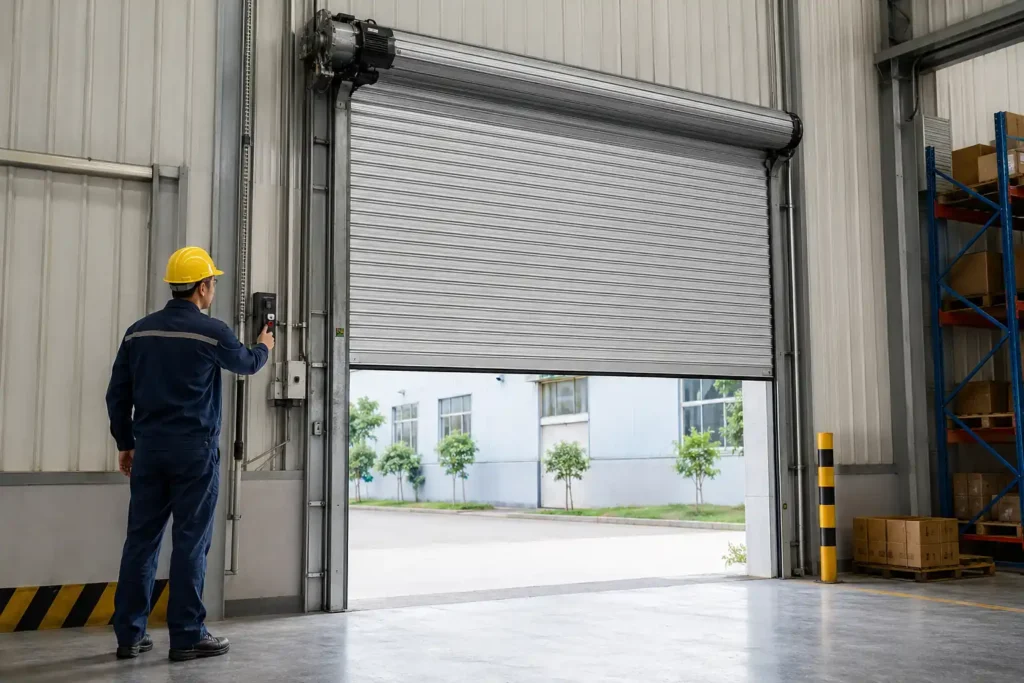
6. Test Safety Devices
Safety devices should not be treated as optional maintenance items.
Depending on the configuration of your aluminum shutter, the system may include:
- Photoelectric sensors
- Bottom safety edge
- Emergency stop
- Safety brake
- Warning light
- Manual emergency release
- Additional control or access safety devices
Check that accessible safety devices are clean, undamaged, correctly positioned, and functioning as intended.
For example, dirt or misalignment can interfere with certain photoelectric sensors.
If a safety device fails a functional test, the cause should be investigated before normal operation continues.
Never bypass a safety device simply to keep the door running.
For electrically operated or larger commercial shutters, periodic testing by trained personnel is recommended.
7. Check for Unusual Noise, Vibration, or Uneven Movement
Changes in the way an aluminum roller shutter sounds or moves are often early warning signs.
Do not wait until the shutter completely stops operating.
Common symptoms include:
| Symptom | Possible Area to Inspect | Recommended Action |
| Curtain moves unevenly | Guides, slats, alignment | Check for obstruction or visible misalignment |
| Scraping sound | Track, guide, curtain edge | Stop and inspect contact points |
| Door becomes slower | Mechanical resistance or operator | Inspect the complete system |
| Excessive vibration | Fasteners, curtain, drive system | Arrange further inspection |
| Door stops unexpectedly | Controls, safety device, motor, obstruction | Diagnose before continued operation |
| Bottom bar closes unevenly | Curtain alignment, guides, slats | Inspect both sides of the system |
| Motor runs but shutter does not move normally | Drive or mechanical system | Stop operation and call a technician |
A useful maintenance habit is to establish what normal operation looks and sounds like. Changes then become easier to detect.
8. Keep the Area Around the Shutter Clear
Not every roller shutter problem originates inside the door.
Objects placed near the guides or closing path can interfere with operation and cause impact damage.
Keep the operating area clear of:
- Pallets
- Packaging
- Carts
- Stored products
- Vehicles
- Tools
- Construction debris
This is particularly important for aluminum roll up doors used in warehouses, loading areas, and commercial facilities.
Repeated impact from vehicles or material-handling equipment can gradually distort guides or the bottom bar even when the initial damage appears minor.
9. Adjust Maintenance for Outdoor and Coastal Installations
Exterior shutters usually require closer attention than equivalent indoor installations.
Rain, windborne dust, temperature changes, and pollution can all increase contamination.
Coastal environments require particular attention because airborne salt deposits may accumulate on exposed surfaces.
For outdoor aluminum roller shutters:
- Clean exposed surfaces more frequently when contamination is visible.
- Keep guides free of sand, leaves, and debris.
- Inspect seals for deterioration.
- Look for damaged surface finishes.
- Check exposed fasteners and mounting points.
- Inspect electrical enclosures for visible damage or moisture entry.
Although aluminum has good corrosion resistance, this does not mean every component in the complete door system is maintenance-free. Fasteners, operators, guide components, seals, and accessories may use different materials.
10. When Maintenance Is Not Enough
Routine maintenance can prevent many problems, but it is not a substitute for repair.
There are situations where continuing to operate the shutter may cause more damage or create a safety risk.
Stop normal operation and arrange professional inspection if you notice:
- Severely bent or separated slats
- Major guide rail deformation
- Curtain coming out of the guides
- Sudden uncontrolled movement
- Door dropping unexpectedly
- Repeated motor overheating
- Burning smell from electrical equipment
- Damaged electrical wiring
- Failed safety devices
- Abnormal shaft or barrel movement
- Severe mechanical noise
- Door repeatedly failing to stop at the correct position
A professional commercial roll up door service technician can determine whether the issue involves adjustment, component repair, replacement rolling door parts, or a larger system problem.
Repair or Roll Up Door Replacement?
Not every damaged shutter requires complete roll up door replacement.
Depending on the design and condition of the door, individual components may be replaceable.
The decision should consider:
- Extent of curtain damage
- Condition of the guides
- Availability of compatible parts
- Operator condition
- Age of the system
- Frequency of recurring failures
- Safety condition
- Cost of repair compared with replacement
- Whether the existing door still meets the building’s operating requirements
If several major components are damaged or the existing shutter no longer meets the project’s requirements, replacement may be more practical than repeated repair.
Aluminum Roller Shutter Preventive Maintenance Checklist
A simple inspection checklist can help facility teams maintain consistent records.
Curtain
- Surface is reasonably clean
- No severely bent slats
- Slat connections appear consistent
- No unusual gaps
- Curtain travels evenly
Tracks and Guides
- Guides are free from debris
- No major bending or impact damage
- Curtain is not scraping excessively
- Visible fasteners are secure
- Guide inserts appear intact
Bottom Bar
- Bottom bar remains straight
- Door closes evenly
- Bottom seal is not severely damaged
- No obvious impact deformation
Motorized Operation
- Motor starts normally
- No new or abnormal noise
- Door opens and closes consistently
- Open and closed stopping positions are correct
- Controls operate normally
Safety Devices
- Sensors are clean
- Safety devices respond correctly
- Emergency stop functions correctly where fitted
- Manual emergency operating procedure is available
- No safety device has been bypassed
General Condition
- Operating area is clear
- No unusual vibration
- No exposed electrical damage
- No unexplained recurring faults
- Previous maintenance issues have been recorded and followed up
Keeping a basic maintenance log is particularly useful for doors that operate frequently. Recording the date, observed problem, corrective action, and replaced components can help identify recurring issues.
Frequently Asked Questions About Aluminum Roller Shutter Maintenance
How often should aluminum roller shutters be maintained?
Maintenance frequency depends on operating cycles, door size, installation environment, and manufacturer recommendations.
A lightly used indoor shutter may require less frequent attention than a heavily used commercial shutter. Regular visual checks should be combined with scheduled cleaning and periodic professional inspection.
High-cycle or outdoor installations generally deserve closer monitoring.
Do aluminum roller shutters need lubrication?
Some moving components may require lubrication, but not every part of an aluminum shutter should be lubricated.
Always check the manufacturer’s instructions before applying lubricant. In particular, do not automatically fill guide rails with oil because excessive lubricant can attract dust and may interfere with certain guide designs.
Clean first, inspect the component, and lubricate only where specified.
How do you clean an aluminum roller shutter?
Remove loose dust and dirt using a soft cloth or brush, then clean the curtain with water and a mild non-abrasive cleaning solution where necessary.
Avoid aggressive chemicals and abrasive tools that could damage the aluminum surface or finish.
Outdoor shutters may require more frequent cleaning when exposed to dirt, pollution, or coastal salt deposits.
Why is my aluminum roller shutter making noise?
Noise can result from several causes, including debris in the guides, curtain contact with the track, worn components, loose fasteners, or increased mechanical resistance.
If cleaning the guides and performing a visual inspection do not identify the cause, arrange professional inspection rather than repeatedly operating the door.
Why does my roll up door keep getting stuck in the tracks?
A roll up door track may contain debris or have become damaged or misaligned. Curtain deformation can also cause the door to bind in the guides.
Do not force the shutter through the obstruction.
Stop operation, clean and visually inspect both tracks, and arrange service if the problem continues.
When should I call a professional roll up door service technician?
Professional roll up door service is recommended when the issue involves internal motor components, electrical wiring, shafts, barrels, springs, counterbalance systems, brakes, major guide deformation, severe curtain damage, or failed safety devices.
Professional inspection is also appropriate when the same fault repeatedly returns after routine maintenance.
Final Thoughts: Preventive Maintenance Is Better Than Emergency Repair
Effective aluminum roller shutter maintenance is mainly about identifying small changes before they develop into larger operational problems.
Regularly cleaning the curtain, keeping guides clear, inspecting the slats and bottom bar, watching motorized operation, and testing safety devices can provide useful early warning of developing wear or damage.
The most important principle is not to force a shutter to continue operating when something has clearly changed.
Unusual noise, resistance, uneven movement, repeated stopping, or safety-device faults should be investigated rather than ignored.
For commercial and industrial facilities, a maintenance plan should also reflect actual operating conditions. A frequently used motorized roller shutter at a warehouse entrance may require more attention than a lightly used indoor shutter.
If you are selecting a new aluminum roller shutter or need technical guidance for an existing project, provide the opening dimensions, application, operating frequency, installation environment, and control requirements. A suitable shutter configuration and maintenance approach can then be determined according to the actual project conditions.
Need an aluminum roller shutter for your commercial or industrial project?
Contact SEPPES with your opening size, quantity, application, project location, and operating requirements to discuss a suitable aluminum roller shutter solution.


