
In food processing plants, buyers often compare standard high speed doors with zipper high speed doors when they need better hygiene control, faster traffic flow, and lower maintenance risk. Standard high speed doors are also commonly searched as rapid doors or fast roll up doors, while zipper high speed doors are often known as self-repairing high speed doors because of their impact recovery design.
Both door types can reduce open-door time and support cleaner, more efficient production areas. However, the better choice depends on the actual working environment: forklift traffic, hygiene zoning, sealing requirements, temperature control, and the cost of downtime if the door is damaged.
Contents
- 1 Why Door Selection Matters in Food Processing Plants
- 2 What Are High Speed Doors in Food Processing?
- 3 What Are Zipper High Speed Doors?
- 4 High Speed Doors vs Zipper High Speed Doors: Key Differences
- 5 Which Door Is Better for Different Food Processing Areas?
- 6 When Should You Choose Standard High Speed Doors?
- 7 When Should You Choose Self-Repairing Zipper Doors?
- 8 Common Mistakes When Choosing Doors for Food Factories
- 9 Simple Selection Checklist
- 10 Recommended Door Selection by Food Processing Area
- 11 Final Recommendation
- 12 FAQ
- 12.1 Are zipper high speed doors better than standard high speed doors?
- 12.2 Where should food factories use self-repairing high speed doors?
- 12.3 Are fast roll up doors suitable for food processing plants?
- 12.4 What is the main advantage of zipper-style self-repairing doors?
- 12.5 How do I choose between rapid doors and zipper-style doors?
Why Door Selection Matters in Food Processing Plants
In a food factory, a door is not just an entrance. It is part of the hygiene zoning system, logistics route, temperature control plan, and maintenance strategy. A poor door choice may not create problems on the first day, but it can slowly increase hidden costs.
For example, a doorway in a forklift lane may be hit several times a week. The real problem is not only the damaged curtain. The bigger problem is production interruption, manual reset, delayed material flow, emergency repair, and possible hygiene exposure while the doorway remains open.
That is why food processing plants should not choose doors only by purchase price. They should consider how often the door opens, what kind of traffic passes through it, whether the area has hygiene requirements, and how expensive downtime would be if the door fails.
What Are High Speed Doors in Food Processing?
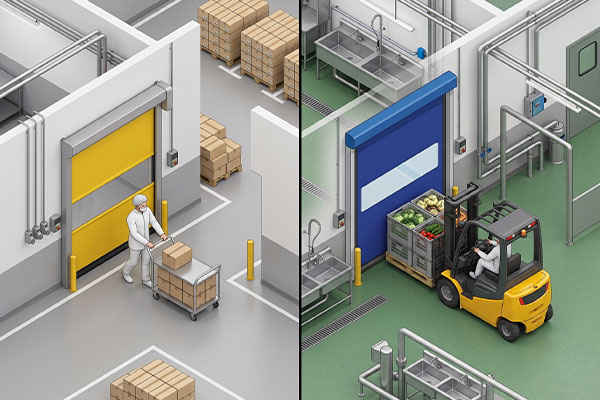
Standard high speed doors are widely used in food processing plants to improve traffic efficiency and reduce open-door time. Compared with traditional swing doors, sliding doors, or slow industrial doors, they open and close quickly, helping reduce air exchange between different working areas.
In food factories, these doors are commonly installed in general production corridors, raw material areas, warehouse entrances, outer packaging zones, finished goods areas, and internal logistics passages. Their main value is straightforward: they help workers, carts, forklifts, and materials move smoothly while helping control dust, insects, and airflow.
For many areas, standard fast doors are already enough. If the doorway is used in a low-impact area and the hygiene requirement is not extremely strict, a standard solution can offer a good balance between cost and performance.
Typical suitable areas include:
| Food Factory Area | Main Requirement | Suitable Door Choice |
| General warehouse | Fast access and basic separation | Standard fast door |
| Outer packaging area | Smooth logistics flow | Fast roll up doors |
| Finished goods area | Dust and pest control | Standard fast door |
| Internal corridor | Frequent pedestrian and cart traffic | Rapid doors |
| Loading transition area | Shorter open-door time | Standard fast door |
However, standard fast doors have limitations. If forklifts frequently hit the curtain, or if the doorway needs stronger sealing, a basic fast-operating door may create more maintenance work over time.
What Are Zipper High Speed Doors?
Zipper high speed doors use a zipper-style side track system. The curtain is guided inside the track more securely, which helps improve sealing performance compared with many standard roll-up structures.
The biggest difference is impact recovery. When the curtain is pushed out of the side track by a minor impact from a forklift, cart, pallet, or trolley, the door can often return into the track during the next opening and closing cycle. This is why they are also called self-repairing high speed doors.
For food factories, this function is very practical. In busy production areas, even trained drivers can accidentally hit a door. If every collision causes the door to stop working, the factory loses time and money. A self-repairing design helps reduce this risk.
Zipper-style doors are especially useful in areas where both traffic and hygiene matter, such as inner packaging rooms, raw and cooked zone separation, cold chain transition areas, and busy forklift passages.
High Speed Doors vs Zipper High Speed Doors: Key Differences
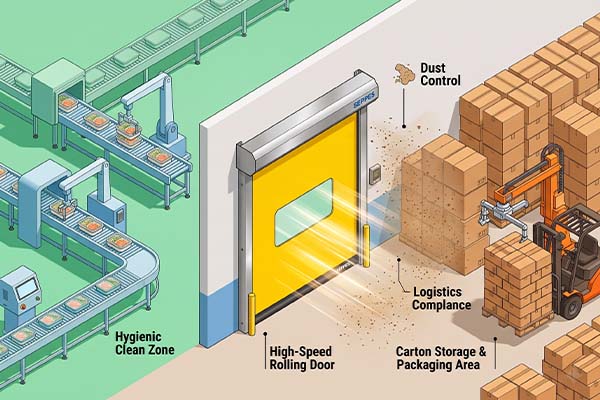
The main difference is not simply speed. In many cases, both door types can open quickly enough for daily production. The real difference is how they perform after impact, how well they seal the opening, and how much maintenance pressure they create in high-frequency areas.
| Comparison Point | Standard High Speed Doors / Fast Roll Up Doors | Zipper High Speed Doors / Self-Repairing Doors |
| Best use | General traffic areas | High-traffic and high-impact areas |
| Impact recovery | May need manual reset after collision | Can recover from certain minor impacts |
| Sealing performance | Suitable for basic dust and pest control | Better for hygiene and air separation |
| Maintenance pressure | Lower initial cost, but more risk after impact | Higher initial cost, but reduced collision downtime |
| Food hygiene control | Suitable for general zones | Better for sensitive or controlled zones |
| Typical traffic | Workers, carts, occasional forklifts | Frequent forklifts, pallets, AGVs, trolleys |
| Best areas | Warehouse, outer packaging, general corridors | Inner packaging, cold buffer zones, forklift lanes |
If the door is used in a simple storage area, a standard fast door may be enough. But if the opening is in a busy production route where a damaged door can interrupt material flow, zipper-style doors usually provide stronger long-term value.
Which Door Is Better for Different Food Processing Areas?
Raw Material Receiving Areas
Raw material receiving areas often face dust, insects, outdoor air, and forklift traffic. If the traffic level is moderate, standard high speed doors can help reduce open-door time and support basic environmental control.
However, if forklifts enter and exit frequently, self-repairing high speed doors may be a better option. In this area, the risk of collision is usually higher because pallets, crates, and forklifts move through the same opening. A door that can recover from certain minor impacts can help keep unloading work moving.
Washing and Wet Processing Areas
Washing areas, wet processing rooms, and cleaning zones often have moisture, water vapor, and frequent sanitation work. In these areas, sealing and material selection become more important than basic opening speed.
Standard rapid doors can separate different work areas, but zipper high speed doors may be more suitable when the factory wants better containment of moisture and airflow. If the doorway connects a wet area with a cleaner or drier zone, better sealing can help reduce water vapor transfer and improve zone management.
Raw and Cooked Food Separation Areas
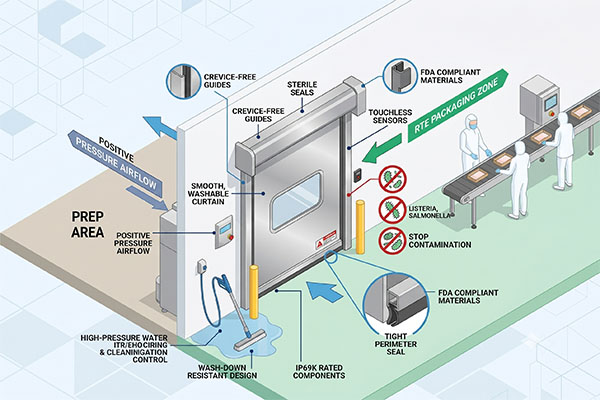
Raw and cooked food separation is one of the most important layout concerns in food processing. The purpose of the door is not only to block traffic; it also supports hygiene zoning and helps reduce unnecessary air exchange between areas.
For basic separation, standard fast doors may work well. But if the area has high traffic, strict hygiene control, or a higher risk of accidental impact, zipper-style doors are usually more reliable. They help keep the opening closed more consistently and reduce the chance of the door being left out of service after a small collision.
Inner Packaging and High Hygiene Zones
Inner packaging areas are sensitive because products may already be close to their final packed state. Dust, pest entry, airflow disturbance, or door failure can affect production management.
In these areas, the best choice depends on traffic intensity. If only workers and light carts pass through, fast roll up doors may be enough. But if forklifts, AGVs, or heavy trolleys frequently move through the doorway, self-repairing doors can reduce maintenance interruptions and help protect the workflow.
Cold Chain Buffer Zones
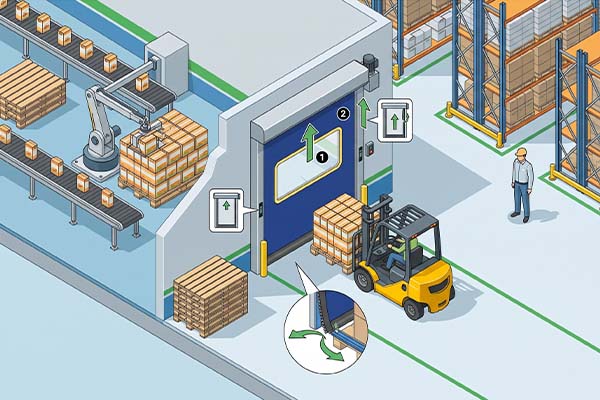
Cold storage entrances and temperature transition areas need fast operation to reduce cold air loss. Standard fast doors can help shorten open time, which is useful for energy control.
But if the opening also has forklift traffic, a zipper structure becomes more valuable. Once a standard door is hit and cannot close properly, cold air loss increases quickly. In this kind of zone, the ability to recover from minor impact can help reduce both maintenance risk and temperature control problems.
When Should You Choose Standard High Speed Doors?
Standard high speed doors are still a practical choice for many food factory areas. They are suitable when the main goal is to improve access speed, reduce open-door time, and provide basic separation between different zones.
You can choose a standard fast door when:
Forklift impact risk is low.
The area has general hygiene requirements.
The traffic volume is moderate.
Budget control is a priority.
The doorway is used mainly by workers, carts, or light logistics equipment.
The production line will not stop immediately if the door needs maintenance.
For outer packaging zones, finished goods storage, general warehouse entrances, and internal corridors, standard fast roll up doors often provide enough performance without unnecessary investment.
When Should You Choose Self-Repairing Zipper Doors?
Self-repairing high speed doors are more suitable when the door is exposed to frequent movement, impact risk, and stricter area control. They are not necessary for every doorway, but they are valuable where one door failure can create bigger operational problems.
You should consider this option when:
Forklifts or pallet trucks pass through the opening frequently.
The door has been hit or damaged in the past.
Maintenance delays affect production schedules.
The area requires better sealing than a basic roll-up structure.
The door separates hygiene zones, packaging areas, or cold chain spaces.
The factory wants to reduce manual reset and emergency repair work.
For these conditions, zipper high speed doors are not just a more advanced product. They are a risk-control solution for food processing environments.
Common Mistakes When Choosing Doors for Food Factories
Mistake 1: Only Comparing Purchase Price
A cheaper door may look attractive at the beginning, but the real cost includes maintenance, downtime, labor, lost temperature control, and cleaning interruption. A food factory should compare lifecycle cost, not only purchase cost.
Mistake 2: Using the Same Door for Every Area
A raw material entrance, wet cleaning room, cold buffer area, and inner packaging room do not have the same requirements. Using one door type everywhere may save time during purchasing, but it can create performance problems later.
Mistake 3: Ignoring Forklift Collision Risk
Many door problems in food factories come from impact, not normal opening and closing. If the doorway is located on a main forklift route, collision recovery should be part of the selection process.
Mistake 4: Overlooking Hygiene Zoning
Doors between different hygiene zones should support separation, not become weak points. The right door should help control airflow, traffic, and exposure time between different production areas.
Simple Selection Checklist
Before choosing between standard fast doors and zipper-style self-repairing doors, ask these questions:
How many times will the door open each day?
Will forklifts, AGVs, pallet trucks, or heavy carts pass through?
Has this doorway had collision problems before?
Is the area part of raw and cooked separation?
Does the door connect a wet zone, cold room, or packaging area?
Would a door failure stop production or delay logistics?
Is sealing performance more important than initial price?
How quickly can the maintenance team respond if the door fails?
If most answers point to low impact and general hygiene needs, a standard fast door is usually enough. If the answers point to high traffic, frequent impact, or stricter hygiene control, zipper high speed doors are usually the safer choice.
Recommended Door Selection by Food Processing Area
| Food Processing Area | Recommended Door Type | Main Reason |
| Raw material receiving area | Standard fast door or self-repairing door | Dust control, pest control, forklift access |
| General warehouse | Standard fast door | Fast access and basic separation |
| Outer packaging area | Fast roll up doors | Smooth carton, pallet, and logistics flow |
| Washing or wet processing area | Zipper-style door | Better sealing and moisture control |
| Raw and cooked separation | Zipper-style door or rapid doors | Hygiene zoning and traffic control |
| Inner packaging area | Self-repairing door | High traffic and lower downtime risk |
| Cold chain buffer zone | Zipper-style door | Reduced air exchange and impact recovery |
| Main forklift passage | Self-repairing door | Collision recovery and reduced maintenance |
Final Recommendation
There is no single best door for every food processing plant. The right choice depends on the area, the traffic, the hygiene requirement, and the cost of downtime.
For general warehouse areas, outer packaging zones, and basic logistics corridors, standard high speed doors can be a cost-effective solution. They help improve traffic efficiency and reduce the time that openings stay exposed.
For forklift-heavy routes, inner packaging rooms, hygiene separation points, and cold chain transition areas, self-repairing zipper doors offer stronger value. Their ability to recover from certain minor impacts can reduce downtime, maintenance pressure, and workflow disruption.In short, choose the door based on risk. If the area has low impact and standard separation needs, use a standard fast door. If the area has high traffic, frequent collision, better sealing requirements, or high downtime cost, choose a zipper-style self-repairing solution.
FAQ
Are zipper high speed doors better than standard high speed doors?
Not always. Zipper high speed doors are better for high-impact, high-traffic, or higher-sealing areas. Standard fast doors are still suitable for general warehouse, packaging, and logistics zones.
Where should food factories use self-repairing high speed doors?
They are best used in forklift lanes, cold chain buffer areas, inner packaging zones, raw and cooked separation points, and other openings where impact or downtime is a serious concern.
Are fast roll up doors suitable for food processing plants?
Yes. Fast roll up doors are suitable for many general food factory areas, especially where the main goal is faster access, basic dust control, and improved workflow.
What is the main advantage of zipper-style self-repairing doors?
The main advantage is the combination of stronger sealing and impact recovery. This is useful in food processing areas where hygiene, traffic, and maintenance risk all matter.
How do I choose between rapid doors and zipper-style doors?
Choose based on traffic volume, collision risk, hygiene level, temperature control needs, and downtime cost. For simple access control, rapid doors may be enough. For high-risk areas, zipper-style self-repairing doors are usually more reliable.


