
A machine protection door is the absolute physical boundary between high-speed robotic palletizing efficiency and catastrophic workplace injuries in modern food processing plants. Once food products pass through the hygienic processing zones and enter the end-of-line case packing and palletizing areas, the operational logic shifts dramatically. Here, you are no longer dealing with washdown procedures; you are managing 200kg robotic arms rotating at 2m/s, heavy wooden or plastic pallets, and continuous AGV (Automated Guided Vehicle) traffic.
In this critical intersection of man and heavy machinery, traditional safety measures often fail. Relying solely on optical sensors or static fencing can destroy your line’s efficiency or leave fatal safety gaps. Let’s explore the engineering realities of robotic packaging cells and why physical isolation is the only foolproof solution.
Contents
- 1 The End-of-Line Dilemma: Cardboard Dust, Stretch Film, and False Tripping
- 2 5 Critical Engineering Demands for a Machine Protection Door
- 2.1 1. Millisecond-Level Synchronization with Pallet Conveyors
- 2.2 2. Dual-Channel Safety Interlock (Meeting ISO 10218-2)
- 2.3 3. Zero-Footprint Design for Tight Case-Packing Layouts
- 2.4 4. Secondary Dust Containment Between Packaging and Warehouse
- 2.5 5. High-Cycle Endurance (The 1 Million Cycle Threshold)
- 3 Light Curtains vs. Steel Fencing vs. Automated Machine Safety Door
- 4 Specifying the Right Enclosure for Your Food Packing Line
- 5 Conclusion: Securing Your Throughput
- 6 FAQ
The End-of-Line Dilemma: Cardboard Dust, Stretch Film, and False Tripping
The greatest enemy of the food packaging area is not just the physical danger of the robotic gripper, but the operational nightmare of “false tripping.”
When case packers form corrugated boxes, they generate a significant amount of fine cardboard dust. Simultaneously, automated stretch wrappers securing the loaded pallets often leave thin, transparent film tails fluttering in the air. If you rely on optical light curtains to guard your robotic cell, this flying debris and corrugated dust will routinely break the optical beams.
Every time a floating piece of stretch film crosses that invisible barrier, the safety relay triggers an emergency stop (E-stop). For a high-throughput palletizing line, a single false trip means manual intervention, entering the cell to inspect, resetting the safety circuit, and homing the robot. This 10-to-15-minute delay destroys your Overall Equipment Effectiveness (OEE).
This is exactly where Automated Barrier Doors change the game. By introducing a physical, high-strength fabric shield, you completely block debris from triggering optical sensors, allowing the robot to work uninterrupted while guaranteeing 100% human exclusion during operation.
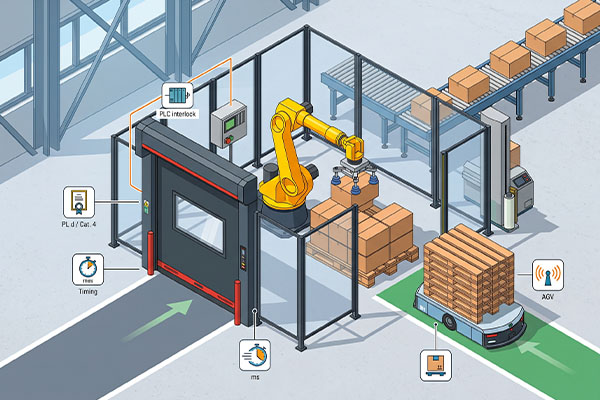
5 Critical Engineering Demands for a Machine Protection Door
Designing the safety perimeter for a robotic palletizer requires strict adherence to international safety directives. Here are the five engineering demands your physical guarding must meet.
1. Millisecond-Level Synchronization with Pallet Conveyors
The speed of your door directly dictates your cycle time. When a pallet is fully loaded, the door must open instantly to let the conveyor roll the pallet out to the AGV pickup station, and close immediately before the robot begins the next cycle. A highly responsive machine protection door for robotic palletizer systems operates at speeds up to 1.8m/s to 2.0m/s. A delay of just 0.5 seconds per cycle can result in dozens of unpalletized loads by the end of a shift.
2. Dual-Channel Safety Interlock (Meeting ISO 10218-2)
Safety cannot be an afterthought; it must be hardwired. According to EN ISO 14120 and ISO 10218-2 standards for industrial robot systems, the door must act as a primary safeguard. High-quality Industrial Safety Doors feature Category 4 / PL d (Performance Level d) safety limit switches. The logic is absolute: if the door is not fully closed and locked, the robotic arm’s power circuit is physically cut. The machine cannot move. Conversely, if the robot has not completely halted, the door’s electromagnetic lock refuses to release.
3. Zero-Footprint Design for Tight Case-Packing Layouts
Floor space in the secondary packaging area is highly expensive. Traditional steel swing gates require a large, semi-circular clearance radius to open, wasting valuable square footage and interfering with forklift routes. A vertical roll-up design consumes zero floor space. The curtain rolls tightly into the top header, accommodating the tightest line layouts without blocking adjacent conveyor lanes.
4. Secondary Dust Containment Between Packaging and Warehouse
In food manufacturing, the palletizing zone often sits right next to the ambient warehouse or shipping docks. When the doors are closed during the robot’s working cycle, the robust PVC curtain acts as a vital secondary environmental barrier. It prevents warehouse dust, forklift exhaust, and seasonal flying insects from drifting backward into your clean case-packing environment.
5. High-Cycle Endurance (The 1 Million Cycle Threshold)
An end-of-line packaging cell is relentless. If a line produces a finished pallet every two minutes, the door will actuate over 700 times a day—exceeding 250,000 cycles annually. Standard warehouse doors will burn out their brake pads and motors within months under this load. An engineered robotic enclosure door utilizes a direct-drive servo motor without traditional wear-prone friction brakes, ensuring millions of maintenance-free cycles.
Light Curtains vs. Steel Fencing vs. Automated Machine Safety Door
To make the best engineering choice, system integrators must evaluate the operational tradeoffs. The table below outlines how different solutions perform in a dusty, high-volume palletizing environment:
| Safety Solution | Safety Level (ISO) | False Trip Rate in Packaging | Cycle Time Impact | Physical Debris Protection |
| Optical Light Curtain | PL c / PL d | High (sensitive to corrugated dust) | Zero | None |
| Static Steel Fencing | PL d | Low | Severe (requires swing clearance) | Good |
| Automated Machine Safety Door | PL d / PL e | Zero | Minimal (millisecond sync) | Excellent |
Specifying the Right Enclosure for Your Food Packing Line
When drafting your Request for Information (RFI) for end-of-line guarding, do not treat these units like standard warehouse roller shutters.
You must ask suppliers specific integration questions. First, verify that their Industrial Safety Doors come standard with non-contact safety switches that integrate directly into your PLC’s dual-channel safety circuit. Second, demand a soft-bottom edge design; in chaotic packaging areas, a rigid metal bottom bar is a crushing hazard for operators’ feet. Finally, ensure the control box features open communication protocols (like Modbus or Profinet) so the door can handshake seamlessly with your AGV fleet dispatch system.
Conclusion: Securing Your Throughput
In the food packaging sector, safety should never be the enemy of efficiency. A well-integrated Automatic Safety Door acts as both a life-saving barrier for your workers and a shield for your line’s cycle times. By eliminating false E-stops caused by stray cardboard and stretch film, you protect your bottom line as fiercely as your personnel.
FAQ
1. Can an Automatic Safety Door integrate directly with our AGV fleet?
Yes. Advanced robotic protection doors come with smart controllers featuring Profinet, EtherCAT, or Modbus communication protocols. This allows the door to receive open/close command signals directly from your AGV traffic management system, ensuring the door is open the exact moment the automated vehicle arrives to pick up a loaded pallet, creating a seamless, zero-wait-time logistics loop.
2. How do Automated Barrier Doors meet ISO standards compared to light curtains?
While light curtains only provide presence sensing (detecting when someone crosses a line), physical barrier doors provide both presence sensing (via interlock switches) AND physical mass containment. They meet the strict requirements of EN ISO 14120 for physical guards and integrate into Cat 4 / PL d or PL e safety circuits, making them legally and practically safer for environments where high-speed robotic impact or flying debris is a risk.
3. What happens if a forklift or AGV accidentally hits the door curtain?
Modern high-speed safety doors designed for robotic cells often feature an “auto-repair” or “breakaway” zipper track system. If an AGV slightly miscalculates its path and bumps the curtain, the flexible PVC fabric effortlessly pops out of the side guides to prevent structural damage. Upon the next opening cycle, the curtain automatically feeds itself back into the tracks, resetting instantly without requiring a maintenance call.


