
An airtight high-speed door is the absolute first line of defense against one of the most destructive and expensive problems in the food processing industry: uncontrolled condensation. When moving perishable goods from strict, low-temperature cooling zones into comparatively warmer packaging areas, the rapid clash of temperature and humidity creates a highly volatile environment. If you rely on standard roll-up doors or unsealed strip curtains in this critical transition area, you are silently bleeding profit through increased energy bills, compromised packaging integrity, and severe food safety risks.
In this comprehensive guide, we will dive deep into the specific thermodynamics of the cooling-to-packaging workflow and reveal exactly why installing an airtight high-speed door is a mandatory upgrade for modern, high-efficiency, and HACCP-compliant food processing facilities. We will strip away the generic features of industrial doors and focus entirely on how a perfectly sealed, rapid-action barrier solves the exact pain points of temperature differentials.
Contents
- 1 The Hidden Danger Between the Cooling Zone and Packaging Area
- 2 How an Airtight High-Speed Door Destroys the Condensation Crisis
- 3 7 Transformative Benefits of an Airtight High-Speed Door in Food Processing
- 3.1 1. Complete Prevention of Packaging Integrity Loss
- 3.2 2. Protection Against Cross-Contamination
- 3.3 3. Drastic Reduction in Defrosting Costs
- 3.4 4. Meeting Uncompromising Food Safety Regulations
- 3.5 5. Seamless Logistics and Workflow Automation
- 3.6 6. Prevention of Floor Icing and Slip Hazards
- 3.7 7. Self-Repairing Technology for Zero Downtime
- 4 Integrating an Airtight High-Speed Door with HACCP Compliance
- 5 Choosing the Right Specifications for Your Packaging Zone
- 6 Conclusion: The Ultimate Investment in Food Quality
The Hidden Danger Between the Cooling Zone and Packaging Area
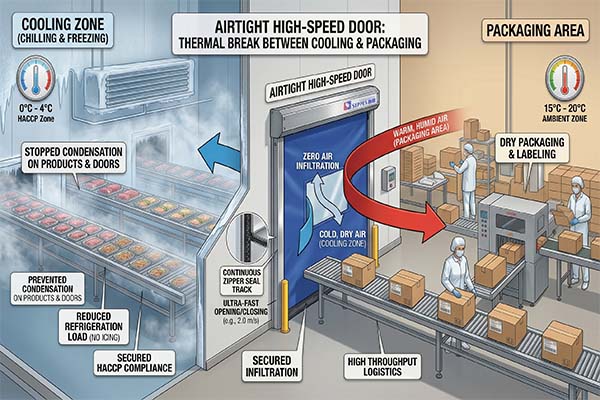
Before understanding the solution, we must analyze the problem. In a typical food processing plant, the cooling zone (or rapid chilling area) is meticulously maintained at temperatures near or below freezing (0°C to 4°C). This ensures that meat, dairy, or processed foods halt bacterial growth. Immediately adjacent is the packaging zone, which is often kept at a more ambient, comfortable temperature for human workers (15°C to 20°C) and contains dry materials like cardboard boxes, plastic films, and adhesive labels.
The enemy here is the “Dew Point.” When the warm, moisture-laden air from the packaging zone infiltrates the cold environment, or when freezing items meet warm air due to a slow-moving doorway, moisture instantly condenses into water droplets.
This condensation leads to:
Soggy Packaging: Cardboard loses its structural integrity.
Label Failure: Adhesives cannot stick to wet surfaces.
Seal Breaches: Vacuum seals fail when moisture interferes with the heat-sealing process.
Microbial Blooming: Water droplets on food surfaces create breeding grounds for pathogens like Listeria and Salmonella.
To combat this, the physical barrier between these two rooms must possess zero-leakage properties. This is precisely where an airtight high-speed door becomes your most vital piece of operational equipment.
How an Airtight High-Speed Door Destroys the Condensation Crisis
You might wonder why a standard high-speed door isn’t enough. The answer lies in the engineering of the seal. An airtight high-speed door is specifically engineered with full-perimeter sealing mechanisms—typically utilizing specialized zipper-track technology and weighted, flexible bottom edges that contour perfectly to uneven floors.
1. Eliminating Thermal Bridging and Air Infiltration
The core function of an airtight high-speed door is to stop air infiltration dead in its tracks. Standard doors leave micro-gaps within the side tracks or underneath the bottom edge. In a facility with high pressure-differentials (which is common when high-powered refrigeration evaporators are running), these tiny gaps act like vacuums, forcefully sucking warm, humid packaging air into the cooling zone.
By utilizing an airtight high-speed door, the curtain is physically locked into the side guides via a continuous zipper system. This creates a near-perfect seal that reduces CFM (Cubic Feet per Minute) leakage to virtually zero when the door is closed, ensuring complete thermal separation.
2. Rapid Cycle Times Minimize Exposure
Even with a perfect seal, a door must open to let forklifts and conveyors pass. The longer the door is open, the more cold air escapes and warm air intrudes. A specialized airtight high-speed door operates at blistering speeds—often exceeding 2.0 meters per second. This rapid cycle means the two environments are exposed to each other for mere seconds. The rapid action of an airtight high-speed door physically cuts off the airflow before convection currents even have time to establish themselves, drastically limiting the opportunity for condensation to form on your newly chilled food products.
7 Transformative Benefits of an Airtight High-Speed Door in Food Processing
When you upgrade your transition zones with an airtight high-speed door, you are not just buying a door; you are investing in an advanced climate control tool. Here are the specific ways this technology protects your bottom line in the cooling-to-packaging workflow.
1. Complete Prevention of Packaging Integrity Loss
As mentioned, an airtight high-speed door stops the humidity transfer that causes condensation. By keeping the packaging zone dry and the cooling zone cold, cardboard boxes remain rigid, allowing for higher pallet stacking without the risk of collapse. Furthermore, tracking labels and barcodes adhere perfectly to dry product surfaces, eliminating costly supply chain scanning errors.
2. Protection Against Cross-Contamination
Packaging zones are inherently dustier due to cardboard fibers and higher foot traffic. Cooling zones must remain highly sterile. An airtight high-speed door for food processing acts as an impenetrable quarantine barrier. When closed, its tight seal prevents airborne particulate matter, dust, and microscopic debris from drifting from the busy packaging area into the vulnerable, exposed food within the cooling zone.
3. Drastic Reduction in Defrosting Costs
When humid air enters a cooling zone, the moisture doesn’t just settle on the food; it is violently sucked into the refrigeration unit’s evaporators, freezing instantly onto the coils. This ice buildup forces the refrigeration system to work twice as hard and requires frequent, energy-heavy defrost cycles. An airtight high speed roll up door prevents this moisture from ever entering the room, keeping your evaporator coils clean, reducing compressor wear and tear, and slashing your energy bills.
4. Meeting Uncompromising Food Safety Regulations
Auditors from the FDA and USDA scrutinize the transition areas between raw/cooling zones and finished packaging zones. Utilizing food grade airtight high-speed doors demonstrates a proactive approach to hazard control. Because these doors feature smooth, crevice-free PVC curtains and stainless steel frames, they not only stop contamination but are also incredibly easy to wash down and sanitize, aligning perfectly with strict regulatory demands.
5. Seamless Logistics and Workflow Automation
In the high-stakes environment of food manufacturing, delays mean degradation. A reliable airtight high-speed door is integrated with advanced radar or magnetic loop sensors. Forklifts moving pallets of chilled meat or dairy into the packaging zone do not need to slow down. The door anticipates the movement, opens instantly, and seals shut the moment the vehicle clears the threshold, ensuring zero bottlenecking in your daily throughput.
6. Prevention of Floor Icing and Slip Hazards
One overlooked danger of air leakage from packaging to cooling zones is floor icing. When moisture enters the sub-zero cooling zone, it settles on the concrete floors near the doorway and freezes, creating lethal slip hazards for forklift operators and walking personnel. The impenetrable seal of an airtight high-speed door keeps the moisture out, ensuring the floors remain dry and your workforce remains safe.
7. Self-Repairing Technology for Zero Downtime
In a busy packaging-to-cooling transition route, forklift collisions are inevitable. Standard hard doors get dented, requiring hours of maintenance while the doorway remains wide open—destroying your temperature control. A modern airtight high-speed door features a flexible curtain that breaks away from its tracks upon impact and automatically re-inserts itself on the next cycle. This self-repairing function means zero downtime, zero loss of cooling, and absolute continuity in production.
Integrating an Airtight High-Speed Door with HACCP Compliance
For plant managers, every equipment purchase must be justified through the lens of Hazard Analysis and Critical Control Points (HACCP). The space between your cooling and packaging areas is arguably the most critical control point in the facility regarding temperature fluctuation.
HACCP guidelines mandate strict temperature documentation and contamination prevention. Because an airtight high-speed door provides unparalleled environmental control, it acts as a mechanical safeguard for your HACCP protocols. By deploying airtight high-speed doors for cooling zones, you eliminate the human error associated with manually leaving doors open or relying on degraded plastic strip curtains that fail to provide a true barrier.
Furthermore, the materials used in a high-quality airtight rapid door—such as FDA-approved, non-porous PVC fabrics and 304/316 stainless steel side columns—resist mold, mildew, and chemical degradation from harsh daily washdowns. This is not merely a door; it is an active participant in your facility’s hygiene management system.
Choosing the Right Specifications for Your Packaging Zone
When specifying an airtight high-speed door for this exact application, avoid general-purpose industrial doors. You must insist on specific engineered features that cater specifically to the thermodynamics of food production:
Zipper Track Systems: Reject stiff brush seals. Insist on continuous zipper tracks that physically bind the curtain to the frame.
Insulated Curtains (Optional but Recommended): If the temperature differential is extreme (e.g., a deep freeze to a warm ambient room), consider an airtight high-speed door with a multi-layered, insulated PVC curtain to prevent condensation from forming on the surface of the door itself.
Sloped Shrouds: Ensure the motor cover and top roll have a sloped design. In food processing, flat surfaces collect dust and water. A sloped shroud ensures that washdown water and condensation roll off immediately, preventing bacterial nesting.
IP65 Rated Control Boxes: The electrical components of your airtight high-speed door must be fully waterproof to withstand the aggressive chemical cleaning routines typical in both cooling and packaging areas.
Conclusion: The Ultimate Investment in Food Quality
The transition from the cooling zone to the packaging area is the final hurdle in ensuring your food products reach the consumer safely and beautifully presented. Permitting temperature and humidity to violently mix in this zone is a recipe for condensation, spoilage, ruined packaging, and failed audits.
By strategically installing an airtight high-speed door, you instantly resolve these complex thermodynamic challenges. The combination of absolute perimeter sealing, lightning-fast cycle times, and hygienic design ensures that your cold areas stay cold, your dry packaging stays dry, and your operational efficiency remains uninterrupted.Stop losing money to high energy bills and compromised product quality. Evaluate your transition zones today, and secure your production line with the unrivaled performance of a dedicated airtight high-speed door.


