
When managing a meat, poultry, or seafood processing facility, the cold portioning room—often referred to as the cutting or processing zone—presents one of the most demanding environmental challenges in the entire plant. Operating strictly between 8°C and 12°C, this high-traffic area acts as a bustling bridge connecting frigid blast freezers to warmer packaging and dispatch zones. In these critical transition areas, standard commercial doors simply fail to keep up with the rigorous demands.
To maintain strict hygiene, protect your workforce, and pass uncompromising food safety audits, investing in Food-Grade Insulated High-Speed Doors is no longer just an optional upgrade; it is a critical operational necessity.
In this comprehensive guide, we will bypass the generic features of industrial warehouse doors and focus entirely on the specialized environment of meat processing. We will uncover exactly why Food-Grade Insulated High-Speed Doors for meat portioning are the ultimate solution specifically engineered to conquer the unique, daily pain points of low-temperature processing environments, ensuring seamless operations without compromising on safety or efficiency.
Contents
- 1 1. Eradicating the Devastating Condensation Crisis in Meat Cutting Zones
- 2 2. Safeguarding Meat Shelf Life and Yield Security
- 3 3. Creating a Reliable Thermal Barrier to Slash Refrigeration Costs
- 4 4. Protecting Worker Comfort and Reducing Turnover
- 5 5. Blocking Airborne Spores and Odor Cross-Contamination
- 6 6. Eliminating Dangerous Frost Build-Up and Floor Slip Hazards
- 7 7. Streamlining High-Frequency Cold Chain Logistics
- 8 FAQ
1. Eradicating the Devastating Condensation Crisis in Meat Cutting Zones
The absolute biggest threat in any chilled portioning room is the formation of condensation. When warm, humid air from a packaging area or ambient hallway collides with the chilled 8°C air of a meat cutting room through a slow, uninsulated doorway, moisture instantly forms on the door curtain, the frame, and the surrounding ceiling.
Why is this a major disaster for facility managers? Droplets of condensation can easily fall directly onto exposed meat or raw food products passing underneath. Under strict USDA and GFSI regulations, overhead condensation is considered a major critical control point failure. A single drop of moisture can introduce dangerous pathogens, leading to immediate product rejection.
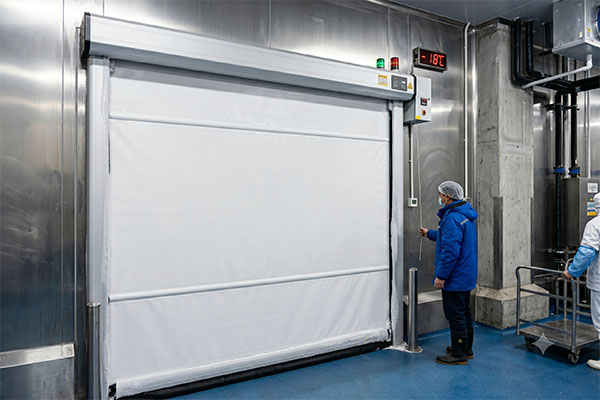
This is where Food-Grade Insulated High-Speed Doors truly excel. Constructed with a highly advanced, multi-layered thermal barrier, the thick curtain of Food-Grade Insulated High-Speed Doors for cold rooms prevents the door’s surface temperature from ever reaching the dew point. By physically separating the contrasting temperature zones with specialized insulated foam, these doors effectively eliminate the formation of water droplets, keeping your facility strictly compliant.
2. Safeguarding Meat Shelf Life and Yield Security
In the highly competitive meat processing industry, every single degree of temperature fluctuation directly impacts your bottom line. If the portioning room temperature spikes even slightly above 12°C because traditional sliding doors are left open by busy forklift drivers, the surface temperature of the raw meat immediately begins to rise.
This dangerous micro-warming accelerates bacterial growth on the meat’s surface, which drastically reduces the final packaged product’s retail shelf life and overall yield. To combat this, you need flawless temperature control.
Food-Grade Insulated High-Speed Doors provide unmatched environmental stability. Operating at exceptional speeds of up to 2.0 meters per second, they ensure the doorway is exposed for only the briefest possible moment. Instantly after the trolley clears the threshold, the Food-Grade Insulated High-Speed Doors automatically seal shut, locking in the chilled air. This rapid action protects your highly valuable raw inventory from thermal spoilage.
3. Creating a Reliable Thermal Barrier to Slash Refrigeration Costs
In a bustling cold processing room, forklifts, motorized meat trolleys, and line personnel pass through doorways hundreds of times during a single shift. If you rely on a fast-moving but uninsulated PVC door, you are constantly bleeding massive amounts of refrigerated air into ambient zones.
This constant thermal loss forces your facility’s chilling compressors and HVAC systems to run at maximum capacity all day long. The result? Skyrocketing daily refrigeration costs.
By utilizing energy-efficient Food-Grade Insulated High-Speed Doors, facility managers successfully combine the best of both worlds: robust insulation and rapid mobility. The dynamic thermal barrier blocks conductive heat transfer when the door is closed, while the extreme speed prevents convective heat loss during operation. This drastically reduces the thermal exchange between rooms, heavily cutting down monthly energy overhead.
4. Protecting Worker Comfort and Reducing Turnover
While plant managers focus intensely on food safety and product yield, the human element within a cold portioning room is equally vital to productivity. Workers stationed at cutting tables in chilled environments for long 8-hour shifts are highly susceptible to fatigue and muscle stiffness. This is severely exacerbated if they are continuously subjected to freezing drafts.
Food-Grade Insulated High-Speed Doors are specifically engineered with tight perimeter sealing and heavy-duty side guides that completely block harsh cold air drafts. By maintaining a highly stable, draft-free environment, Food-Grade Insulated High-Speed Doors significantly improve daily operator comfort. Workers who feel comfortable execute more precise cuts and contribute to lower employee turnover rates.
5. Blocking Airborne Spores and Odor Cross-Contamination
Modern food safety auditing heavily scrutinizes material transfer routes and airborne particulate flow. The physical action of a heavy rigid door opening and closing slowly can pull dust, airborne microbes, and strong odors from one processing zone into another.
Because they act as highly reliable HACCP compliant Food-Grade Insulated High-Speed Doors, these systems utilize advanced sealing technology along the entire track frame. When airtight Food-Grade Insulated High-Speed Doors drop into the closed position, they form a near-impenetrable barrier. This airtight seal stops the migration of airborne pathogens and strongly isolates odors, allowing facilities to maintain crucial air pressure differentials within their sterile cutting zones.
6. Eliminating Dangerous Frost Build-Up and Floor Slip Hazards
Very often, a busy meat portioning room connects directly to a deep storage room operating at a punishing -20°C. If the physical partition separating these two extreme zones is inadequate, the relatively humid 8°C air from the portioning room will violently rush into the freezer upon opening, creating highly dangerous black ice on the floor.
Standard doors will quickly jam with frost, halting production entirely. Furthermore, icy floors create massive slip-and-fall liabilities for workers.
Advanced partitions must handle this extreme environmental differential effortlessly. Food-Grade Insulated High-Speed Doors for cold rooms mitigate this exact hazard by trapping the moisture on the warmer side. By utilizing superior thermal breaks within their frame construction, these Food-Grade Insulated High-Speed Doors guarantee that your workers remain safe from slips and your forklifts maintain perfect traction.
7. Streamlining High-Frequency Cold Chain Logistics
In modern industrial food processing, speed directly translates to profit. Any delays in moving raw materials into the cutting zone severely bottleneck your daily yield.
Heavy, traditional sliding cold storage doors can take anywhere from 10 to 15 seconds to fully open. Over a busy shift, that translates to hours of completely lost productivity.
Food-Grade Insulated High-Speed Doors eliminate this frustrating bottleneck entirely. By seamlessly integrating with advanced radar sensors or magnetic floor loops, Food-Grade Insulated High-Speed Doors open precisely as the pallet approaches and close instantly behind it. This ensures a fluid, uninterrupted, and highly efficient material flow.
Feature Comparison in the Portioning Scenario
To clearly understand why Food-Grade Insulated High-Speed Doors absolutely dominate this specific scenario, let’s look at an objective comparison:
| Critical Challenge | Standard PVC High-Speed Door | Traditional Rigid Door | Food-Grade Insulated High-Speed Doors |
| Condensation Prevention | Fails (Heavy surface dripping) | Excellent | Excellent (Zero dripping via thermal barrier) |
| High-Traffic Logistics | Excellent (Fast opening) | Fails (Too slow) | Excellent (Up to 2.0m/s operation) |
| Airborne Contamination Seal | Fair | Good | Exceptional (Airtight perimeter sealing) |
| Energy Savings in High Use | Poor (No thermal insulation) | Poor (Stays open too long) | Exceptional (Seals instantly with insulation) |
Conclusion: Securing Your Food Processing Workflow and Profitability
Outfitting a low-temperature meat portioning room requires a highly specific engineering approach. Facility managers cannot afford the daily risks of overhead condensation contaminating the product line, or massive thermal loss inflating energy bills.
By proactively replacing outdated partitions with Food-Grade Insulated High-Speed Doors, you directly tackle the most expensive and dangerous operational pain points. From stopping massive thermal loss to passing rigorous food safety audits, Food-Grade Insulated High-Speed Doors act as the ultimate, reliable safeguard for your product quality and your company’s bottom line.
FAQ
How do these doors physically prevent condensation in cold portioning?
They utilize a specialized multi-layered curtain design. The thick insulation layer inside Food-Grade Insulated High-Speed Doors completely stops the warmer ambient air on one side from transferring its heat to the cold surface on the opposite side, preventing water droplets from forming.
Do Food-Grade Insulated High-Speed Doors help maintain specific air pressure?
Absolutely. By employing tight track seals and rapidly closing after traffic passes, airtight Food-Grade Insulated High-Speed Doors help HVAC systems maintain positive or negative air pressure differentials. This is a critical requirement for keeping airborne contaminants out of hygienic cutting zones.


