
A roller shutter OEM order needs more than an opening size and a logo file. Before production, the buyer and manufacturer need to agree on the door configuration, approved drawings, branding scope and records that will accompany each batch. Those decisions give production and receiving teams the same specification to work from.
This guide follows OEM purchasing for commercial and industrial aluminum roller shutter doors. It is for distributors, contractors and buyers arranging a defined supply package with a manufacturer. Use it to turn an inquiry into an order that both sides can check, without assuming that every factory offers the same customization services.
Contents
- 1 Define the roller shutter OEM scope first
- 2 Prepare a requirement sheet that can be quoted
- 3 Match manufacturer capability to the requested work
- 4 Approve the drawings and configuration together
- 5 Confirm private-label details separately
- 6 Agree inspection evidence and batch identification
- 7 Hand over an order record the next team can use
- 8 Discuss your OEM requirements with SEPPES
Define the roller shutter OEM scope first
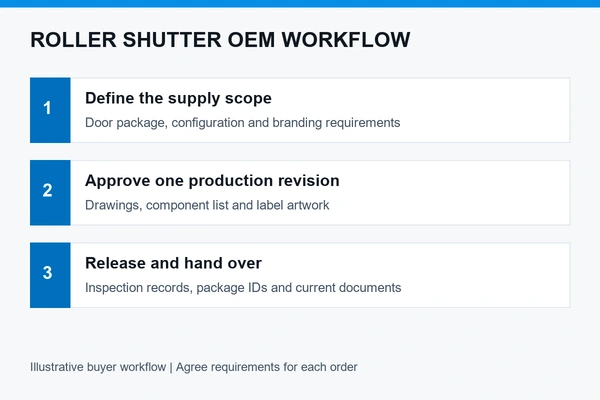
OEM means original equipment manufacturer, but the term alone does not define what you are buying. In a roller shutter OEM inquiry, separate a complete door package from components, assembly kits and private-label requirements. State whether the request concerns an existing configuration, a modified design or development that needs a separate feasibility review.
For custom roll up doors, size is only one part of the scope. For aluminum roller shutter doors, identify the intended application and required curtain construction before discussing labels or packaging. Mark each requested option as required, preferred or open for the manufacturer to recommend. This prevents an optional feature from becoming an assumed inclusion.
For roller shutter OEM work, ask the supplier to confirm which tasks it performs and which depend on another party. Examples include drawing preparation, profile sourcing, surface finishing, operator supply and printed packaging. Record the responsible company or team for each task. A catalogue statement about customization is not an agreed order scope.
Prepare a requirement sheet that can be quoted
Give each opening a door reference and keep it throughout the order. Include opening width and height, available headroom and sideroom, mounting position, supporting structure, intended use and quantity. For motorized doors, provide the site voltage, phase, frequency and required controls. Identify who will verify site measurements and installation conditions.
Record the curtain profile, finish reference, guide arrangement, bottom bar, hood if required, operator and agreed safety equipment. Let the manufacturer assess suitability for the selected dimensions and application. Do not treat a component choice or a product-family name as proof of the finished door’s performance.
The requirement sheet for roller shutter OEM orders should also distinguish the initial quantity from an estimated future demand. Ask whether special finishes, packaging or tooling have separate minimum quantities and charges. Confirm production timing against the actual configuration and approval milestones; a forecast does not establish a guaranteed repeat-order schedule.
Match manufacturer capability to the requested work
Ask for evidence that answers the specific customization request. If you need a changed guide or hood, ask how the drawing will be reviewed. If you need a different operator, ask who checks compatibility with the curtain, controls and operating duty. If the requirement cannot be met, request a clearly identified alternative before comparing price.
For a roller shutter OEM project, useful evidence includes an agreed drawing deliverable, a configuration list with component references and an inspection plan linked to the order. Request relevant product documentation where the project requires it. General factory photographs and company certificates do not establish that a particular configuration meets your requirements.
Our manufacturer selection guide covers the broader supplier evaluation. At this stage, concentrate on the unresolved requirements in your own order. Assign an owner and a due date to each open item so it cannot disappear between quotation and production.
Approve the drawings and configuration together
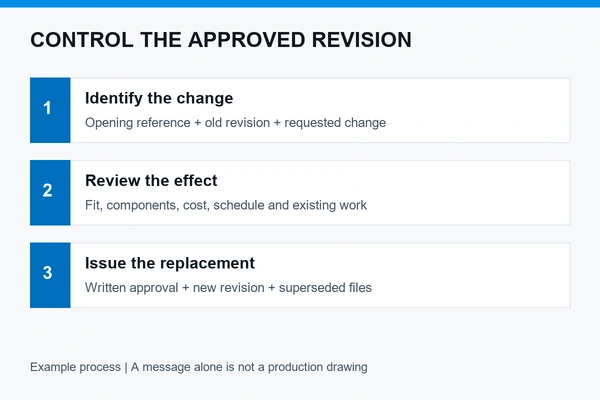
Use one identified revision for the roller shutter drawings and the configuration list. Check the door reference, opening and overall dimensions, clear passage, guide positions, mounting details and motor side. Define the viewing direction on the drawing so that “left” and “right” mean the same thing to the buyer, factory and installer.
In roller shutter OEM production, the bill of materials should agree with the approved configuration. Record the references needed to identify the curtain, guides, drive and controls. The level of detail available depends on the supply agreement, but the buyer still needs an unambiguous description of what the order includes and excludes.
For example, a buyer may request a motor-side change after approving the drawing. The manufacturer should review the affected clearances, brackets, wiring arrangement, price and schedule before issuing a revised document. This is an illustrative change-control example, not a completed SEPPES project. Keep the previous revision for reference and clearly mark which version now governs production.
Agree who can approve roller shutter OEM changes. Record the change, affected door references, revised documents and written acceptance before releasing the affected work. Do not allow an informal message, an old drawing attachment or an unconfirmed component substitution to become the production instruction.
Confirm private-label details separately
Private-label roller shutters require a separate review of artwork and identification. Provide the intended logo, colour reference, position, size and document language, then ask which items the supplier can provide. Distinguish the door label from the operator label, outer packaging and installation documents. Approval of one does not approve the others.
Treat branding as a controlled part of the roller shutter OEM order. Request a proof that shows the actual wording and layout, and keep its revision with the approved documents. Have the responsible parties verify the required product identification and safety information for the destination. Branding changes should not obscure instructions or identification needed for the supplied system.
Confirm ownership and permitted use of buyer-supplied artwork, along with any tooling or document deliverables, in the order arrangements. This article does not assume that SEPPES offers every private-label option. Ask for written confirmation of feasibility, scope, charges and responsibilities for your request.
Agree inspection evidence and batch identification
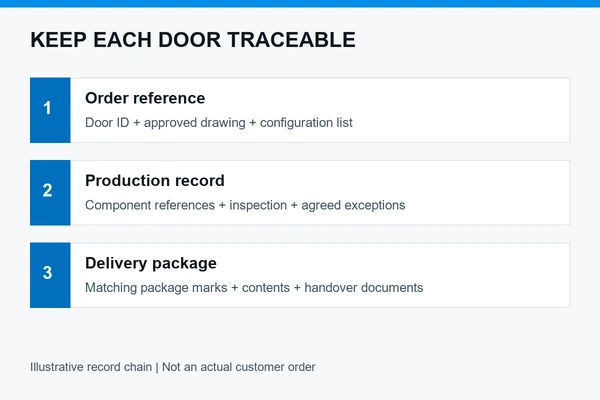
Before releasing roller shutter OEM production, agree what will be checked and what evidence the buyer will receive. Tie the inspection list to the approved door references and configuration. Relevant checks may cover dimensions, component identification, finish, labelling, package contents and agreed operating tests. Define how discrepancies will be recorded and closed.
Keep batch traceability practical. A door reference should connect the approved drawing to the finished assembly, inspection record and package marks. If one door occupies several packages, identify those packages together. If accessories serve several doors, make that allocation clear on the packing list.
For repeat roller shutter OEM orders, confirm the revision again instead of copying the previous purchase order without review. Ask whether components, finishes or documents have changed since the last batch. Record any agreed substitution before production. An earlier order is a useful reference, but it does not replace approval of the current supply.
Hand over an order record the next team can use
The final roller shutter OEM handover should connect the order confirmation, current drawings, agreed component references, inspection records, package list and applicable installation and operating documents. Identify unresolved items and the person responsible for closing them. Keep the receiving team’s copy consistent with the documents used to release the goods.
Assign who will receive the shipment, reconcile package contents and pass the current documents to the installer. Installation and commissioning remain separate tasks for appropriately qualified personnel following the supplied instructions. For the wider transport and receiving process, see our roller shutter imports workflow.
Discuss your OEM requirements with SEPPES
Send SEPPES your application, opening schedule, destination, quantity and proposed branding or configuration changes. Include current drawings where available and identify the points that still need technical review. Use the form below or contact the team about your roller shutter OEM requirements. Confirm the available configuration, customization scope and order deliverables before approving production.


