
Commercial roller shutter doors can look similar in a quotation and still differ in the space they need, how often they can run, and what arrives on site. A price comparison only becomes useful when each supplier is quoting against the same requirements.
Before buying, confirm the clear opening, installation space, curtain construction, operating duty, electrical supply, controls, safety arrangements and delivery scope. For a contractor, distributor or facility buyer, the practical goal is a specification sheet that the supplier and installer can both check before manufacture.
This guide covers metal commercial roller shutters for shops, service entrances and industrial buildings. Use it alongside the roller shutter door range to narrow the configuration, then ask for a drawing and a written list of inclusions for the selected model.
Contents
- 1 Commercial roller shutter doors: a specification checklist
- 2 Confirm the usable opening and installation space
- 3 Define the curtain material and construction
- 4 Match operating duty to the busiest period
- 5 Check the motor, power supply and controls together
- 6 Specify safety behavior, not just a sensor name
- 7 Translate site exposure into a documented requirement
- 8 Compare the complete supply and installation scope
- 9 Approve one configuration before manufacture
- 10 Questions buyers ask before ordering
- 11 Prepare your specification for review
Commercial roller shutter doors: a specification checklist
Separate site information from supplier confirmation. You provide the building and operating conditions; the supplier identifies the proposed assembly and its limits. The following commercial roller shutter specifications give both sides a common starting point.
| Parameter | What to confirm before ordering |
|---|---|
| Opening and quantity | Clear width and height, finished floor level, door location and quantity for each size. |
| Installation envelope | Headroom, space beside both jambs, mounting face, motor position and maintenance access. |
| Curtain and guides | Material, profile construction, defined thickness, finish, guide arrangement and bottom seal. |
| Operating duty | Open-close cycles per day, busiest period, required opening time and operator duty rating. |
| Power and controls | Voltage, phase, frequency, supply point, control method and interface requirements. |
| Safety and emergency use | Protective devices, response to an obstruction, fault behavior and approved power-failure operation. |
| Exposure and performance | Indoor/outdoor location, wind requirement, temperature, moisture and any documented special requirement. |
| Supply and handover | Included parts, installation responsibilities, drawings, packing, spare parts and acceptance records. |
Confirm the usable opening and installation space
Record the clear width and height that must remain available when the door is fully open. State whether your measurements describe the structural opening, finished opening or required passage. These dimensions are different from the overall shutter assembly size.
Measure width and height at several points and record differences, floor slopes and obstructions. Identify each opening on a drawing or photo. For multiple commercial roller shutter doors, a door schedule prevents a dimension or motor position from being assigned to the wrong entrance.
Next, measure the available headroom and space beside each jamb. Include the winding assembly, hood, guides, brackets and motor in the installation review. Pipes, cable trays, beams and suspended ceilings can obstruct a door even when its nominal width and height fit.
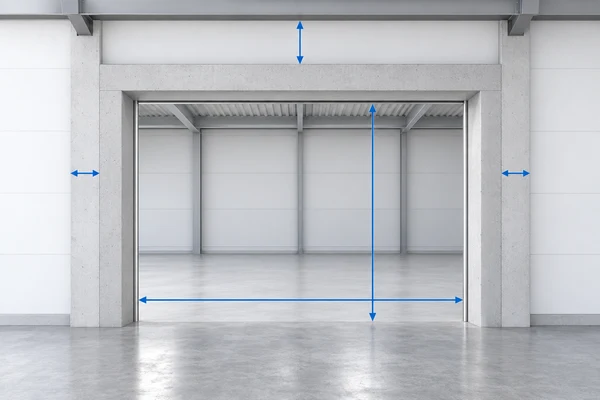
Ask the supplier to mark the finished clear opening and overall installation envelope on the same drawing. Confirm which side the motor occupies, viewed from a stated direction. Allow access for adjustment, inspection and later component replacement.
The installer or responsible building professional should also confirm the supporting structure and fixing arrangement. Wall cladding alone does not establish that the opening can carry the door loads. Record who supplies any additional steelwork, anchors or building preparation.
Define the curtain material and construction
When comparing commercial roller shutter doors, a material name is only the first detail. Ask for the slat profile, construction, thickness definition and finish. A profile’s overall depth is not the same measurement as its metal wall thickness.
If you are considering aluminum roller shutter door options, confirm the exact profile and whether the proposed curtain is single-wall, double-wall or filled. Ask the same construction questions for a steel proposal. Do not assume that a material choice automatically includes insulation, a particular wind rating or a tested security classification.
Specify the required color and finish reference, along with exposure to moisture, salt or cleaning chemicals. Have the supplier confirm the suitability of the proposed curtain, guides and exposed hardware for those conditions. A finish sample can resolve a color question before the whole order is produced.
For commercial roller doors used at public-facing entrances, also review appearance from both sides, visible fixings and the bottom seal. If ventilation or visibility is needed, ask whether a suitable configuration is available and how it affects other requirements.
Match operating duty to the busiest period
An entrance opened at the start and end of a shift has different demands from one cycling repeatedly during deliveries. Give the supplier the expected number of complete open-close cycles per day and the maximum number during the busiest hour. Explain any sequence of repeated movements with little rest.
Confirm the proposed door assembly’s cycle rating separately from the motor’s duty limits. A lifetime cycle figure does not tell you how many consecutive operations the operator can perform. Ask for the permitted operating pattern and any required rest period for the selected equipment.
If access time matters, request the expected opening time at your actual opening height. Include control delays in the discussion. Commercial roller shutter doors selected mainly for overnight closure should not be assumed suitable for a busy traffic route without a duty review.
Check the motor, power supply and controls together
For electric roller shutter doors, provide voltage, phase and frequency as separate entries. A country name or the phrase “standard power” leaves room for an incompatible selection. Confirm the supply location and who provides the electrical connection and isolation.
Ask the supplier to select the motor for the complete door, including curtain weight, opening size, mechanical arrangement and operating duty. Motor power alone is an incomplete comparison. Record the operator model, mounting position and the documented limits that apply to the proposed assembly.
Describe how users will operate the entrance: a wall station, key switch, remote control, access-control signal or another agreed method. State whether closing requires a held button or occurs automatically. If an interface is needed, have the supplier and system integrator confirm the signals and responsibilities before ordering.
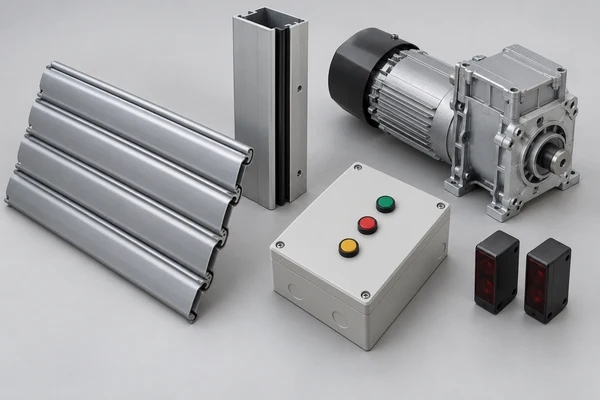
Specify what should happen during a power failure and how authorized staff will operate the door safely. A manual chain, release arrangement or backup supply must be appropriate to the actual model and location. Do not assume an option shown in a product image is included in the quotation.
Specify safety behavior, not just a sensor name
A list that says “sensor included” does not explain which hazard the device addresses or how the door responds. For powered commercial roller shutter doors, describe who uses the entrance, whether the public can approach it and how pedestrians and vehicles move nearby.
Ask the supplier and installer to document the protective arrangement, detection coverage and response to an obstruction or device fault. Confirm any safety edge, photoelectric device, guarding, emergency stop or other protective measure selected for the installation. A remote control is an operating device, not evidence that the closing area is protected.
The UK Health and Safety Executive explains that powered-door safety depends on how components work together in the intended environment. Use that principle when comparing proposals, while having the responsible project team establish the requirements for the destination market.
Include commissioning checks and operator instruction in the handover scope. Identify who will verify the installed system and provide its operating and maintenance instructions. Keep emergency escape and fire-separation requirements as separate design questions for the responsible professionals.
Translate site exposure into a documented requirement
Commercial roller shutter doors on an external opening need an exposure review. Provide the site location, orientation, opening dimensions and any project wind-load requirement. Ask what the quoted performance covers and which assembly, size and fixing arrangement it applies to.
Resistance while closed and permission to operate under wind are separate questions. Cornell’s technical FAQ discusses operational wind loads and the supporting building structure. Request the applicable evidence and operating limits for your selected door; another manufacturer’s rating is not a SEPPES specification.
For temperature-controlled areas, identify the temperature difference and the required thermal performance. Check whether a quoted value describes an individual slat or the complete installed door. Include perimeter seals and the frequency of opening in the review.
If the project requires tested fire, smoke, acoustic or security performance, put the exact requirement into the inquiry. Ask whether an appropriate documented product is available. An ordinary metal shutter, or an insulated curtain, does not establish a fire rating.
Compare the complete supply and installation scope
The lowest quote for commercial roller shutter doors may cover a different package. Compare the curtain, guides, barrel assembly, brackets, hood, motor, controls, protective devices and seals line by line. Mark each item as included, optional or supplied by others.
Confirm who handles unloading, lifting equipment, structural supports, electrical work, installation and commissioning. For an export order, agree the delivery term and named place, packing details and any destination-side responsibilities. Do not read a general offer of technical support as a promise of local installation.
Request the documents your project needs before committing: approved drawings, the final configuration schedule, operating instructions, maintenance guidance and relevant model-specific evidence. Agree warranty terms, spare-part identification and the process for requesting support in writing.
If you are still collecting information for the first inquiry, the roller shutter quotation requirements guide covers the initial RFQ package. Before placing the order, use the checklist here to close the remaining technical and supply questions.
Approve one configuration before manufacture
Keep the drawing, quotation and configuration schedule under the same revision reference. For each of your commercial roller shutter doors, check that the opening ID, dimensions, material, motor side, power supply and controls agree across those documents.
For example, if the motor side changes after the quotation, check the installation clearance, cable route and maintenance access again. A marked-up drawing should lead to an updated confirmation, rather than an informal assumption that everyone has seen the change.
Record unresolved items with an owner and a due date. Agree which changes affect price or delivery before releasing the order. At handover, compare the supplied equipment and commissioning records against the approved configuration.
Questions buyers ask before ordering
Which dimensions do I need for commercial roller shutter doors?
Provide clear width and height, finished floor level, headroom, space beside both jambs and the proposed mounting face. Ask the supplier to confirm the final clear passage and overall installation envelope on the selected door drawing.
Is a larger motor always a better choice?
No. The motor must suit the door assembly, power supply, operating duty and controls. Ask for the manufacturer’s selection and duty limits instead of choosing by wattage alone.
Are safety sensors included as standard?
That depends on the quoted model and configuration. Require a written device list and the intended safety behavior, then have the installer verify the completed system for its location and use.
Can one specification cover every opening in a building?
You can use one schedule format, but commercial roller shutter doors at different openings may need different dimensions, motor positions, operating duties or exposure provisions. Give each entrance its own identifier and confirmed configuration.
What should I send SEPPES for a configuration discussion?
Send the opening dimensions and quantity, application, destination, available power and expected daily use. State any required performance or documents, and mention whether site photos or drawings are available.
Prepare your specification for review
Bring the site details and open questions together before selecting commercial roller shutter doors. SEPPES can discuss the proposed configuration and document requirements for your project; the quotation should identify the agreed supply and support scope. Discuss your commercial roller shutter door requirements with your dimensions, quantity and intended use.


