
Choosing an aluminum roller shutter involves much more than selecting a door that fits the opening. For a commercial or industrial project, buyers also need to consider the application, door dimensions, curtain design, operating frequency, control method, safety devices, installation conditions and local environment.
Two doors with similar opening sizes may require very different configurations if one is installed at a retail storefront and the other at a warehouse exposed to wind and frequent vehicle traffic.
That is why a good purchasing decision should begin with the project requirements—not simply with a door model or price.
This buying guide explains the main factors to evaluate before ordering aluminum roll up doors for commercial and industrial applications. It will also help you prepare the information a manufacturer needs to recommend a suitable configuration and provide an accurate quotation.
Contents
- 1 1. Is an Aluminum Roller Shutter the Right Choice for Your Project?
- 2 2. How to Choose the Right Aluminum Roller Shutter for Your Application
- 3 3. Measure the Opening and Check the Installation Space
- 4 4. Choose the Right Aluminum Slat and Curtain Design
- 5 5. Manual or Motorized Operation: Which Should You Choose?
- 6 6. Check Safety and Security Features
- 7 7. Consider Wind, Weather and the Installation Environment
- 8 8. Confirm the Power Supply and Control Requirements
- 9 9. Understand What Affects Aluminum Roll Up Door Prices
- 10 10. Evaluate the Manufacturer, Not Just the Door
- 10.1 Can the manufacturer work from project dimensions?
- 10.2 Can they provide technical drawings?
- 10.3 Are specifications clearly documented?
- 10.4 Can they explain the safety configuration?
- 10.5 Can relevant certificates or test information be provided?
- 10.6 How is the door checked before shipment?
- 10.7 How is the product packaged for export?
- 10.8 What installation support is available?
- 11 11. Information to Send Before Requesting a Quote
- 12 12. Common Aluminum Roller Shutter Buying Mistakes to Avoid
- 12.1 Mistake 1: Comparing only the purchase price
- 12.2 Mistake 2: Providing only width × height
- 12.3 Mistake 3: Choosing the motor before defining the door
- 12.4 Mistake 4: Ignoring operating frequency
- 12.5 Mistake 5: Forgetting the local voltage
- 12.6 Mistake 6: Treating every aluminum shutter as the same product
- 12.7 Mistake 7: Leaving installation planning until the door arrives
- 13 13. Aluminum Roller Shutter Buying Checklist
- 14 Frequently Asked Questions About Aluminum Roller Shutter Doors
- 14.1 How much does an aluminum roller shutter door cost?
- 14.2 What sizes are available for aluminum roll up doors?
- 14.3 How do I measure for a roll up door?
- 14.4 How much installation space does a roller shutter require?
- 14.5 Should I choose a manual or motorized aluminum roller shutter?
- 14.6 Are aluminum roller shutters suitable for commercial buildings?
- 14.7 Are aluminum roller shutters secure?
- 14.8 Are aluminum shutters suitable for outdoor use?
- 14.9 What information should I provide to get a quotation?
- 15 Final Thoughts: Buy Based on the Project, Not Just the Product Name
1. Is an Aluminum Roller Shutter the Right Choice for Your Project?
An aluminum roller shutter uses interlocking aluminum slats that travel vertically through guide rails and coil around a barrel above the opening. This compact operating method allows the door to use very little floor space compared with many swinging or horizontally moving door systems.
For this reason, aluminum roller shutters are commonly considered for commercial entrances and other openings where space efficiency, appearance, corrosion resistance and convenient operation are important.
Typical applications may include:
- Retail storefronts
- Shopping malls
- Commercial entrances
- Warehouses
- Workshops
- Service counters
- Industrial facilities
- Building access points
- Internal partitions
- Selected loading or service openings
However, aluminum is not automatically the best material for every opening.
For projects where very high impact resistance, specialized fire performance, unusually large openings or demanding structural requirements are the main priority, other door constructions may need to be evaluated as well.
The correct question is therefore not:
“Is aluminum better than steel?”
It is:
“Which door construction best meets the requirements of this specific opening?”
Before selecting an aluminum roll up door, define what the door actually needs to accomplish.
2. How to Choose the Right Aluminum Roller Shutter for Your Application
One of the most common purchasing mistakes is beginning with technical specifications before defining the application.
The intended use of the door influences almost every major configuration decision.
A shop roll up door, for example, may place greater emphasis on appearance, security and convenient daily operation. An industrial opening may place greater emphasis on operating frequency, environmental exposure and integration with the building’s workflow.
A useful starting point is to identify the primary requirement for each application.
| Application | Main Requirement | Key Factors to Consider |
|---|---|---|
| Retail storefront | Security and appearance | Slat design, finish, control method, locking |
| Shopping mall | Appearance and compact installation | Headroom, finish, motorized control |
| Warehouse | Reliable daily operation | Opening size, motor, safety devices |
| Commercial entrance | Security and convenience | Access control, automation, safety |
| Workshop | Durability and practical operation | Usage frequency, environment, controls |
| Industrial facility | Reliable operation under project conditions | Size, cycles, safety, structural conditions |
This is why the term commercial roll up doors covers many different configurations. A door suitable for a small retail opening should not automatically be specified for an industrial facility simply because both openings have similar dimensions.
Before contacting a supplier, answer these questions:
- Where will the door be installed?
- Is the opening indoors or outdoors?
- Who or what passes through it?
- How many times will the door typically operate each day?
- Is appearance important?
- Is security the main priority?
- Will the door be exposed to wind, rain, dust or humidity?
- Does it need to integrate with access control or other building systems?
These answers provide a much stronger basis for product selection than size alone.
3. Measure the Opening and Check the Installation Space
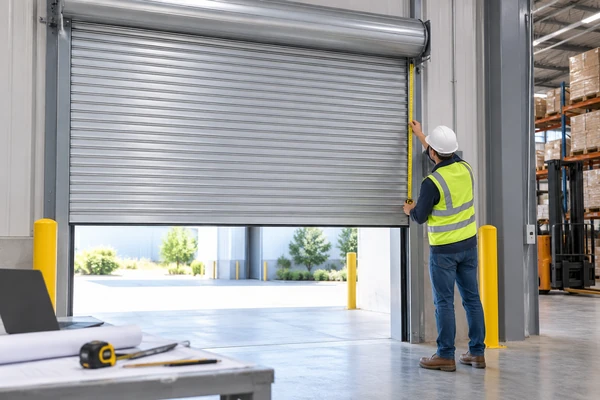
Correct measurement is one of the most important steps when purchasing a custom roller shutter.
Many buyers provide only the opening width and height. These dimensions are essential, but they do not describe the complete installation condition.
Important roll up door dimensions to confirm
A manufacturer may need information about:
Opening width
The clear horizontal distance of the opening.
Opening height
The clear vertical distance from the finished floor to the top of the opening.
Headroom
The available space above the opening for the barrel, curtain coil, hood and operator.
Sideroom
The available space on each side for guide rails, brackets, motor components or other hardware.
Mounting position
Whether the system will be installed on the inside face, outside face or another structural position.
Supporting structure
The wall, steelwork or structural surface to which the guides and brackets will be fixed.
One important point is:
The clear opening size is not the same as the overall installed door dimensions.
The complete shutter system requires additional space around the opening.
Why headroom matters
As the curtain opens, the slats coil around a barrel above the doorway. The amount of space required depends on factors such as:
- Opening height
- Slat profile
- Curtain construction
- Barrel design
- Motor arrangement
- Hood configuration
For this reason, a building with limited space above the opening may require a different configuration from a project with generous headroom.
If architectural or structural drawings are available, sending them to the manufacturer before production can reduce the risk of installation conflicts.
4. Choose the Right Aluminum Slat and Curtain Design
The curtain is one of the main components of an aluminum roller shutter door. Its construction affects appearance, weight, security, durability and—in some designs—thermal performance.
Different suppliers may offer different profiles, so buyers should evaluate the curtain based on project requirements instead of selecting a slat only by appearance.
Standard solid aluminum slats
Solid interlocking aluminum profiles are commonly used where privacy, separation and general security are important.
They may be suitable for:
- Commercial entrances
- Retail stores
- Interior building openings
- Service areas
- Selected industrial applications
Insulated curtain options
Some aluminum roll up doors are available with double-wall or insulated slat constructions.
Where such products are offered, they may be considered when improved thermal or acoustic performance is part of the project requirement.
The actual insulation performance should always be confirmed from the specific product data rather than assumed from the appearance of the slat.
Perforated or vision designs
Retail and commercial projects sometimes require visibility or airflow while the shutter is closed.
Depending on the product system, options may include:
- Perforated slats
- Vision sections
- Ventilated configurations
- Other transparent or open-profile designs
These solutions can be useful for storefront applications, but the effect on security and other performance requirements should be considered.
Surface finish and color
The visible finish is especially important for architectural and retail projects.
Available options may include:
- Natural aluminum finishes
- Powder coating
- Standard colors
- Custom RAL colors
- Other project-specific surface treatments
If the doors must match a facade, storefront system or corporate identity, provide the required color reference when requesting a quotation.
5. Manual or Motorized Operation: Which Should You Choose?
The operating method affects convenience, cost and how the door can be integrated into daily building operations.
Depending on the system and size, a roller shutter may use manual, chain-assisted or motorized operation.
Manual operation
Manual operation may be suitable for relatively small openings with low operating frequency.
Potential advantages include:
- Simpler system
- No electrical power required for normal operation
- Fewer electrical components
However, it may become less practical as the curtain becomes larger or heavier.
Chain operation
A chain hoist can provide mechanical assistance for certain manual door configurations.
It may be considered where electrical operation is not required but direct manual lifting would be inconvenient.
Motorized aluminum roll up doors
Motorized systems are often preferred for commercial and industrial projects where convenience or regular operation is important.
They can also allow integration with control devices such as:
- Push buttons
- Remote controls
- Key switches
- Access control systems
- Selected sensors
- Building control interfaces
The motor should not be selected independently from the door.
Correct operator selection can depend on:
- Door width and height
- Curtain weight
- Operating frequency
- Control requirements
- Local power supply
- Installation arrangement
- Project-specific performance requirements
Avoid assuming that a particular motor power is suitable simply because it was used on another door with apparently similar dimensions.
6. Check Safety and Security Features
Security and operational safety are related, but they are not the same thing.
Security
The security function of roll up security doors is primarily concerned with controlling access to the opening when the shutter is closed.
Depending on the project and product configuration, factors may include:
- Curtain strength
- Guide rail design
- Bottom bar construction
- Locking method
- Motor locking or braking arrangements
- Access control
For storefronts and commercial buildings, security roller shutters can combine physical separation with a compact architectural design.
However, no shutter should simply be described as “high security” without defining the relevant construction or performance requirements.
Operational safety
A motorized shutter introduces moving components. Appropriate safety features should therefore be evaluated based on the application and applicable local requirements.
Available systems may include:
- Photoelectric sensors
- Bottom safety edges
- Safety brakes
- Emergency stop devices
- Warning lights or alarms
- Manual release arrangements
- Control interlocks
Not every feature is necessarily standard on every roller shutter door.
Before ordering, confirm:
- Which safety devices are included as standard.
- Which are optional.
- Which are required by the project specification or applicable regulations.
- How the door behaves during a power failure or emergency.
For openings used by pedestrians, vehicles or material-handling equipment, this discussion becomes especially important.
7. Consider Wind, Weather and the Installation Environment
An indoor shutter separating two areas of a shopping mall operates under very different conditions from an exterior door installed at an exposed industrial building.
Before selecting the door, describe the actual environment.
Important factors can include:
- Indoor or outdoor installation
- Wind exposure
- Rain
- Dust
- Humidity
- Coastal or corrosive conditions
- Temperature
- Frequency of cleaning
- Exposure to industrial contaminants
Exterior installations
For exterior industrial roller shutter doors, wind and weather conditions can affect the curtain, guides, fixings and supporting structure.
If the project has a specific wind-load requirement, provide it to the manufacturer.
Do not assume that all shutters of the same dimensions have the same wind resistance.
The required configuration may depend on:
- Opening size
- Slat design
- Guide rail design
- Structural support
- Fixing method
- Site wind conditions
Corrosive environments
Aluminum naturally offers useful corrosion resistance, which is one reason it is selected for many commercial applications.
However, coastal or chemically aggressive environments may still require additional consideration of:
- Surface treatment
- Fasteners
- Guides
- Hardware
- Electrical components
Describe the environment clearly during the specification stage.
8. Confirm the Power Supply and Control Requirements
For international projects, electrical information should be confirmed before production.
Do not assume that the manufacturer uses the same power supply as the project location.
Provide:
- Voltage
- Frequency
- Single-phase or three-phase supply where applicable
- Control voltage requirements if specified
- Available electrical connection location
You should also decide how users need to operate the door.
Possible control options can include:
- Wall-mounted push button
- Key switch
- Remote control
- Access control
- Central building control
- Other project-specific interfaces
If the shutter forms part of a larger security or building management system, discuss integration requirements before the control system is finalized.
9. Understand What Affects Aluminum Roll Up Door Prices
Buyers searching for roll up door prices often expect a simple price per door.
For customized commercial products, however, a single price without specifications can be misleading.
The cost of an aluminum roll up door normally depends on several project variables.
| Price Factor | Why It Matters |
|---|---|
| Opening width and height | Determines curtain size and component requirements |
| Slat construction | Different profiles and constructions have different costs |
| Operation method | Manual and motorized systems require different hardware |
| Motor and controls | Operator and control configuration depend on the project |
| Safety devices | Sensors, safety edges and other devices add components |
| Surface finish | Custom colors or finishes may affect production cost |
| Special performance | Wind, insulation or other requirements may change construction |
| Quantity | Production setup and order volume can affect unit cost |
| Packaging | Export packaging depends on shipment and product dimensions |
| Destination | Freight, documentation and delivery terms vary by country |
This is also why comparing commercial roll up door prices only by the final number can lead to the wrong conclusion.
Two quotations may appear to describe the same door while including very different:
- Slat profiles
- Motors
- Controls
- Safety devices
- Surface treatments
- Accessories
- Packaging
- Technical support
A better comparison is:
Specification + scope of supply + price
rather than price alone.
10. Evaluate the Manufacturer, Not Just the Door
Choosing between roller door manufacturers should involve more than comparing product photos or quotation totals.
A reliable supplier should be able to explain why a particular configuration is suitable for your project.
Before placing an order, consider asking the following questions.
Can the manufacturer work from project dimensions?
Custom commercial doors should be designed around the actual opening and installation condition.
Can they provide technical drawings?
Drawings can help installers verify:
- Dimensions
- Fixing locations
- Headroom
- Sideroom
- Electrical position
- Component arrangement
Are specifications clearly documented?
Important information should be defined instead of described only with marketing terms such as “heavy duty” or “premium quality.”
Can they explain the safety configuration?
The supplier should be able to distinguish between standard and optional safety devices.
Can relevant certificates or test information be provided?
Where a project requires certification or a particular performance classification, verify that the documentation actually applies to the proposed product or model.
How is the door checked before shipment?
Ask about relevant inspection and operation testing procedures.
How is the product packaged for export?
For international orders, packaging should protect long components, curtain parts, motors, controls and accessories during handling and transportation.
What installation support is available?
Clarify whether the supplier provides:
- Installation drawings
- Wiring information
- Manuals
- Remote technical guidance
- Spare parts support
These questions are particularly important when purchasing customized commercial roller doors from an overseas manufacturer.
11. Information to Send Before Requesting a Quote
The quality of a quotation depends heavily on the quality of the information supplied by the buyer.
A message saying:
“Please quote one aluminum shutter, 4 × 4 meters.”
may not provide enough information to determine the correct configuration.
For a more accurate quotation, prepare the following details.
Aluminum Roller Shutter RFQ Checklist
1. Opening dimensions
- Width
- Height
2. Quantity
- Number of identical doors
- Different sizes if applicable
3. Application
- Retail store
- Warehouse
- Workshop
- Shopping mall
- Industrial facility
- Other
4. Installation environment
- Indoor
- Outdoor
5. Project location
- Country
- City if environmental conditions are relevant
6. Operation method
- Manual
- Chain
- Motorized
7. Operating frequency
- Approximate cycles per day
8. Local power supply
- Voltage
- Frequency
- Phase where applicable
9. Safety requirements
- Photoelectric sensor
- Safety edge
- Emergency control
- Other required devices
10. Environmental or performance requirements
- Wind
- Weather
- Corrosion
- Insulation
- Other project specifications
11. Finish
- Standard finish
- Required color
- RAL number if available
12. Delivery requirement
- Expected delivery date
- Project schedule
13. Drawings or photos
- Architectural drawing
- Opening drawing
- Site photo
- Installation detail
Providing these details allows the manufacturer to understand the project instead of simply guessing at the required door configuration.
12. Common Aluminum Roller Shutter Buying Mistakes to Avoid
Even experienced procurement teams can encounter problems if important details are missed during the early specification stage.
Mistake 1: Comparing only the purchase price
The lowest quotation may not include the same curtain, motor, safety equipment, controls or accessories as another offer.
Compare the complete technical scope.
Mistake 2: Providing only width × height
Correct roll up door dimensions also depend on the available installation space around the opening.
Headroom and sideroom can be critical.
Mistake 3: Choosing the motor before defining the door
Motor selection should follow the door design and operating requirements, not the other way around.
Mistake 4: Ignoring operating frequency
A shutter that operates only a few times per day has a different duty requirement from one used regularly throughout a working shift.
Tell the manufacturer how the door will actually be used.
Mistake 5: Forgetting the local voltage
This is especially important for exported motorized doors.
Confirm electrical requirements before production.
Mistake 6: Treating every aluminum shutter as the same product
Different slat profiles, guides, motors, controls and safety configurations can create very different door systems.
A photo alone is not enough for technical comparison.
Mistake 7: Leaving installation planning until the door arrives
Successful roll up door installation begins before manufacturing.
The opening, supporting structure, available space, electrical supply and mounting arrangement should be reviewed in advance.
13. Aluminum Roller Shutter Buying Checklist
Before approving an order, work through this final checklist.
Application
What will the door be used for?
Opening
Are the width, height, headroom and sideroom confirmed?
Curtain
Which aluminum slat construction best fits the project?
Operation
Manual, chain-assisted or motorized?
Usage
How frequently will the door operate?
Safety
Which safety devices are required?
Security
What level of access control and physical security is needed?
Environment
Indoor or outdoor? Wind, rain, humidity or corrosive exposure?
Electrical
Are voltage and frequency confirmed?
Control
Push button, remote control, access control or other interface?
Finish
Is a particular architectural finish or RAL color required?
Installation
Has the mounting position and supporting structure been reviewed?
Documentation
Are drawings, manuals or required certificates available?
Supplier
Can the manufacturer explain and document the proposed configuration?
Quotation
Does the quotation clearly define what is and is not included?
If these questions have clear answers, the project is much closer to being ready for production.
Frequently Asked Questions About Aluminum Roller Shutter Doors
How much does an aluminum roller shutter door cost?
There is no reliable universal price for a customized aluminum roller shutter because cost depends on the opening size, curtain construction, operation method, motor, safety devices, controls, finish, quantity and delivery requirements.
For commercial projects, provide the opening dimensions and project requirements before comparing quotations.
What sizes are available for aluminum roll up doors?
Available sizes depend on the specific shutter system, slat profile, guides, barrel, operator and project performance requirements.
Instead of assuming that one standard maximum size applies to all products, provide your required opening width and height to the manufacturer for confirmation.
How do I measure for a roll up door?
Measure the clear opening width and height, but also check the available headroom above the opening and sideroom on both sides.
For custom projects, drawings or site photos can help the manufacturer review installation conditions.
How much installation space does a roller shutter require?
The required space varies by door size and construction.
The curtain needs space to coil above the opening, while guides and other components require space at the sides. Motor arrangements may require additional clearance.
The manufacturer should confirm the complete installation dimensions for the proposed model.
Should I choose a manual or motorized aluminum roller shutter?
Manual operation can be suitable for smaller, infrequently operated openings. Motorized operation is generally more practical where the door is larger, used regularly or needs to integrate with remote control or access systems.
Final selection should consider door size, weight, usage and project requirements.
Are aluminum roller shutters suitable for commercial buildings?
Yes, aluminum roller shutters can be suitable for many commercial applications, including retail stores, shopping malls, service openings, building entrances and other areas where compact operation, appearance and security are important.
The exact configuration should still be selected according to the opening and operating conditions.
Are aluminum roller shutters secure?
An aluminum shutter can provide a physical barrier and access control for a commercial opening, but security performance depends on the complete system rather than material alone.
Slat profile, guides, bottom bar, locking arrangement, operator and installation all contribute to the overall security of roll up security doors.
Are aluminum shutters suitable for outdoor use?
Many aluminum shutter systems can be used outdoors, but the project environment should be evaluated first.
Wind exposure, rain, humidity, corrosive conditions, opening size and structural support may all influence the required configuration.
What information should I provide to get a quotation?
At minimum, provide:
- Opening width × height
- Quantity
- Application
- Project country
- Indoor or outdoor installation
- Preferred operation method
- Local voltage and frequency for motorized doors
For a more accurate recommendation, also provide operating frequency, environmental requirements, required safety features, color and any available drawings or site photos.
Final Thoughts: Buy Based on the Project, Not Just the Product Name
The best aluminum roller shutter is not simply the door with the thickest slat, the largest motor or the lowest price.
It is the door whose configuration matches the actual project.
Start with the application. Confirm the opening and installation space. Then evaluate the curtain, operating method, safety devices, controls, environmental conditions and required performance.
For commercial and industrial buyers, this approach makes it much easier to compare different aluminum roll up doors on an equal basis and reduces the risk of discovering specification problems during installation.
If you are preparing an aluminum roller shutter project, send us your opening width × height, quantity, application, installation environment, project location and local power supply. If drawings or site photos are available, include them as well.
Our team can review the information and recommend a suitable door configuration based on the requirements of your project.


