
Self-repairing high speed doors are the ultimate solution for one of the most critical challenges in the food processing industry. The transition zone between the inner packaging area (a high-risk hygiene zone) and the outer packaging or palletizing area (a lower-risk zone) is often the most vulnerable link in your entire facility layout. In this fast-paced environment, forklifts, Automated Guided Vehicles (AGVs), and pallet jacks are constantly moving. The priority here is no longer extreme washdown capability, but surviving relentless traffic. When an accidental impact occurs, you cannot afford downtime. By eliminating maintenance delays, these specialized doors ensure that your end-of-line automation runs without costly interruptions.
Contents
- 1 The Hidden Cost of Forklift Collisions in End-of-Line Packaging
- 2 How High Speed Self Repairing Doors Work in Palletizing Zones
- 3 Why Traditional Doors Fail in Food Industry Logistics Hubs
- 4 5 Benefits of Zipper High Speed Doors for Palletizing Areas
- 5 Choosing the Right Self-Repairing Doors for Your Food Facility
- 6 FAQ
- 6.1 Q1: How long does it take for a high speed self repairing door to fix itself after a forklift impact?
- 6.2 Q2: Are zipper high speed doors safe for AGVs and automated palletizing robots?
- 6.3 Q3: Can these doors effectively control dust and temperature differences between the packaging zone and the warehouse?
The Hidden Cost of Forklift Collisions in End-of-Line Packaging
In the food industry, palletizing zones are high-energy logistics hubs. Forklift drivers are moving heavy, stacked loads of finished products into the warehouse, often with restricted visibility due to the bulk of the pallets. Because of this, forklift collisions with door curtains or side tracks are practically inevitable.
When a traditional door is hit, the results are immediate and costly. The door is knocked out of its guides, requiring emergency maintenance. This physical breakdown immediately causes palletizing bottlenecks. If the door is stuck open, the protective barrier of the transition zone is lost, allowing dust and pests from the warehouse to enter the clean packaging area. If it is stuck closed, your continuous workflow is completely halted. How to reduce downtime in end-of-line packaging? The answer lies in upgrading your infrastructure to handle these impacts seamlessly rather than trying to prevent the inevitable.
How High Speed Self Repairing Doors Work in Palletizing Zones
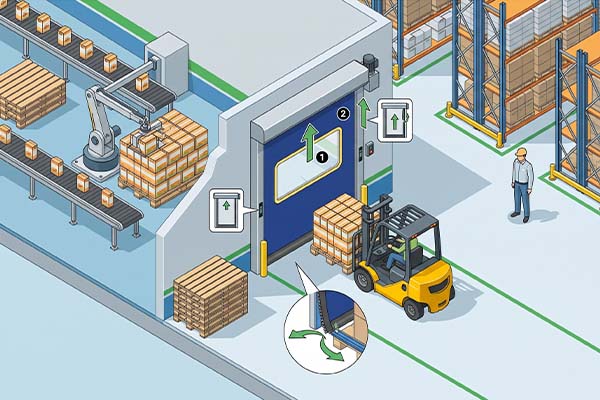
The core technology behind high speed self repairing doors is ingeniously simple yet highly effective for heavy traffic areas. Instead of using rigid metal bars or stiff wind ribs, the curtain is designed with a flexible edge that runs continuously inside a specialized side track.
When a forklift or an AGV accidentally bumps into the curtain, the breakaway mechanism is triggered. The flexible curtain safely pops out of the side guides to absorb the impact energy without damaging the track, the motor, or the curtain fabric itself. Once the obstruction is clear, the door automatically cycles up. During this upward movement, a specialized re-insertion block at the top guides the curtain back into the tracks. By the time the door closes again, it is fully operational. This entire process takes just seconds, requiring zero human intervention.
Why Traditional Doors Fail in Food Industry Logistics Hubs
Rigid overhead doors or standard fast-action doors simply are not built for the punishment of an active palletizing area. Rigid metal panels dent or buckle upon impact, requiring expensive replacement parts and hours of labor. Standard soft PVC doors might have rigid aluminum wind bars; when struck, these metal bars bend permanently and can even pierce the boxed food products waiting to be loaded.
In the palletizing area, you do not typically face the extreme wind loads of an exterior warehouse door, nor do you need the intense chemical washdown properties of the raw processing zone. You need continuous throughput. Implementing breakaway roll up doors for forklift traffic ensures that a momentary driving error does not escalate into a multi-hour production halt. This is where a high speed self repairing door vastly outperforms conventional rigid alternatives.
5 Benefits of Zipper High Speed Doors for Palletizing Areas
To truly understand their value, let’s explore how zipper high speed doors specifically optimize the packaging and palletizing workflow.
1. Zero Maintenance Downtime After Impacts
The most significant advantage is the absolute elimination of maintenance downtime. With auto-reset technology, a collision does not mean calling a technician or waiting for spare parts. The door fixes itself in a single cycle, allowing your logistics efficiency to remain at peak levels.
2. Perfect Integration with AGV and Conveyor Systems
End-of-line automation relies heavily on robotics. High speed zipper doors integrate flawlessly with AGVs and palletizing robots. In highly automated production lines, proper safety logic dictates that protective doors remain securely closed during operation to actively isolate hazards, rather than only dropping when danger is detected. Through precise sensor linkage, these doors open exactly when an AGV approaches and close immediately and securely behind it, maintaining strict safety isolation and continuous workflow.
3. Protecting Packaged Goods with Flexible Bottom Edges
Unlike traditional doors with heavy, rigid bottom profiles, these specialized doors feature a completely soft, flexible bottom edge. If a door accidentally descends while a forklift is moving a stacked pallet of finished food products, the soft edge will gently reverse upon contact. This ensures that delicate cardboard packaging and the food inside are never crushed or damaged.
4. Seamless Transition Zone Dust Control
Even though the palletizing area does not require a sterile cleanroom environment, you must strictly prevent warehouse dust, cardboard fibers, and insects from blowing backward into the packaging line. The tight seal provided by the continuous zipper mechanism ensures an excellent environmental barrier, maintaining strict hygiene compliance even during high-frequency operations.
5. Extended Lifespan in High-Traffic Workflows
Because the curtain can break away upon impact, the intense mechanical shock is not transferred to the motor, the rolling shaft, or the side frames. This self-preservation mechanism drastically extends the overall lifespan of the equipment, providing an excellent return on investment for high-traffic food logistics hubs.
Choosing the Right Self-Repairing Doors for Your Food Facility
Upgrading the transition points in your facility is a strategic move to protect your bottom line. When evaluating options, look for systems that offer rapid reset times, robust track systems, and seamless integration with your existing end-of-line automation. By investing in self-repairing high speed doors, you are not just buying a piece of equipment; you are securing your operational efficiency against the unpredictable nature of heavy material handling.If you want to completely eliminate palletizing bottlenecks and ensure your packaged goods flow smoothly into the warehouse, integrating self-repairing high speed doors for food palletizing is the most reliable, cost-effective strategy.
FAQ
Q1: How long does it take for a high speed self repairing door to fix itself after a forklift impact?
A: It takes only a few seconds. The door requires just one standard open-and-close cycle. As the door travels upward, the curtain is automatically fed back into the side guides. There is absolutely no need for manual repairs, tools, or maintenance personnel, which guarantees zero downtime for your palletizing line.
Q2: Are zipper high speed doors safe for AGVs and automated palletizing robots?
A: Yes, they are designed specifically for these environments. These doors seamlessly connect with your facility’s PLC systems, radar sensors, and magnetic loops. Furthermore, the soft bottom edge prevents damage to expensive AGV equipment if a minor collision occurs, supporting the continuous, non-stop rhythm required by automated robotics.
Q3: Can these doors effectively control dust and temperature differences between the packaging zone and the warehouse?
A: Absolutely. While their primary selling point is impact resistance, the continuous zipper design creates a very tight, flush seal along the entire side track. This effectively blocks dust, drafts, and pests from migrating from the outer warehouse into the cleaner packaging transition zone, helping you effortlessly maintain food safety compliance.


