
Upgrading to a rapid roll up door is no longer a luxury but an absolute necessity for modern food processing facilities, especially in the critical transition zones between carton storage and outer packaging areas. In the highly regulated food manufacturing industry, the end-of-line packaging sector represents a unique and chaotic battleground. This is the exact location where pristine, hygienically prepared food products meet the inherently messy world of cardboard logistics, wooden pallets, and heavy machinery.
If you manage a food facility, you already know the distinct challenges of this specific zone. You are dealing with a relentless flow of corrugated boxes, constant forklift traffic, automated guided vehicles (AGVs), and the ever-present threat of external contamination from nearby loading docks. Traditional industrial doors simply cannot keep up with this frantic pace without compromising the strict hygiene zoning required by food safety standards. In this comprehensive guide, we will explore why stripping away the generalities and focusing on the unique pain points of the carton storage and palletizing areas reveals exactly why a rapid roll up door is the ultimate solution for seamless, compliant, and uninterrupted operations.
Contents
- 1 Why Carton Storage & Palletizing Areas Demand a High Speed Rolling Door
- 2 7 Powerful Benefits of Rapid Roll Up Doors in Outer Packaging Zones
- 2.1 1. Blocking Cardboard Dust Migration
- 2.2 2. Seamless Forklift and AGV Traffic Integration
- 2.3 3. Reliable Pest Control for HACCP Compliance
- 2.4 4. Self-Repairing Features for High-Traffic Palletizing
- 2.5 5. Maintaining Climate Control and Positive Pressure
- 2.6 6. Space-Saving Design for Cramped End-of-Line Areas
- 2.7 7. Enhancing Worker Safety in Busy Hubs
- 3 Standard Doors vs. High Speed Fabric Doors in Carton Storage
- 4 Conclusion: Securing Your Food Packaging Line
- 5 FAQ
- 5.1 Q1: How does a rapid roll up door prevent cross-contamination between carton storage and clean food processing areas?
- 5.2 Q2: Will installing a high-speed door slow down our AGVs and forklifts in a busy palletizing zone?
- 5.3 Q3: Our end-of-line packaging area is packed with conveyor belts and robotic palletizers. Will a rapid roll up door fit in such a cramped space?
Why Carton Storage & Palletizing Areas Demand a High Speed Rolling Door
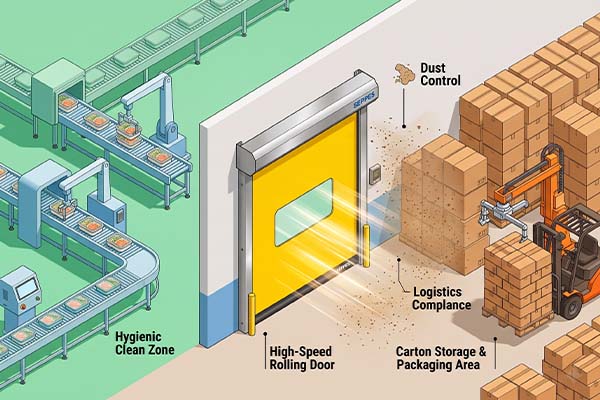
To truly understand the value of this equipment, we must first look at the specific environmental dynamics of the outer packaging zone. This area acts as a vital buffer—a physical bridge between the ultra-clean primary processing rooms and the logistics-heavy, contamination-prone shipping docks.
When corrugated boxes are erected, folded, and sealed by case packers, they release a tremendous amount of cardboard dust and micro-particulates into the air. This dust migration is a massive liability. If these airborne particles are allowed to drift backward into the primary food handling areas, they can cause severe cross-contamination, leading to failed audits and product recalls. Therefore, isolating the carton storage from the inner production zones is critical.
However, you cannot simply seal off the room. This area experiences some of the highest logistics throughput in the entire plant. A high speed rolling door becomes the critical intervention point. Every minute, pallets of finished goods are moving out, and stacks of flat cardboard are moving in. A standard barrier would create an immediate bottleneck, slowing down forklifts and causing an overflow of goods on the conveyor belts. By installing a high speed rolling door in carton storage, facility managers bridge the impossible gap: achieving perfect environmental separation while maintaining a completely unhindered flow of heavy industrial traffic.
7 Powerful Benefits of Rapid Roll Up Doors in Outer Packaging Zones
When evaluating automated palletizing door solutions, it is essential to look beyond basic product specifications like motor voltage or fabric colors. Instead, let us focus on how a rapid roll up door actively resolves the daily nightmares faced by production managers in the packaging area.
1. Blocking Cardboard Dust Migration
As mentioned, the simple act of manipulating corrugated boxes generates a continuous cloud of fine paper dust. A rapid roll up door provides a superior perimeter seal that standard overhead doors lack. Thanks to tight side guides and flexible bottom edges, these doors create an impenetrable barrier when closed. More importantly, because a rapid roll up door for food packaging opens and closes in mere seconds, the actual “open time” of the doorway is reduced to an absolute minimum. This drastically cuts down the window of opportunity for airborne dust migration, ensuring that the primary hygiene zoning of your facility remains completely uncompromised.
2. Seamless Forklift and AGV Traffic Integration
In a modern palletizing area, time is measured in seconds. Forklift operators and AGVs are constantly shuttled between the packaging line and the warehouse. A fast action roller door eliminates the dreaded wait time. Equipped with advanced radar sensors, magnetic induction loops, or direct software integration with your AGV fleet, a fast action roller door anticipates the approach of machinery. It opens swiftly, allowing a forklift carrying a fully loaded, two-meter-high pallet to pass through without ever tapping the brakes. Once the vehicle clears the threshold, the fast action roller door instantly descends, keeping your end-of-line packaging operations flowing continuously without causing frustrating bottlenecks.
3. Reliable Pest Control for HACCP Compliance
Palletizing areas are typically located adjacent to outbound shipping docks, making them highly susceptible to external temperature fluctuations and invading pests. Flies, rodents, and birds are naturally drawn to the warmth and food odors of the plant. Maintaining strict pest control is a foundational pillar of HACCP compliance. A quick roll up door serves as an aggressive, active defense mechanism against these intruders. By acting as a nearly instantaneous physical barrier, a quick roll up door ensures that insects flying around the loading bay do not find their way into your pristine carton storage area. Every time the door drops rapidly to the floor, it effectively shuts out the outside world.
4. Self-Repairing Features for High-Traffic Palletizing
Let us address a very common, frustrating reality in the outer packaging zone: forklift collisions. Forklift drivers are often navigating cramped spaces in reverse, with their vision completely obscured by towering stacks of finished goods. Accidents happen, and traditional metal doors are easily dented, derailed, and destroyed, leading to hours or days of costly downtime.
This is where a high speed fabric door truly shines. Designed with a flexible curtain and a zipper-like track system, if a forklift accidentally rams into a high speed fabric door, the curtain safely breaks away from its guides. Then, during the very next operational cycle, it automatically feeds itself back into the track. This self-repairing capability guarantees that a minor driver error does not result in shutting down your entire packaging line.
5. Maintaining Climate Control and Positive Pressure
Food processing plants utilize sophisticated HVAC systems to maintain positive air pressure in clean rooms, ensuring that air flows out of the clean zones and pushes contaminants away. The outer packaging area must sustain this delicate pressure balance. A quick roll up door is engineered to withstand these pressure differentials without ballooning or jamming. The rapid cycle time of a quick roll up door means that the conditioned air—and the positive pressure required to keep the hygiene zoning intact—is locked inside, significantly reducing energy waste and minimizing the strain on your facility’s climate control systems.
6. Space-Saving Design for Cramped End-of-Line Areas
The footprint of a palletizing zone is often incredibly crowded, packed tight with robotic arms, conveyor belts, shrink wrappers, and stacks of wooden pallets. There is simply no room for the sprawling tracks of traditional sectional doors or the wide swing paths of solid panel doors. A rapid roll up door is the perfect architectural fit for these congested environments. The curtain simply gathers into a compact header box directly above the doorway. This streamlined, vertical-lifting profile ensures that a rapid roll up door demands zero lateral or deep ceiling space, leaving maximum floor area for your essential automated packaging machinery.
7. Enhancing Worker Safety in Busy Hubs
The transition point between carton storage and the shipping floor is a high-risk zone for workplace accidents. Pedestrians, manual pallet jacks, and heavy automated machinery are all sharing the same tight corridors. A high speed fabric door significantly enhances operational safety. Built with large, transparent PVC vision panels, a high speed fabric door eliminates dangerous blind spots. A forklift driver accelerating toward the threshold can clearly see if a worker is standing on the other side of the high speed fabric door, allowing them to react instantly and prevent catastrophic collisions in these incredibly busy logistics hubs.
Standard Doors vs. High Speed Fabric Doors in Carton Storage
To summarize the operational leap that these automated palletizing door solutions provide, let us compare how traditional options fare against specialized flexible doors in this exact environment.
| Feature / Scenario | Traditional Steel / Sectional Door | High Speed Rolling Door |
| Dust Migration Control | Poor. Slow closing times allow cardboard dust to drift freely between zones. | Excellent. Instantaneous closure locks out particulates and maintains strict hygiene zoning. |
| Forklift Traffic Flow | Severe Bottleneck. Drivers must stop, wait for the door to slowly rise, and then proceed. | Seamless. Opens at speeds up to 2.0+ m/s, allowing vehicles to pass without decelerating. |
| Collision Recovery | Catastrophic. A forklift impact permanently bends tracks, requiring expensive maintenance and halting production. | Instant Recovery. The curtain easily pops out of the tracks and automatically realigns itself on the next cycle. |
| Space Utilization | High. Requires extensive overhead ceiling tracks or side swing clearance. | Minimal. Rolls up tightly into a compact top header, freeing up space for conveyor belts. |
Conclusion: Securing Your Food Packaging Line
The journey your product takes from the cleanroom to the cardboard box is fraught with logistical and hygienic vulnerabilities. Relying on outdated barriers in your carton storage and palletizing zones is a direct threat to your facility’s efficiency and food safety compliance.By implementing a rapid roll up door at these critical junctures, you are not merely installing a piece of hardware; you are investing in an active safeguard that prevents dust migration, physically enforces your pest control strategies, and keeps your high-volume forklift traffic moving without costly interruptions.
Do not let a slow, easily damaged door be the weakest link in your meticulously planned end-of-line packaging operation. Upgrade your facility’s internal logistics today and experience the uninterrupted peace of mind that only advanced, self-repairing door technology can provide.
FAQ
Q1: How does a rapid roll up door prevent cross-contamination between carton storage and clean food processing areas?
A: In the outer packaging zone, erecting and folding corrugated boxes generates a significant amount of airborne cardboard dust. A rapid roll up door minimizes the doorway’s “open time” to mere seconds. Combined with tight perimeter seals and a flexible bottom edge, it effectively traps these particulates in the logistics area. This rapid sealing action maintains the facility’s positive air pressure, ensuring that dust and pests cannot migrate backward into pristine, hygienic food handling zones, keeping you completely HACCP compliant.
Q2: Will installing a high-speed door slow down our AGVs and forklifts in a busy palletizing zone?
A: Not at all; it actually eliminates existing bottlenecks. A rapid roll up door operates at speeds exceeding 2.0 meters per second. When equipped with radar sensors, magnetic loops, or integrated directly with your AGV fleet software, the door anticipates the arrival of heavy machinery. This allows forklifts carrying tall pallets of finished goods to drive through seamlessly without ever hitting the brakes. If a driver does accidentally clip the curtain, the self-repairing zipper track automatically resets the door on the next cycle, ensuring zero downtime for your packaging line.
Q3: Our end-of-line packaging area is packed with conveyor belts and robotic palletizers. Will a rapid roll up door fit in such a cramped space?
A: Yes, it is the ideal architectural fit for congested spaces. Traditional industrial doors require deep overhead tracking or large side-swing clearances, which clash with automated packaging machinery. A rapid roll up door features a highly compact, vertical-lifting design. The flexible fabric curtain gathers tightly into a small header box directly above the doorway. It requires zero lateral floor space and minimal headroom, leaving maximum real estate for your shrink wrappers, conveyors, and palletizing robots.


