
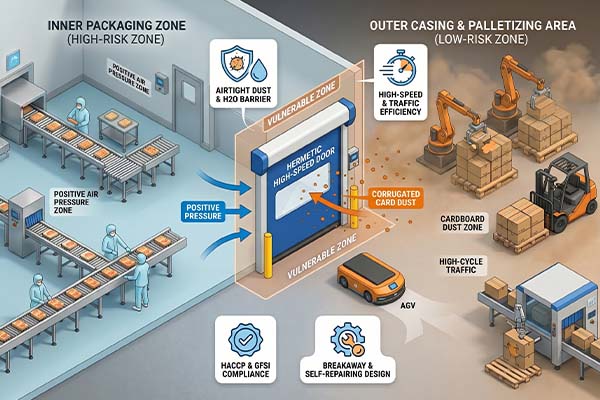
A hermetic high-speed door is no longer just a luxury for food processing facilities; it is a critical line of defense. If you manage a food manufacturing plant, you know that the transition point between the inner packaging area (high-care zone) and the outer packaging or palletizing area (low-care zone) is one of the most vulnerable spots in your entire layout.
In the inner packaging zone, your food products are highly susceptible to airborne particulates. Just feet away, in the outer casing and palletizing zone, robotic arms, forklifts, and conveyors are handling corrugated cardboard boxes and wooden pallets, generating massive amounts of invisible dust. Without the right barrier, the disastrous consequences of cross-contamination are inevitable. This is exactly where a specialized hermetic high-speed door becomes your ultimate operational safeguard.
In this comprehensive guide, we will explore why standard doors fail in this specific scenario and detail seven proven ways a hermetic high-speed door eliminates bottlenecks, locks in positive air pressure, and secures your food packaging lines against disastrous contamination.
Contents
- 1 1. Eradicating Corrugated Cardboard Dust Transfer
- 2 2. Maintaining Crucial Positive Air Pressure
- 3 3. Why Your Packaging Transition Needs a Hermetic High-Speed Door for Traffic Efficiency
- 4 4. Uncompromising HACCP and GFSI Compliance
- 5 5. Preventing Pest Infiltration in the Casing Area
- 6 6. Self-Repairing Features for Forklift-Heavy Zones
- 7 The Bottom Line: Choosing the Right Door for the Right Niche
- 8 FAQ
- 8.1 What’s the real difference between a hermetic high-speed door and a standard high-speed door?
- 8.2 Can a hermetic high-speed door be retrofitted into an existing packaging line, or does it require new construction?
- 8.3 How often do hermetic high-speed doors need to be cleaned or maintained in a food plant?
1. Eradicating Corrugated Cardboard Dust Transfer
The most significant threat when moving products from an inner packaging zone to an outer casing area is cardboard dust. When flat cardboard is folded, glued, and stacked by palletizers, it releases microscopic corrugated fibers into the air. If these fibers float backward into the inner packaging line where exposed or semi-exposed food resides, the entire batch could fail quality control.
A hermetic high-speed door tackles this problem through extreme sealing technology. Unlike standard industrial doors that leave gaps at the bottom or sides, a true hermetic high-speed door features a completely sealed perimeter. When the door closes, it creates a near-airtight barrier that physically blocks cardboard dust and wooden pallet fragments from traveling up the production line. By isolating the low-care casing area from the high-care filling area, you drastically reduce the risk of particulate cross-contamination.
2. Maintaining Crucial Positive Air Pressure
Food processing cleanrooms and inner packaging areas typically rely on positive air pressure. This HVAC strategy ensures that when a door opens, clean air blows out, preventing dirty air from flowing in. However, if your doors are too slow or lack an airtight seal when closed, your HVAC system has to work in overdrive, and positive pressure is rapidly lost.
Installing a hermetic high-speed door solves this aerodynamic challenge. Thanks to its airtight zip-track mechanisms and heavy-duty seals, it locks the air pressure inside the high-care room when closed. Because the door operates at astonishing speeds (often up to 2.5 meters per second), the time the barrier is broken is minimized to mere seconds. This ensures that the pressure differential between the inner packaging zone and the palletizing zone remains stable, significantly lowering your facility’s energy consumption and protecting the hygiene of the environment.
3. Why Your Packaging Transition Needs a Hermetic High-Speed Door for Traffic Efficiency
In modern food facilities, the throughput rate between the primary packaging conveyor and the final palletizer is immensely high. Forklifts, Automated Guided Vehicles (AGVs), and continuous conveyor belts cannot afford to wait for slow-moving conventional doors. Delaying this traffic leads to major production bottlenecks.
A hermetic high-speed door is explicitly designed for high-cycle operations. It integrates seamlessly with radar sensors, magnetic loops, or conveyor belt PLC systems. When a pallet of packaged food approaches, the door opens instantly and closes firmly the millisecond the load clears the threshold. This flawless integration means your forklift drivers never have to hit the brakes, and your automated palletizing robotics never have to pause, boosting your overall Operational Equipment Effectiveness (OEE).
4. Uncompromising HACCP and GFSI Compliance
Food safety auditors—whether checking for FDA, HACCP, or GFSI compliance—pay strict attention to facility flow and zone segregation. They look specifically for how you separate raw/exposed product handling from warehouse and casing activities. Failing to properly seal off the inner packaging zone from the palletizing area is a common cause for audit deductions.
Implementing a top-tier hermetic high-speed door acts as undeniable proof to auditors that your facility takes zone segregation seriously. These doors are usually manufactured with smooth, washdown-ready PVC fabrics and stainless-steel frames that resist bacterial harborage. By investing in a high-quality food grade hermetic rapid door, you eliminate the crevices where mold and bacteria hide, making your daily sanitation washdowns faster and fully compliant with rigorous food safety regulations.
5. Preventing Pest Infiltration in the Casing Area
The outer packaging and palletizing area is constantly receiving raw shipping materials—pallets, cardboard bundles, and shrink wrap—from external delivery trucks. Consequently, this zone is highly susceptible to pests such as insects and rodents. If the transition between the outer palletizing zone and the inner packaging line is unsecured, pests have a direct highway to your most sensitive food items.
Standard strip curtains or rigid doors often fail here; strip curtains separate over time, and rigid doors are frequently left propped open by lazy operators. A hermetic high-speed door is automated and self-closing. Once the traffic passes, it seals completely tight against the floor. There are no gaps for rodents to squeeze under or flies to buzz through. Searching for specialized hermetic high-speed door solutions is one of the most effective structural pest control methods a facility manager can implement.
6. Self-Repairing Features for Forklift-Heavy Zones
Let’s face the reality of the outer packaging and palletizing area: it is chaotic. Forklifts are maneuvering tight corners carrying heavy loads of finished goods. Accidental collisions with warehouse doors are a daily occurrence, which normally means shattered door panels, expensive emergency repairs, and hours of downtime where the hygienic barrier is left wide open.
Advanced hermetic high-speed door models come equipped with a revolutionary self-repairing (breakaway) function. If a forklift accidentally strikes the door curtain, the flexible zipper simply pops out of its side tracks to absorb the impact without permanent damage. As the door cycles up and back down, the zipper automatically re-threads itself into the track. This means zero downtime, zero repair costs, and immediate restoration of the critical hygienic seal between your inner and outer packaging zones.
The Bottom Line: Choosing the Right Door for the Right Niche
It is essential to understand that not all rapid doors are created equal. You might find generic fast-rolling doors that claim to improve logistics, but without a genuine airtight mechanism, they are useless in a high-care food environment. When you are explicitly dealing with the transition from inner food packing to external cardboard casing and palletizing, standard solutions will leave you vulnerable to particulate drift and positive pressure loss.
You need a specific, engineered solution. Opting for a hermetic high-speed door for food packaging guarantees that you are addressing the unique pain points of this exact transition. From stopping corrugated cardboard dust dead in its tracks to supporting seamless, high-speed AGV traffic, this is the definitive upgrade your processing line needs.
If you are upgrading your facility’s segregation zones, do not settle for standard industrial doors. When looking to connect your clean packaging lines with your heavy-duty palletizing areas, specifically request airtight high-speed doors for palletizing zones.
Upgrade Your Packaging Line Today
Are you ready to stop disastrous contamination, pass your next HACCP audit with flying colors, and speed up your forklift traffic? The threshold between your inner packaging area and your outer casing zone is too important to ignore. By investing in an advanced hermetic high-speed door, you are investing in the safety of your food products and the ultimate efficiency of your production line.Evaluate your current cleanroom-to-warehouse transitions today. If you feel drafts, see dust accumulation, or experience forklift bottlenecks, it is time to upgrade to the airtight, high-cycle performance of a dedicated hermetic high-speed door. Protect your product, protect your brand, and maximize your throughput.
FAQ
What’s the real difference between a hermetic high-speed door and a standard high-speed door?
A standard high-speed door is built primarily for speed — it gets people, forklifts, and pallets through quickly, but it usually still leaves small gaps at the bottom edge or side tracks. A hermetic high-speed door adds a fully sealed perimeter on top of that speed, so when it’s closed, it behaves more like an airtight wall than a simple barrier. For zones where you need to hold positive air pressure or block fine particulates like cardboard dust, that sealing difference is the whole point — a fast door alone won’t do it.
Can a hermetic high-speed door be retrofitted into an existing packaging line, or does it require new construction?
In most cases, retrofitting is possible without a full structural rebuild. These doors are designed to fit standard opening sizes found in food plants, and the frame, track, and control box can typically be mounted onto an existing wall opening between the inner and outer packaging zones. That said, if your current opening lacks a clean, level mounting surface, or your HVAC system wasn’t originally designed to hold positive pressure, you may need some supporting adjustments alongside the door installation. It’s worth having a supplier assess your specific opening before assuming a straightforward retrofit.
How often do hermetic high-speed doors need to be cleaned or maintained in a food plant?
Because these doors sit directly on a high-care/low-care boundary, most food facilities include them in their daily or per-shift washdown routine, especially the bottom seal and floor-contact areas where dust and debris accumulate fastest. Beyond daily cleaning, a more thorough mechanical check — tracks, seals, sensors, and the breakaway zipper mechanism if equipped — is typically recommended on a monthly or quarterly basis depending on cycle volume. High-traffic doors running thousands of cycles a day will naturally need more frequent inspection than a door used only a few times per shift.


