
High-speed doors play a critical role in hygienic food packaging areas where exposed products, clean packaging materials, and high-frequency traffic meet at the final stage before dispatch. In food processing plants, the inner packaging area is not just another room on the production floor. It is often the final controlled zone before products are sealed, boxed, stored, or shipped.
For ready-to-eat food, cooked meat, dairy products, bakery products, seafood, frozen food, and high-care food production, contamination at this stage can be extremely costly. Once the product enters the packaging stage, there may be no further cooking, sterilizing, or kill step to correct a hygiene failure. That is why every opening between the inner packaging room, cooling area, outer packaging area, warehouse, corridor, and personnel entrance must be carefully controlled.
This is where high-speed doors can make a real difference. Their value is not only opening speed. In hygienic packaging areas, high-speed doors help reduce door-open time, protect clean packaging materials, support hygienic zoning, stabilize airflow, reduce pest entry, and improve traffic efficiency around busy packaging lines.This article explains how to choose the right door solution for inner packaging rooms and high-hygiene packaging areas in food processing facilities.
Contents
- 1 What Are Inner Packaging Areas and High-Hygiene Packaging Areas?
- 2 Why High-Speed Doors Matter in Hygienic Packaging Areas
- 3 7 Powerful Ways High-Speed Doors Help Avoid Costly Contamination
- 3.1 1. They Reduce Door-Open Time at Critical Hygiene Boundaries
- 3.2 2. They Help Maintain Hygienic Zoning
- 3.3 3. They Protect Clean Packaging Materials
- 3.4 4. They Support Smooth Traffic Around Packaging Lines
- 3.5 5. They Help Control Temperature and Condensation Risk
- 3.6 6. They Reduce Pest, Dust, and Airborne Contamination Entry
- 3.7 7. They Reduce Downtime Caused by Door Impact
- 4 Door Selection Guide for Inner Packaging and High-Hygiene Packaging Areas
- 5 Key Specifications Buyers Should Check Before Choosing High-Speed Doors
- 6 Common Mistakes to Avoid When Selecting Doors for Packaging Areas
- 6.1 Mistake 1: Using the Same Door Standard for Inner and Outer Packaging
- 6.2 Mistake 2: Looking Only at Opening Speed
- 6.3 Mistake 3: Ignoring Packaging Material Flow
- 6.4 Mistake 4: Forgetting About Waste and Reject Flow
- 6.5 Mistake 5: Not Considering Condensation
- 6.6 Mistake 6: Choosing a Door That Is Hard to Clean
- 6.7 Mistake 7: No Interlock for High-Care Entrances
- 7 Best Door Types for Hygienic Food Packaging Areas
- 8 Practical Example: Cooling Area to Inner Packaging Room
- 9 Practical Example: Inner Packaging to Outer Packaging Boundary
- 10 Practical Example: Packaging Material Staging Room
- 11 Conclusion: Choose Doors Based on Hygiene Risk, Not Only Traffic
- 12 FAQ About High-Speed Doors for Hygienic Food Packaging Areas
- 12.1 Are high-speed doors necessary for inner packaging rooms?
- 12.2 What is the best door for RTE food packaging areas?
- 12.3 Can high-speed doors reduce cross-contamination?
- 12.4 Should high-hygiene packaging areas use interlocked doors?
- 12.5 Are stainless steel high-speed doors better for packaging rooms?
- 12.6 What is the difference between inner packaging and outer packaging door requirements?
- 12.7 Can high-speed doors work with AGV systems?
What Are Inner Packaging Areas and High-Hygiene Packaging Areas?
Inner packaging areas are zones where food products are packed into their primary packaging. This may include bags, trays, pouches, cups, films, vacuum packs, thermoformed packs, or other packaging materials that directly protect the food product.
High-hygiene packaging areas are usually more controlled. They are commonly found in ready-to-eat food plants, cooked food factories, dairy plants, meat processing plants, seafood facilities, frozen food plants, and bakery production lines. These areas often require stricter control of people, air, materials, waste, water, cleaning tools, and traffic flow.
Common inner packaging and high-hygiene packaging zones include:
- Primary packaging rooms
- Ready-to-eat food packaging areas
- Cooked meat packaging rooms
- Dairy product packaging zones
- Bakery product packaging areas after cooling
- Seafood packaging areas
- Frozen food packing areas
- Packaging material staging rooms
- Cooling-to-packaging transfer openings
- Gowning rooms and hygiene entrances
- Inner packaging to outer packaging transfer points
- Allergen-controlled packaging areas
- Waste and rejected product exit points
- AGV or trolley traffic openings near packaging lines
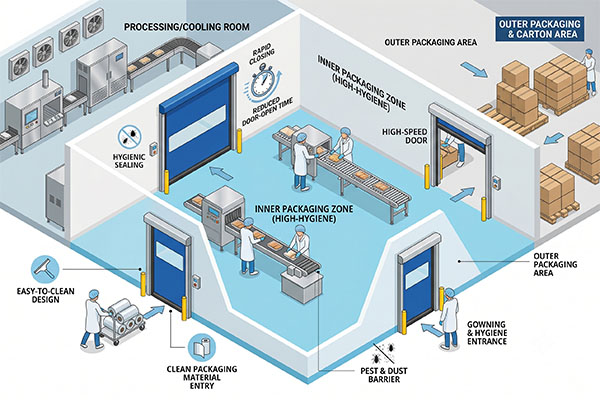
Each of these zones has a different risk level. For example, the door between a corridor and an outer packaging room may not need the same hygiene performance as the door between a cooling room and an RTE food packaging room. That is why door selection should be based on the actual hygiene zone, traffic type, temperature condition, cleaning method, and contamination risk.
Why High-Speed Doors Matter in Hygienic Packaging Areas
In many food factories, the packaging area is a high-traffic zone. Operators move in and out. Trolleys transport products. Packaging materials need to be delivered. Finished products move toward outer packaging. Cleaning tools and waste may also pass through nearby areas if the layout is not well controlled.
If the door stays open too long, the hygienic boundary becomes weak.
Traditional manual doors or slow industrial doors often create several problems. Workers may leave them open for convenience. Trolleys may wait at the doorway. Air from a lower hygiene zone may enter the packaging room. Dust, insects, moisture, or temperature fluctuations may affect the controlled environment.
High-speed doors help solve these problems by opening quickly, closing automatically, and reducing unnecessary exposure time at critical openings. In a hygienic packaging area, this is especially important because the product is often already processed and close to final packing.
The door is not just an access point. It is part of the contamination control strategy.
7 Powerful Ways High-Speed Doors Help Avoid Costly Contamination
1. They Reduce Door-Open Time at Critical Hygiene Boundaries
The longer a door remains open, the greater the chance of air exchange between different hygiene zones. In inner packaging rooms, this can allow dust, microorganisms, insects, humidity, or temperature changes to enter the controlled area.
High-speed doors reduce the time that the doorway remains exposed. When combined with sensors, pull cords, radar, or AGV signals, the door can open only when needed and close quickly after traffic passes through.
This is especially useful for:
- Primary packaging rooms
- RTE food packaging areas
- Cooling-to-packaging transfer openings
- Packaging material entrances
- High-frequency trolley passages
- Automated packaging line traffic
For food processors, the benefit is clear: less open-door time means better separation between the high-hygiene packaging area and surrounding lower-risk zones.
2. They Help Maintain Hygienic Zoning
Hygienic zoning is one of the most important principles in food factory layout. Different areas should be separated according to risk level. Raw material receiving, washing, cooking, cooling, inner packaging, outer packaging, storage, and waste handling should not be treated as the same type of environment.
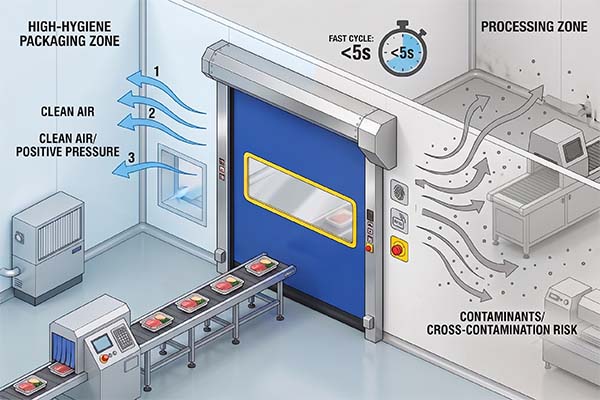
High-speed doors for hygienic packaging areas help create a clear physical boundary between zones. For example, a door between the inner packaging room and the outer packaging area can prevent carton dust, pallet contamination, and warehouse airflow from entering the primary packaging space.
In high-care or high-risk packaging zones, the door can also be combined with:
- Airlocks
- Interlock control
- Access control systems
- Positive pressure design
- Personnel hygiene procedures
- Material transfer control
- One-way traffic flow
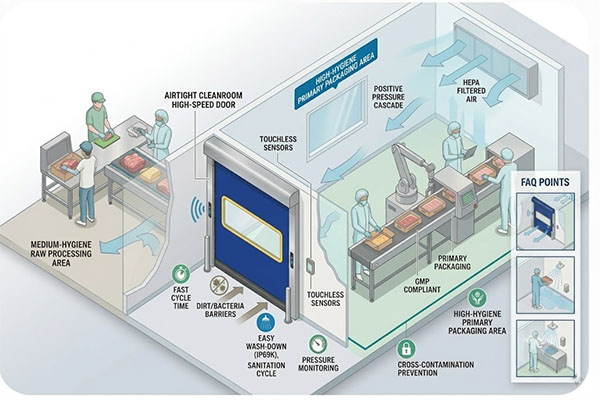
Interlocked high-speed doors for high hygiene zones are especially useful when two areas must not be open to each other at the same time. For example, a packaging material staging room may use two doors with an interlock system: one door opens to the lower hygiene side, and the other opens to the inner packaging side. This helps reduce direct airflow and cross-traffic between different zones.
3. They Protect Clean Packaging Materials
Packaging materials are often overlooked in food factory hygiene design. However, films, trays, cups, bags, lids, and liners may directly contact food or protect food after sealing. If packaging materials pass through dusty corridors, low-hygiene storage areas, or uncontrolled traffic routes, they can become a contamination carrier.
Food-grade high-speed doors for packaging areas can help separate packaging material staging rooms from general production areas. They allow fast material transfer while keeping the high-hygiene packaging zone protected.
For better control, the packaging material flow should be designed carefully:
- Store clean packaging materials close to the inner packaging area
- Avoid moving clean packaging through raw material or waste areas
- Use dedicated entrances for packaging materials
- Keep outer cartons and pallets away from high-hygiene zones
- Use fast-closing doors to reduce air exchange during material transfer
In this scenario, the purpose of high-speed doors is not just convenience. They help prevent clean packaging materials from being exposed to unnecessary contamination risk before they enter the packaging line.
4. They Support Smooth Traffic Around Packaging Lines
Packaging lines often require fast and stable movement. Products need to move from processing or cooling into packaging. Packaging materials need to be supplied. Finished packs need to move to outer packaging or cold storage. If a door is too slow, workers may leave it open, or traffic may build up at the entrance.
High-speed doors for inner packaging rooms help improve traffic flow without sacrificing hygiene control. Operators and trolleys can pass through quickly, while the door still closes automatically after each movement.
This is valuable for:
- Trolley traffic
- Manual cart movement
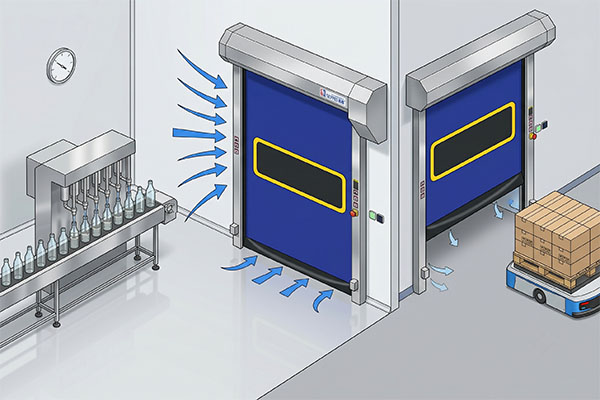
- AGV passages
- Conveyor transfer points
- Forklift-limited areas
- Packaging material delivery routes
- Finished product exits
In automated packaging lines, doors can also be connected with sensors or AGV systems. The door opens only when the vehicle or product flow approaches and closes immediately after passage. This reduces manual operation and lowers the chance of human error.
5. They Help Control Temperature and Condensation Risk
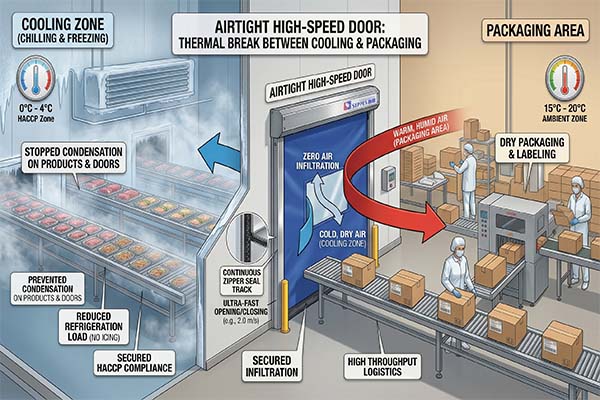
Many food packaging areas are temperature-controlled. Meat, dairy, seafood, frozen food, and ready-to-eat products often require lower temperatures before or during packaging. If warm air enters through an open doorway, it can create condensation on walls, ceilings, equipment, door surfaces, or packaging materials.
Condensation is not only a comfort issue. In high-hygiene food areas, moisture can increase cleaning challenges and create potential microbial risk points if not controlled properly.
High-speed doors for temperature-controlled packaging areas can help reduce temperature fluctuations by closing quickly after each passage. In some applications, insulated high-speed doors or high-sealing zipper doors may be more suitable than standard PVC fast doors.
Typical locations include:
- Cooling room to packaging room openings
- Chilled product packaging rooms
- Frozen food packing areas
- Dairy packaging zones
- Meat and seafood packaging rooms
- Cold chain transfer points
When temperature difference is large, the door selection should consider sealing performance, opening frequency, curtain material, insulation needs, and whether the surrounding area has a risk of condensation.
6. They Reduce Pest, Dust, and Airborne Contamination Entry
Packaging areas should be protected from insects, dust, and uncontrolled airflow. A slow door or frequently open doorway can become a weak point in the hygiene system.
High-speed doors help by reducing the time that the opening is exposed. A door with good side sealing, bottom sealing, and fast automatic closing can help protect the room from pests and airborne contamination.
This is especially important at:
- Packaging room entrances near corridors
- Transfer points close to warehouses
- Doors between inner and outer packaging
- Areas close to loading zones
- Packaging material entrances
- Waste or reject product exits
For higher hygiene requirements, a zipper high-speed door or cleanroom high-speed door may be more suitable because the side tracks provide better sealing than ordinary brush-sealed doors. In high-care packaging rooms, a stainless steel frame and easy-clean design may also be preferred.
7. They Reduce Downtime Caused by Door Impact
Packaging areas are busy. Trolleys, carts, pallet trucks, AGVs, and operators move frequently. Door impact is common, especially when traffic is dense or space is limited.
If a traditional door is hit, it may bend, jam, or stop working. This can block the packaging line, delay production, and create maintenance costs. In a high-hygiene area, a damaged door may also weaken zone separation.
Self-repairing high-speed doors for packaging lines are useful in these conditions. When the curtain is accidentally hit, the zipper structure can guide the curtain back into the track during the next operating cycle. This reduces downtime and helps maintain production flow.
For food factories, this is not only a maintenance benefit. A reliable door helps keep the hygienic boundary closed and functional during daily production.
Door Selection Guide for Inner Packaging and High-Hygiene Packaging Areas
Different openings require different door solutions. The best choice depends on hygiene level, traffic frequency, temperature, cleaning method, and whether the door separates two different risk zones.
| Application Area | Recommended Door Type | Why It Works |
| Inner packaging room entrance | Food-grade zipper high-speed door | Good sealing, fast closing, suitable for frequent trolley traffic |
| RTE food packaging area | Cleanroom high-speed door with interlock control | Helps protect high-care zones and reduce cross-airflow |
| Cooling room to packaging room | Insulated or high-sealing high-speed door | Helps reduce temperature fluctuation and condensation risk |
| Packaging material staging room | Fast roll-up door or zipper high-speed door | Allows quick material transfer while separating lower hygiene areas |
| Washdown packaging room | Stainless steel washdown high-speed door | Better for wet cleaning and high-humidity environments |
| Inner packaging to outer packaging boundary | High-speed partition door | Helps prevent carton dust, pallet contamination, and warehouse airflow |
| AGV passage near packaging line | Sensor-linked high-speed door | Supports automated traffic and reduces manual operation |
| Allergen-controlled packaging area | Sealed high-speed door with access control | Helps separate different product or allergen zones |
| Waste or reject exit | Fast-closing one-way access door | Reduces reverse flow and protects clean packaging areas |
This table can help buyers understand that door selection is not about choosing one standard product for every opening. Each hygiene boundary should be evaluated separately.
Key Specifications Buyers Should Check Before Choosing High-Speed Doors
When selecting high-speed doors for hygienic packaging areas, buyers should focus on practical food factory requirements, not just general door specifications.
Important points include:
Sealing Performance
The door should help reduce air exchange, dust entry, and pest access. For high-hygiene packaging zones, side sealing and bottom sealing are more important than appearance.
Easy-Clean Design
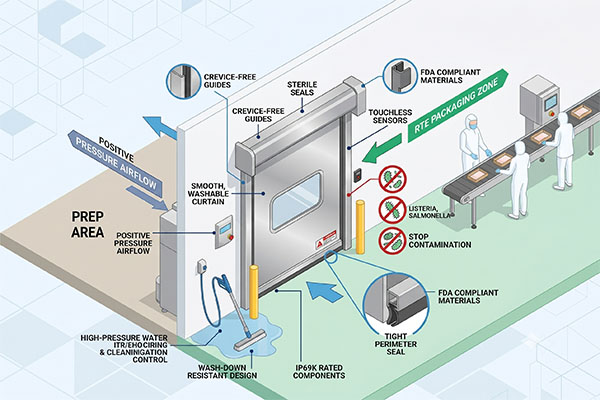
Packaging areas often require strict cleaning routines. Door frames, curtains, side tracks, and bottom edges should be easy to clean and should avoid unnecessary dust traps.
Food-Grade Materials
For humid or washdown environments, stainless steel frames may be preferred. The door curtain should also be suitable for the production environment and cleaning method.
Interlock Function
For high-care packaging zones, interlocked high-speed doors can help prevent two doors from opening at the same time. This is useful for airlocks, personnel entrances, and packaging material transfer rooms.
Automation Compatibility
Doors near packaging lines may need to connect with radar sensors, pull cords, photoelectric sensors, AGV systems, access control, or production line signals.
Impact Recovery
In busy packaging areas, accidental impact is common. A self-repairing zipper high-speed door can reduce downtime and maintenance cost after minor collisions.
Temperature Suitability
If the door is used between cooling and packaging areas, the material and sealing structure should be suitable for temperature differences and possible condensation risk.
Maintenance Access
A door used in a packaging area should be easy to inspect and maintain. Long downtime near a packaging line can affect the entire production schedule.
Common Mistakes to Avoid When Selecting Doors for Packaging Areas
Many food factories choose doors based only on size and price. This often leads to problems later. In hygienic packaging areas, buyers should avoid the following mistakes.
Mistake 1: Using the Same Door Standard for Inner and Outer Packaging
Outer packaging areas may handle cartons, labels, boxes, pallets, and finished goods. Inner packaging areas are more sensitive because the product or clean primary packaging may still be exposed. These two areas should not always use the same door type.
Mistake 2: Looking Only at Opening Speed
Speed is important, but sealing, cleaning, impact recovery, and control logic are just as important in high-hygiene food packaging areas.
Mistake 3: Ignoring Packaging Material Flow
If clean packaging materials must pass through uncontrolled areas, the risk does not disappear just because the packaging room has a door. The entire route should be considered.
Mistake 4: Forgetting About Waste and Reject Flow
Waste and rejected products should not move back through clean packaging routes. Doors at reject exits should support one-way flow and fast closing.
Mistake 5: Not Considering Condensation
A door between a cold area and a warmer area may create condensation problems if it stays open too long or has poor sealing. This is especially important for chilled food packaging.
Mistake 6: Choosing a Door That Is Hard to Clean
In food packaging areas, complex structures, dust traps, and difficult-to-clean components can create hygiene concerns during audits and daily cleaning.
Mistake 7: No Interlock for High-Care Entrances
For high-risk packaging rooms, a single fast door may not be enough. Airlocks and interlocked high-speed doors may be needed to reduce direct contact between hygiene zones.
Best Door Types for Hygienic Food Packaging Areas
Food-Grade Zipper High-Speed Doors
Food-grade zipper high-speed doors are often a strong choice for inner packaging rooms. Their side-sealing structure helps reduce air leakage, and the self-repairing function helps recover after accidental impact. They are suitable for trolley traffic, high-frequency passages, and busy production environments.
Cleanroom High-Speed Doors
Cleanroom high-speed doors are suitable for RTE food packaging, high-care rooms, and controlled packaging zones. They can be used with interlock systems, access control, and positive pressure layouts to help maintain cleaner airflow conditions.
Washdown High-Speed Doors
Washdown high-speed doors are suitable for wet packaging rooms or areas that require frequent cleaning. Stainless steel frames and easy-clean structures are useful where moisture, cleaning chemicals, and hygiene inspections are common.
Insulated High-Speed Doors
Insulated high-speed doors are useful when the packaging area is connected to a cooling room, chilled storage, or frozen product transfer area. They help reduce temperature loss and condensation risk at high-frequency openings.
Standard PVC High-Speed Doors
Standard PVC high-speed doors may be suitable for lower-risk packaging support areas, such as some outer packaging rooms, dry corridors, or general material transfer openings. However, they may not be the best option for high-care inner packaging zones if stronger sealing or cleaning performance is required.
Practical Example: Cooling Area to Inner Packaging Room
A cooked food product may move from a cooling zone into an inner packaging room. At this stage, the product has already been cooked and cooled. If the doorway remains open, warm air, humidity, and airborne contamination may enter the packaging room.
A high-sealing high-speed door can help close the opening quickly after each trolley or conveyor movement. If the area is temperature-controlled, an insulated high-speed door may be considered. If the packaging room is high-care, interlock control or airlock design may also be needed.
In this example, the door helps solve three problems at the same time:
- Reducing open-door exposure
- Supporting temperature stability
- Protecting the high-hygiene packaging boundary
This is more valuable than simply saying the door is “fast.”
Practical Example: Inner Packaging to Outer Packaging Boundary
In many food factories, the inner packaging area and outer packaging area are close to each other. However, the hygiene requirements are different. Inner packaging may involve primary packaging and exposed clean product. Outer packaging may involve cartons, labels, pallets, and warehouse traffic.
If there is no proper separation, dust from cartons, pallet movement, or warehouse air may affect the inner packaging space.
A high-speed partition door can help separate these two areas while still allowing efficient product movement. If the opening is used frequently, automatic sensors can reduce manual contact and help workers maintain the door-closing habit.
Practical Example: Packaging Material Staging Room
Packaging materials should be protected before entering the inner packaging room. A packaging material staging room can act as a buffer between general storage and high-hygiene packaging.
Using interlocked high-speed doors in this area can help prevent both sides from opening at the same time. This reduces direct air exchange and supports cleaner material transfer.For food processors, this layout is useful when films, trays, cups, or bags need to be transferred into a high-care room without exposing the packaging line to the general warehouse environment.
Conclusion: Choose Doors Based on Hygiene Risk, Not Only Traffic
In inner packaging and high-hygiene packaging areas, the door is part of the food safety boundary. It helps protect exposed products, clean packaging materials, controlled airflow, temperature stability, and production efficiency.
The right high-speed doors can help food processors reduce door-open time, protect hygienic zoning, improve packaging line traffic, reduce condensation risk, and avoid unnecessary downtime caused by door impact.
However, no door can replace good factory layout, cleaning procedures, personnel hygiene, allergen control, environmental monitoring, and food safety management. A high-speed door works best when it is selected as part of a complete contamination control strategy.For food factories that want to improve hygiene control in primary packaging rooms, RTE packaging areas, cooling-to-packaging transfer points, or packaging material staging rooms, choosing the right high-speed doors is a practical step toward safer and more efficient production.
FAQ About High-Speed Doors for Hygienic Food Packaging Areas
Are high-speed doors necessary for inner packaging rooms?
High-speed doors are not always mandatory, but they are highly useful in inner packaging rooms with frequent traffic, exposed products, clean packaging materials, or strict hygiene requirements. They help reduce open-door time and support hygienic zoning.
What is the best door for RTE food packaging areas?
For RTE food packaging areas, a cleanroom high-speed door or food-grade zipper high-speed door is often recommended. If the entrance connects two different hygiene levels, interlock control or an airlock design may also be needed.
Can high-speed doors reduce cross-contamination?
High-speed doors can help reduce cross-contamination risk by limiting airflow exchange, separating hygiene zones, supporting one-way traffic, and reducing the chance of doors being left open. However, they should be used together with proper sanitation, personnel hygiene, material flow design, and food safety management.
Should high-hygiene packaging areas use interlocked doors?
Interlocked high-speed doors are useful for high-care or high-risk packaging areas where two doors should not open at the same time. They are commonly used for airlocks, personnel entrances, and packaging material transfer rooms.
Are stainless steel high-speed doors better for packaging rooms?
Stainless steel high-speed doors are often better for wet, washdown, or high-humidity packaging rooms. They are easier to clean and more suitable for food factory hygiene requirements than standard painted steel structures.
What is the difference between inner packaging and outer packaging door requirements?
Inner packaging areas usually require better hygiene control because products or primary packaging materials may still be exposed. Outer packaging areas often handle cartons, pallets, labels, and finished goods, so their door requirements may focus more on logistics efficiency and general separation.
Can high-speed doors work with AGV systems?
Yes. High-speed doors can be connected with AGV systems, radar sensors, photoelectric sensors, pull cords, access control, and production line signals. This helps reduce manual operation and improves traffic efficiency around automated packaging lines.


