
High-speed doors play an important role in food processing cooling zones where cooked, chilled, or semi-finished products must move quickly between different temperature-controlled areas.
In many food factories, cooling areas are not just simple passageways. They are critical transition points between heat processing, chilling, low-temperature handling, packaging, and cold chain storage. When the wrong door is used in these areas, the result is often temperature fluctuation, cold air loss, condensation, production delays, and higher pressure on cooling equipment.
This is why choosing the right door for cooling rooms, blast chilling areas, and low-temperature processing zones should not be based only on door price or basic door size. The door must match the actual workflow, temperature range, hygiene requirements, traffic frequency, and cleaning conditions of the food processing facility.
This guide explains where cooling-zone doors are used, what problems they solve, and how to select the right high-speed doors for different low-temperature areas in food production.
Contents
- 1 Why Cooling Zones Need More Than a Standard Industrial Door
- 2 Common Cooling and Low-Temperature Areas in Food Processing Plants
- 3 How High-Speed Doors Help Reduce Temperature Loss in Cooling Rooms
- 4 Choosing Doors for Blast Chilling Rooms and Cooling Tunnels
- 5 Door Selection for Low-Temperature Processing Areas
- 6 High-Speed Doors for Chilled Packaging and RTE Food Areas
- 7 Recommended Door Types for Different Cooling Zone Applications
- 8 Key Questions Before Choosing a Cooling Zone Door
- 9 Common Mistakes to Avoid When Selecting Cooling Zone Doors
- 10 What Door Should Be Used for Cooling Zones?
- 11 Conclusion
- 12 FAQ
- 12.1 Are high-speed doors suitable for blast chilling rooms?
- 12.2 What is the best door for low-temperature food processing areas?
- 12.3 Can high-speed doors reduce condensation in cooling zones?
- 12.4 Should cooling rooms use insulated high-speed doors?
- 12.5 What is the difference between a cooling zone door and a freezer door?
Why Cooling Zones Need More Than a Standard Industrial Door
Cooling zones are different from ordinary warehouse entrances or general workshop partitions. In food processing, these areas often connect spaces with different temperatures, humidity levels, hygiene grades, and traffic patterns.
For example, a cooked food product may move from a hot processing line into a cooling room. A meat product may leave a blast chilling room and enter a chilled cutting area. Ready-to-eat food may pass from a low-temperature holding area into a packaging room. In each case, the door opening becomes a point where air, temperature, moisture, people, carts, and forklifts interact.
A standard industrial door may open slowly or stay open too long. This can allow warm air to enter the cooling zone and cold air to escape. Over time, this may create unstable room temperatures, more condensation around the opening, and extra workload for refrigeration systems.
High-speed doors help reduce the time that the opening is exposed. This does not replace proper refrigeration or food safety management, but it supports a more stable controlled environment.
In cooling-zone applications, the real value of the door is not only “fast opening.” Its value is helping the production area maintain temperature control while keeping people and materials moving efficiently.
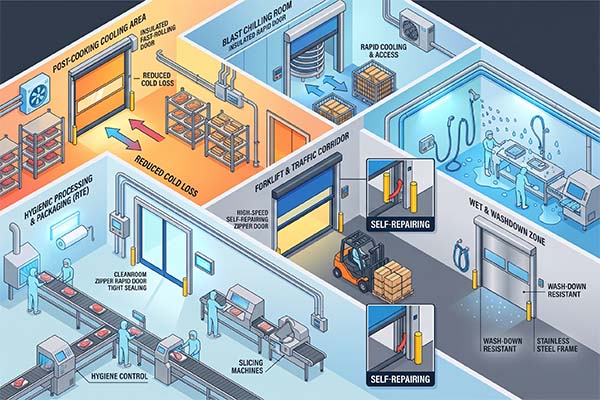
Common Cooling and Low-Temperature Areas in Food Processing Plants
Food processing plants may use cooling-zone doors in many different locations. Each area has a different function, so the door selection should also be different.
| Area | Typical Application | Main Door Function |
| Post-cooking cooling area | After steaming, baking, frying, boiling, or sterilizing | Reduce warm air transfer into the cooling zone |
| Blast chilling room | Cooked food, meat products, prepared meals, bakery products | Reduce cold air loss during frequent access |
| Cooling tunnel entrance and exit | Conveyor cooling line or spiral cooler | Support continuous product flow and temperature separation |
| Low-temperature processing room | Cutting, trimming, deboning, forming, mixing, or portioning | Maintain a chilled working environment |
| Chilled packaging area | Ready-to-eat food, dairy, meat, seafood, bakery, prepared meals | Support hygiene separation before packaging |
| Cooling buffer room | Between hot processing and cold processing areas | Reduce direct air exchange between temperature zones |
| Cold chain transfer passage | Between cooling area, cold storage, and dispatch zone | Improve logistics efficiency and reduce waiting time |
| RTE cooling separation area | Ready-to-eat food before final packaging | Help separate controlled food zones and reduce air exchange |
These areas should not all use the same door type. A blast chilling room may need stronger insulation. A chilled packaging area may need better hygiene design. A forklift transfer passage may need a self-repairing structure. A conveyor cooling tunnel may need customized sensing and automatic opening.
How High-Speed Doors Help Reduce Temperature Loss in Cooling Rooms
Temperature loss is one of the most common problems in cooling rooms. The issue is not always caused by poor insulation in the wall or refrigeration equipment. In many factories, the biggest weak point is the door opening.
When workers move carts, racks, trays, or pallet trucks through the entrance, the door may stay open for several seconds or even longer. If this happens repeatedly throughout the day, the cooling room may experience constant warm air intrusion.
High-speed doors reduce this problem by shortening the opening and closing cycle. The less time the opening remains exposed, the less opportunity there is for cold air to escape and warm air to enter.
For cooling rooms, this can help in several practical ways:
- Reduce cold air loss during frequent access
- Improve temperature stability near the door opening
- Lower the pressure on refrigeration equipment
- Reduce waiting time for workers and carts
- Support smoother movement between processing steps
- Help maintain a more controlled chilled environment
In food processing cooling zones, these benefits are especially important because products are often moving through a time-sensitive cooling process. A door that opens too slowly can interrupt the rhythm of production. A door that stays open too long can make the cooling environment harder to control.
Choosing Doors for Blast Chilling Rooms and Cooling Tunnels
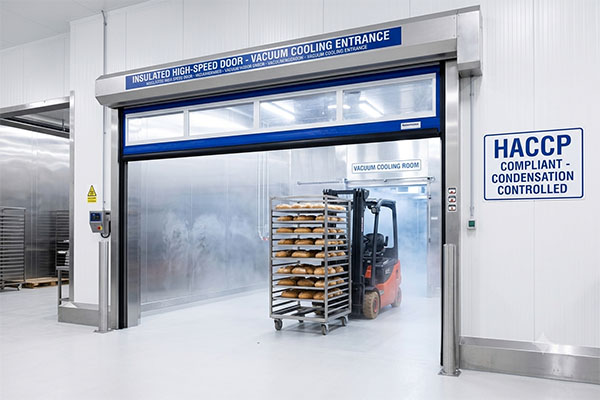
Blast chilling rooms and cooling tunnels are more demanding than ordinary chilled rooms. These areas are designed to remove heat from products quickly and efficiently. Any unnecessary air exchange at the entrance can affect cooling performance.
For blast chilling rooms, insulated high-speed doors are usually a better choice than standard PVC roll-up doors. The door should help reduce cold air loss, close quickly after carts or racks pass through, and maintain a more stable barrier between the blast chilling area and the outside environment.
For cooling tunnels or spiral coolers, the door may need to work with conveyor systems, sensors, or automated controls. In these cases, the door is not only a barrier. It becomes part of the production line. It must open at the right time, close quickly, and avoid interfering with product movement.
Key points for blast chilling and cooling tunnel door selection include:
- Room temperature range
- Door opening frequency
- Cart, rack, pallet, or conveyor traffic
- Size of the product and transport equipment
- Whether the door needs sensor or PLC linkage
- Whether condensation occurs around the entrance
- Whether the area requires daily washdown
High-speed doors for blast chilling areas should be selected based on real production movement, not only room temperature. A well-matched door can help protect cooling efficiency while keeping production flow smooth.
Door Selection for Low-Temperature Processing Areas
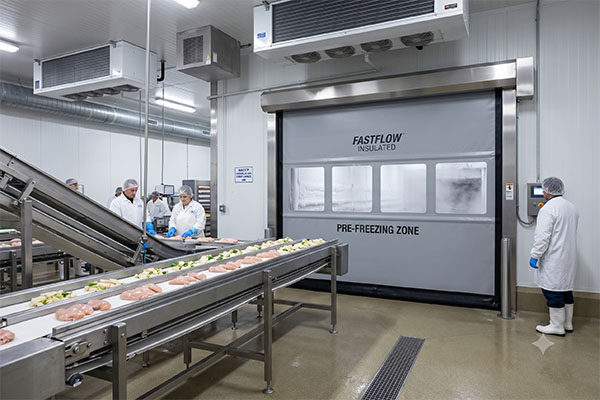
Low-temperature processing areas are common in meat, seafood, dairy, bakery, ready-meal, and prepared food factories. These rooms may be used for trimming, cutting, slicing, mixing, filling, forming, or temporary chilled handling.
The main challenge in these areas is balancing temperature control with frequent movement. Workers, carts, ingredients, trays, and semi-finished products may pass through the door many times per hour. If the door is too slow or inconvenient, workers may leave it open. If the door is not suitable for the environment, condensation and hygiene problems may appear around the opening.
In low-temperature processing rooms, high-speed doors can help create a more practical boundary between different areas. They can separate chilled processing rooms from corridors, raw material areas, packaging rooms, or buffer zones.
For this type of area, the door should be chosen according to:
- Chilled room temperature
- Hygiene grade of the processing zone
- Whether the product is exposed or packaged
- Whether the area handles raw food or cooked food
- Frequency of personnel and trolley movement
- Cleaning method and washdown intensity
- Risk of impact from carts or forklifts
If the area handles exposed food or ready-to-eat products, a food-grade design is more important. Stainless steel frames, easy-to-clean surfaces, and better sealing details may be required. If the area has heavy trolley traffic, a zipper high-speed door or self-repairing design can reduce downtime after accidental impact.
High-Speed Doors for Chilled Packaging and RTE Food Areas
Chilled packaging areas and RTE food areas need special attention because the products may already be cooked, cooled, or close to final packaging. At this stage, the door is not only used for temperature separation. It also helps support hygiene zoning.
A poor door choice may allow unnecessary air exchange between areas with different hygiene levels. It may also create a bottleneck where carts wait, workers open the door manually, or traffic crosses in an uncontrolled way.
High-speed doors for chilled packaging areas should support three goals:
- Keep production moving smoothly
- Reduce air exchange between controlled zones
- Support clean and hygienic operation around the entrance
For RTE or cooked food areas, the door should be placed as part of a wider hygiene zoning plan. It can work with personnel flow, material flow, air pressure strategy, and cleaning procedures. The door itself cannot replace a complete food safety system, but it can help make the separation between zones more reliable in daily operation.
In some facilities, cleanroom zipper high-speed doors are used between chilled processing rooms and packaging areas. They are suitable when the customer needs frequent access, controlled airflow, and better sealing performance.
Recommended Door Types for Different Cooling Zone Applications
Different cooling and low-temperature areas require different door solutions. The table below can be used as a practical selection reference.
| Application | Recommended Door Type | Why It Fits |
| Cooling room entrance | Insulated high-speed door | Helps reduce cold air loss during frequent access |
| Blast chilling room | Insulated high-speed door or zipper high-speed door | Supports faster traffic and better temperature separation |
| Cooling tunnel entrance | Customized high-speed roll-up door | Can work with conveyors, sensors, or automatic controls |
| Low-temperature cutting room | Food-grade high-speed door | Supports chilled processing and hygiene separation |
| Chilled packaging area | Cleanroom high-speed door | Helps reduce air exchange between controlled zones |
| RTE food cooling area | Cleanroom zipper high-speed door | Supports controlled access and hygienic zoning |
| Forklift transfer passage | Self-repairing zipper high-speed door | Reduces downtime after accidental impact |
| Wet cooling or washdown area | Stainless steel high-speed door | Better suited for moisture, cleaning, and corrosion resistance |
| Cold chain transfer passage | Insulated rapid door | Supports fast logistics and reduced temperature fluctuation |
This table is not a fixed rule. The final selection should depend on temperature, traffic, cleaning, hygiene grade, and door size.
Key Questions Before Choosing a Cooling Zone Door
Before selecting high-speed doors for cooling rooms or low-temperature processing areas, the buyer should answer several practical questions.
First, what is the room temperature? A room at 10°C, 4°C, 0°C, and below-freezing temperature may require different door structures. A general chilled room and a freezer entrance should not be treated the same way.
Second, how often will the door open? A door that opens 20 times per day has different requirements from a door that opens 200 times per day. High-frequency access needs faster operation and better durability.
Third, what type of traffic uses the door? Personnel doors, trolley passages, pallet truck routes, and forklift lanes all require different door sizes, sensors, and safety configurations.
Fourth, is the area wet or dry? A dry chilled packaging area and a wet seafood cooling area need different materials and cleaning considerations.
Fifth, is the product exposed? If the product is unpackaged, cooked, or ready-to-eat, the hygiene requirement is usually higher.
Sixth, does condensation already happen near the door? If yes, the cause may be air exchange, humidity, temperature difference, poor airflow design, or an unsuitable door opening cycle.
Finally, does the door need to connect with other equipment? Some cooling-zone doors may need radar sensors, pull cords, access control, conveyor linkage, or air shower/cleanroom interlock logic.
These questions make the article more useful for buyers and also help your website attract customers who are seriously planning a project.
Common Mistakes to Avoid When Selecting Cooling Zone Doors
Many food factories choose the wrong door because they only compare the purchase price. However, in cooling and low-temperature areas, the lowest-cost door may create long-term problems.
The first mistake is using a normal industrial roller shutter for a frequent-access cooling room. A slow door can increase cold air loss and disrupt daily workflow.
The second mistake is ignoring condensation. When warm and humid air meets a cold surface or cold room entrance, condensation may appear. This can lead to water dripping, fogging, slippery floors, or hygiene concerns.
The third mistake is using the same door type for every low-temperature area. A blast chilling room, chilled packaging room, and forklift transfer corridor do not have the same requirements.
The fourth mistake is ignoring cleaning conditions. In food processing, some areas need daily washing, foam cleaning, or high-humidity operation. The door material and structure should match this environment.
The fifth mistake is treating the door as an isolated product. In reality, the door should work together with refrigeration, airflow, drainage, traffic route, hygiene zoning, and production rhythm.
Avoiding these mistakes can help food processors choose a door that performs better in real daily operation.
What Door Should Be Used for Cooling Zones?
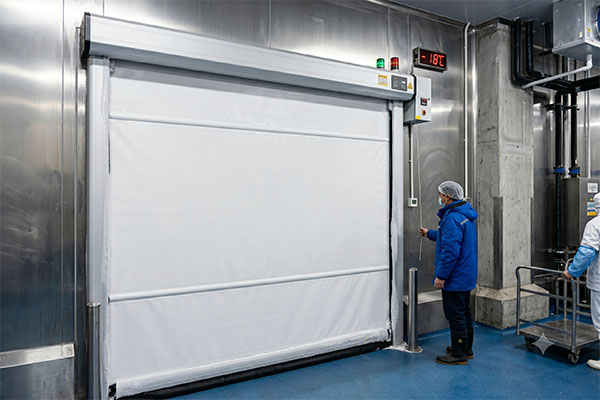
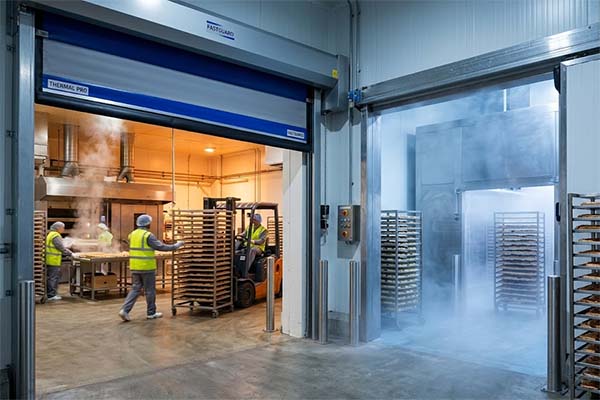
For most cooling-zone applications, insulated high-speed doors are a strong option because they combine faster access with better thermal separation. For clean or RTE food areas, cleanroom zipper high-speed doors may be more suitable. For wet or washdown cooling areas, stainless steel food-grade high-speed doors should be considered. For forklift-heavy areas, self-repairing zipper doors can reduce maintenance downtime.
However, if the application is a deep freezer or a very low-temperature cold storage room, the customer may need a dedicated freezer door with anti-freezing features, heated parts, or special sealing design. A standard high-speed door should not be used in every cold environment without checking the actual working conditions.
The best solution is to select the door based on the full application, not just the product name.
Conclusion
High-speed doors are valuable in food processing cooling zones because they help reduce temperature loss, support smoother traffic, reduce unnecessary air exchange, and improve separation between different processing areas.
In cooling rooms, they help reduce cold air escape during frequent access. In blast chilling areas, they support faster product movement and more stable cooling conditions. In low-temperature processing rooms, they help maintain a chilled working environment. In chilled packaging and RTE food areas, they support hygiene zoning and controlled access.
For food factories, the right door is not simply the fastest or most expensive option. The right door is the one that matches the room temperature, cleaning method, product exposure, traffic frequency, and hygiene requirement.If you are planning doors for a cooling room, blast chilling area, chilled packaging room, or low-temperature processing zone, the first step is to review the door opening size, temperature range, traffic type, and daily operating conditions. With this information, it becomes much easier to choose high-speed doors that support both production efficiency and temperature control.
FAQ
Are high-speed doors suitable for blast chilling rooms?
Yes, high-speed doors can be suitable for blast chilling rooms, especially when the entrance is used frequently by carts, racks, or pallet trucks. For this application, insulated high-speed doors are usually preferred because they help reduce cold air loss and support faster access.
What is the best door for low-temperature food processing areas?
The best door depends on the temperature, hygiene level, traffic frequency, and cleaning method. Insulated high-speed doors are suitable for many chilled processing areas, while cleanroom zipper doors may be better for RTE or controlled packaging zones. Wet areas may require stainless steel food-grade doors.
Can high-speed doors reduce condensation in cooling zones?
High-speed doors can help reduce air exchange between warm and cold areas, which may help lower condensation risk around the opening. However, condensation can also be affected by humidity, airflow, drainage, room pressure, and temperature difference. The door should be selected as part of the full environmental design.
Should cooling rooms use insulated high-speed doors?
In many frequent-access cooling rooms, insulated high-speed doors are a practical choice. They help reduce cold air loss while allowing workers, carts, and materials to move quickly. For light-duty or mild-temperature areas, a standard food-grade rapid door may be enough, but colder or high-traffic areas usually benefit from better insulation.
What is the difference between a cooling zone door and a freezer door?
A cooling zone door is usually used for chilled processing, cooling rooms, or temperature-controlled production areas. A freezer door is designed for much lower temperatures and may require special anti-freezing features, heated components, or stronger insulation. The two should not be selected in the same way.


