
Insulated High-Speed Doors are not just simple physical barriers in a modern food processing facility; they are critical thermal management instruments, especially within the highly demanding pre-freezing processing area. In the industrial food sector, the cooling zone—often referred to as the rapid cooling or low-temperature processing zone—acts as the vital bridge between ambient preparation areas and extreme-cold freezing environments like IQF (Individually Quick Frozen) systems or blast freezers.
If your facility is currently struggling with severe condensation issues, skyrocketing energy bills, or frequent blast freezer defrosting cycles, the root of the problem likely lies in your transition zones. Upgrading to Insulated High-Speed Doors that are specifically engineered for pre-freezing environments is a proven, highly effective strategy to eliminate these operational profit leaks. In this comprehensive technical guide, we will explore exactly why these specific doors are completely indispensable for modern cooling zones and how they directly address the most critical pain points of food manufacturers.
Contents
- 1 Understanding the Pre-Freezing Zone Crisis
- 2 The Critical Role of Insulated High-Speed Doors in Cooling Zones
- 3 Technical Advantages Over Generic Door Solutions
- 4 Maximizing ROI with Industrial Doors for Cooling Zones
- 5 Conclusion: Securing Your Cold Chain Infrastructure
- 6 FAQ
- 6.1 Q1: Can Insulated High-Speed Doors withstand the daily high-pressure Washdown processes required by HACCP in food processing?
- 6.2 Q2: How much energy can our facility actually save by switching from standard rigid cold storage doors to Insulated High-Speed Doors in our cooling zones?
- 6.3 Q3: If we install these insulated doors in our pre-cooling zones, do we still need to run overhead air curtains?
Understanding the Pre-Freezing Zone Crisis
Before we analyze the mechanical solution, we must deeply understand the environmental challenge. The pre-freezing area typically operates at a strictly controlled temperature, usually between 0°C and 10°C. Its primary function is to aggressively remove surface moisture and extract residual core heat from processed foods—such as recently blanched vegetables, freshly baked goods, or portioned raw meat—right before they enter the -40°C deep freeze.
When standard, uninsulated doors are deployed in this high-traffic, high-temperature-differential zone, two disastrous physical phenomena occur. First, warm and humid air easily invades the deep freezer, directly causing severe evaporator frosting. Second, heavy condensation forms rapidly on ceilings, walls, and the door surfaces themselves, posing a catastrophic risk of food contamination. This is precisely the critical juncture where Insulated High-Speed Doors change the operational game entirely.
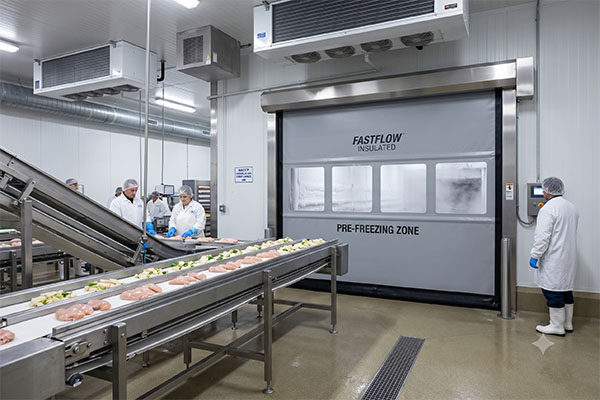
The Critical Role of Insulated High-Speed Doors in Cooling Zones
1. Eliminating Condensation to Ensure Total Food Safety
In a low-temperature processing zone, uncontrolled humidity is your absolute biggest enemy. When warm, moisture-laden air from the cooking, washing, or raw material handling area meets a poorly insulated door separating the cooling zone, the surface temperature of that door instantly drops below the ambient dew point. This rapid thermal clash creates heavy condensation. Water droplets forming on door tracks, headers, or PVC curtains can easily drip directly onto the exposed food passing below. This results in a severe violation of strict HACCP regulations and global food safety standards.
Insulated High-Speed Doors are equipped with advanced thermal barriers embedded within their multi-layered curtain design. By effectively preventing the transfer of cold energy—a process known as stopping the thermal bridge—the exterior surface of the door remains safely above the dew point. This basic thermodynamic management means zero condensation, no dripping contaminated water, and a completely hygienic pre-freezing transit process.
2. Protecting the Main Freezer from Evaporator Frosting
The pre-freezing zone sits strategically right in front of your facility’s most expensive and sensitive equipment: the main blast freezer or IQF line. Every single time a batch of product moves from the cooling zone into the deep freeze, air exchange inevitably occurs. If you rely on traditional, slow-moving doors, a massive volume of humid, slightly warmer air rushes directly into the freezer chamber. This airborne moisture instantly freezes directly onto the evaporator coils.
By utilizing Insulated High-Speed Doors, which operate at opening and closing speeds frequently exceeding 1.5 to 2.0 meters per second, the costly air infiltration window is cut down to almost zero. These fast roll-up doors for food processing ensure that your IQF machine doesn’t choke on accumulated ice. By preventing this moisture intrusion, you drastically reduce mandatory and time-consuming defrost downtime, thereby keeping your primary production line moving at maximum capacity.
3. Maintaining Continuous High-Traffic Flow and Throughput
Industrial food processing is a relentless game of continuous motion. Conveyor belts, automated guided vehicles (AGVs), and forklift operators must move perishable products rapidly through the cooling zone to lock in maximum freshness and cellular integrity. Traditional, heavy, rigid cold storage doors inevitably slow down this delicate process, creating logistical bottlenecks and exposing the food to fluctuating temperatures for too long.
Because Insulated High-Speed Doors are mechanically engineered for rapid, high-cycle operations, they can easily keep up with the most aggressive, 24/7 production schedules. They open instantaneously for incoming traffic via radar or magnetic loop sensors and seal tightly the very fraction of a second the product clears the threshold. This makes them the ultimate pre-freezing transition doors for ambitious facilities that simply cannot afford to slow down their throughput.
Technical Advantages Over Generic Door Solutions
You might wonder why standard, single-layer high-speed PVC doors aren’t sufficient for this specific area. The answer comes down to advanced thermal dynamics and structural integrity.
4. Advanced Thermal Insulation Properties
Standard industrial doors act merely as basic windbreaks; they offer virtually no R-value. In stark contrast, Insulated High-Speed Doors are constructed with technologically advanced, multi-layered, foam-filled, or aerogel-lined curtains. When installed in a rapid cooling zone, this specialized insulation actively and aggressively resists temperature bleed. You can maintain a strict, unwavering 5°C environment on the inside, without ever forcing your expensive HVAC and refrigeration systems to work overtime to fight the ambient 25°C temperature on the other side.
5. Robust Seal Technology for Unwavering Temperature Control
True thermal efficiency is not just about the thickness of the curtain; it is heavily dependent on the perimeter integrity. High-quality thermal insulated rapid doors utilize heavy-duty, frictionless zipper systems or specialized magnetic track seals. When the door cycles closed, it forms an almost completely airtight, hermetic barrier. This is absolutely critical in low-temperature processing zones, where even a seemingly insignificant draft can cause localized temperature spikes, leading to uneven pre-cooling of the food products and inconsistent final freezing results.
Maximizing ROI with Industrial Doors for Cooling Zones
6. Drastic Reduction in Facility Energy Consumption
The massive refrigeration compressors powering your rapid cooling zones and blast freezers consume staggering amounts of electricity. Every single second a door is left open, or every hour it bleeds cold air through a weak seal, your operational budget is literally escaping into the atmosphere. Insulated High-Speed Doors provide an unbeatable dual-defense mechanism against energy loss: their internal insulation forcefully stops passive heat transfer when closed, and their rapid cycling speed stops active air exchange when open. Facilities upgrading to these specialized rapid doors for temperature control routinely see a full return on investment within 12 to 18 months strictly through verifiable energy savings.
7. Crash-Forgiving Design for Uninterrupted Operations
In a bustling, high-stress pre-freezing processing area, accidental forklift or pallet jack collisions with equipment are an unfortunate inevitability. A damaged, jammed door in a critical cold zone means an immediate, costly halt to production until a maintenance crew can repair it. Modern Insulated High-Speed Doors feature intelligent, self-repairing track systems. If the insulated curtain is accidentally impacted by heavy machinery, it safely breaks away from the vertical track to prevent permanent structural damage. As the door cycles up, it automatically reinserts itself into the guides. This brilliant engineering guarantees zero mechanical downtime in your facility’s most critical cold chain pathway.
Conclusion: Securing Your Cold Chain Infrastructure
The pre-freezing processing area is the critical final checkpoint before your valuable product is permanently preserved in the deep freeze. Failing to strictly control the climate, humidity, and hygiene in this specific transitional zone compromises the texture and quality of your food, dangerously inflates your energy bills, and inflicts unnecessary wear and tear on your expensive freezing equipment.
Investing strategically in Insulated High-Speed Doors is not merely a standard facility maintenance upgrade; it is a fundamental, non-negotiable requirement for mastering temperature control, effortlessly passing strict hygiene audits, and optimizing your overall food processing operational efficiency. By installing the correct thermal insulated rapid doors, you effectively seal your hard-earned profits inside the production line and keep costly operational headaches out permanently.
FAQ
Q1: Can Insulated High-Speed Doors withstand the daily high-pressure Washdown processes required by HACCP in food processing?
Absolutely. High-quality Insulated High-Speed Doors designed for food applications are built with 304 or 316 stainless steel side frames, sloped hoods to prevent water pooling, and fully sealed, non-absorbent curtain materials. They are specifically engineered to withstand aggressive, daily Washdown procedures using high-pressure water and chemical foaming agents without degrading, rusting, or harboring bacterial growth.
Q2: How much energy can our facility actually save by switching from standard rigid cold storage doors to Insulated High-Speed Doors in our cooling zones?
While exact numbers depend on your facility’s specific temperature differentials and traffic frequency, the savings are universally substantial. Standard rigid doors are notoriously slow, leaving the chamber exposed for 10-15 seconds per cycle. Insulated High-Speed Doors reduce this exposure to merely 2-3 seconds. By nearly eliminating the massive loss of refrigerated air and stopping the compressor from constantly kicking on, most processing plants report an immediate 30% to 40% reduction in the localized energy costs associated with their cooling zones.
Q3: If we install these insulated doors in our pre-cooling zones, do we still need to run overhead air curtains?
In most standard pre-freezing and cooling zone applications, the exceptional speed and airtight perimeter seals of Insulated High-Speed Doors eliminate the need for secondary air curtains. Air curtains are often used to compensate for slow-moving or poorly sealed doors. Because a rapid insulated door minimizes the open-time window so aggressively and seals tight to the floor and tracks, you can often power down or entirely remove redundant air curtains, saving further on equipment maintenance and electrical overhead.


