
Contents
- 1 Introduction
- 2 Exploring the Invisible Destroyer: Why Do Logistics Centers Generate Extreme Wind Loads and Negative Pressure?
- 3 The Fatal Weakness of Traditional Speed Roll Up Doors Under Strong Winds
- 4 Cracking the Wind Pressure Puzzle: The Hardcore Mechanical Aesthetics of High Speed Stacking Doors
- 5 Standard Exterior Speed Doors vs. High Speed Stacking Doors
- 6 Case Study: Typhoon Retrofit at a Coastal Port Distribution Center
- 7 Conclusion & Integration Advice
- 8 FAQ for Exterior Wind-Resistant Doors
Introduction
In the design of modern ultra-large distribution centers, massive “drafts” and intense “negative pressure effects” frequently form inside the building. When dealing with such extreme aerodynamic environments, ordinary exterior speed roll up doors are often overwhelmed. Massive wind loads cause the flexible curtains to balloon severely, or even completely derail and tear, paralyzing logistics aisles. To break this deadlock, the professional high speed stacking door emerged. This article will deeply deconstruct the hardcore physics of its “horizontal wind ribs” and “strap-lifting” technologies, revealing why it is the ultimate wind-resistant armor for oversized exterior openings.
Exploring the Invisible Destroyer: Why Do Logistics Centers Generate Extreme Wind Loads and Negative Pressure?
To solve the problem of wind-damaged doors, we must first understand the fluid dynamics inside large warehousing buildings:
1. The Draft/Cross-Ventilation Effect
Modern logistics hubs span tens of thousands of square meters, surrounded by loading docks. When exterior doors on opposite sides of the building open simultaneously, outdoor airflow is accelerated and sucked through the facility like entering a wind tunnel, creating highly destructive drafts.
2. The Negative Pressure Trap
When powerful HVAC exhaust systems operate, or when external gales blow across the flat roof (according to Bernoulli’s principle), the indoor air pressure drops significantly below the outdoor pressure. At this moment, all exterior doors are “sucked inward” by an invisible, massive force. This continuous pulling force, reaching tens of Pascals, is devastating to the tracks of traditional high-speed doors.
The Fatal Weakness of Traditional Speed Roll Up Doors Under Strong Winds
Traditional flexible speed roll up doors excel in indoor dust control and insulation, but face two fatal bottlenecks in high-wind exterior environments:
- Friction Overload and Blowouts: Ordinary zipper doors rely on friction within the side tracks to secure the curtain. When wind loads exceed levels 6-8, the curtain balloons violently (sail effect), and the immense friction easily burns out the lifting motor. If the wind increases further, the curtain is forcefully ripped out of the tracks (Blowout).
- Size Bottlenecks: The larger the opening, the wind-exposed area grows exponentially. On exterior openings exceeding 5 meters in width or height, the wind resistance of purely flexible curtains degrades sharply to a dangerous breaking point.
Cracking the Wind Pressure Puzzle: The Hardcore Mechanical Aesthetics of High Speed Stacking Doors
To completely resolve the contradiction between massive sizes and high wind resistance, the High Speed Stacking Door employs a fundamentally different mechanical structure:
1. Heavy-Duty Horizontal Wind Ribs
- Technical Analysis: Abandoning purely flexible designs, stacking doors insert robust aluminum or steel wind ribs every 40-60cm between the double-layer PVC curtain.
- Core Function: These metal skeletons evenly transfer and dissipate massive wind pressure into the heavy-duty steel side tracks. It turns the door into a solid armored wall, effortlessly withstanding Class 10+ gales (meeting Class 3/4 wind load under EN 12424), completely eliminating the risk of curtain ballooning and derailment.
2. Frictionless: Innovative Strap-Lifting Mechanism
- Technical Analysis: Facing the friction of strong winds pressing the curtain hard against the tracks, ordinary doors easily burn motors. Stacking doors don’t use a roller to “hard roll” it; they use a “fold and lift” principle.
- Core Function: Using heavy-duty industrial nylon lifting straps inside or outside the curtain, the motor pulls the ribbed curtain up layer by layer, folding and stacking it like blinds. This ingeniously bypasses vertical track friction, maintaining smooth and high-speed opening even when howling winds press against the door.
3. Scaling Up: Breaking Engineering Limits
- Technical Analysis: Thanks to the rigid support of the wind ribs and the load-bearing advantages of folding and stacking, these doors can be easily customized to massive sizes of 10m wide x 10m high or more. This is unimaginable in traditional high-speed roll doors, perfectly meeting the access needs of heavy trucks, gantry cranes, or oversized
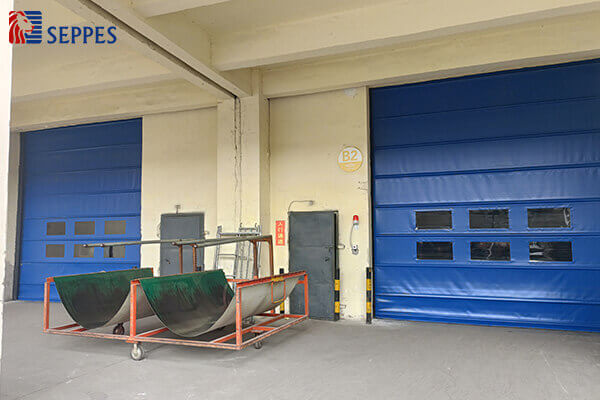
Standard Exterior Speed Doors vs. High Speed Stacking Doors
| Dimension | Standard Exterior Fast Door | High Speed Stacking Door | Engineering Impact |
| Wind Class – EN 12424 | Low, Class 1-2, balloons & derails | Very High, Class 3-4, resists Class 10+ gales | Determines if exterior doors fail in coastal/large plants. |
| Lifting Mechanism | Top roller forced roll-up. | Heavy straps folding & stacking layer by layer. | Folding eliminates motor burnout risk under wind pressure. |
| Max Size | Rarely exceeds 5×5 meters. | Easily achieves 10×10 meters or larger. | Ensures smooth transit for oversized equipment & trucks. |
| Repair Cost | Tearing requires full curtain replacement. | Modular replacement of single fabric segments. | Lowers maintenance costs after accidental forklift impacts. |
Case Study: Typhoon Retrofit at a Coastal Port Distribution Center
- Background: A port-side logistics distribution center suffered from strong sea breezes year-round, and its massive internal volume was constantly under negative pressure. During a Level-9 gale, the existing exterior zipper doors completely derailed and tore, allowing massive rain and salt spray indoors, forcing logistics to halt for two full days.
- Solution: The facility manager decisively restructured the perimeter, upgrading six 6m x 6m wind-facing main doors to high speed stacking doors with a Level-11 wind resistance rating, featuring reinforced horizontal aluminum wind ribs.
- Measurable Results: In subsequent typhoon seasons, facing fierce external positive wind pressure and indoor negative pressure pulls, the doors acted like solid steel walls, still operating normally at speeds of 1.0 m/s. This completely solved the long-standing “wind paralysis” problem of the coastal logistics center, maintaining 100% full-load logistics throughput.
Conclusion & Integration Advice
In large distribution centers, wind loads and negative pressure are nature’s harshest tests for buildings. Attempting to use standard indoor doors to resist outdoor hurricanes is not only a waste of engineering resources but a severe threat to high-frequency logistics efficiency.
Don’t let fragile exterior aisle doors become the “Achilles’ heel” of your logistics efficiency. Invest in a high speed stacking door equipped with a wind-resistant skeleton and strap-lifting technology for oversized wind-facing openings. Use mechanical rigidity and ultra-fast transit to calmly resist the invisible massive forces of nature.
FAQ for Exterior Wind-Resistant Doors
Q1: Does the folding mechanism of the high speed stacking door slow down its opening speed?
No negative impact. Although slightly heavier than pure indoor soft doors, equipped with high-power servo brake motors and high-strength strap structures, stacking doors still achieve high-speed runs of 0.8 – 1.2 m/s. This speed far exceeds traditional metal roller shutters or sectional doors, perfectly meeting the high-frequency transit of exterior forklifts.
Q2: How is the bottom seal? Can it effectively prevent heavy rain and dust from entering?
Excellent sealing. Stacking doors come standard with thickened flexible EPDM rubber seals or safety air bags at the bottom. When closed, it uses the weight of the wind ribs to tightly conform to or even compensate for uneven floors, creating an outstanding weather barrier that effectively blocks rain and high wind penetration.
Q3: If a wind rib is bent by an out-of-control forklift, do I need to replace the entire door?
Not at all. This is a massive advantage of the stacking door design. Its curtain is composed of multiple independent PVC fabric segments. If a severe impact bends a horizontal beam, maintenance personnel simply slide out the damaged rib and single fabric piece for local replacement. Repair costs are extremely low and very quick.


