
Contents
- 1 High-Speed Roll-Up Doors for Food Processing Workshops: How to Prevent Dust, Pests, and Temperature Loss
- 1.1 Common Problems in Food Processing Workshops
- 1.2 Why Traditional Doors Are Not Enough for Food Workshops
- 1.3 Why Choose High-Speed Roll-Up Doors for Food Processing Workshops?
- 1.4 How High-Speed Roll-Up Doors Solve Food Workshop Problems
- 1.5 Traditional Doors vs. High-Speed Roll-Up Doors
- 1.6 Application Case: High-Speed Roll-Up Doors in a Food Processing Workshop
- 1.7 Door Upgrade Solution
- 1.8 Results After Three Months of Operation
- 1.9 Conclusion
- 1.10 FAQ: High-Speed Roll-Up Doors for Food Processing Workshops
- 1.10.1 1. Are high-speed roll-up doors required in food processing workshops?
- 1.10.2 2. Can high-speed roll-up doors prevent insects?
- 1.10.3 3. Are high-speed roll-up doors suitable for cold storage areas?
- 1.10.4 4. Do high-speed roll-up doors comply with food industry requirements?
- 1.10.5 5. What type of high-speed door is best for food factories?
High-Speed Roll-Up Doors for Food Processing Workshops: How to Prevent Dust, Pests, and Temperature Loss
In the food processing industry, the workshop environment directly affects product quality, food safety, and compliance with standards such as HACCP and GMP. Among all control points in a food factory, workshop entrances and exits are especially important because they are key areas for air exchange, contamination control, personnel movement, and logistics flow.
However, many food manufacturers still face persistent problems in daily operations, including dust contamination, insect intrusion, unstable temperature, high energy consumption, and cross-contamination risks caused by frequent door opening.
So, how can food processing workshops solve these problems effectively?One practical solution is the use of high-speed roll-up doors for food processing workshops. Compared with traditional doors, high-speed roll-up doors are better suited for clean, high-frequency, and temperature-controlled industrial environments.
Common Problems in Food Processing Workshops
1. Dust and Airborne Contamination Are Difficult to Control
During food production, raw materials, packaging, forklifts, and workers frequently move in and out of the workshop. If doors remain open for too long, external dust, particles, and airborne pollutants can easily enter the production area.
This problem becomes more serious when the workshop does not have stable airflow organization, such as positive pressure or negative pressure control. Once the door opens, air convection may bring external particles directly into the clean production area.
Over time, poor dust control can affect product quality and may even cause difficulties during food safety audits.This is why many food factories now choose dust-proof high-speed roll-up doors to reduce air exchange time and support cleaner workshop conditions.
2. High Risk of Insects and Foreign Objects Entering the Workshop
Food processing workshops have strict hygiene requirements. However, traditional doors often have poor sealing performance, and frequent personnel or logistics movement creates opportunities for mosquitoes, flies, and other insects to enter.
This issue is especially serious in summer. Once insects enter the production area, they may affect product quality, trigger customer complaints, or even lead to product recall risks.
In integrated pest management systems, entrance sealing performance and door opening time are two important factors affecting the probability of flying insects entering a food factory.A properly designed insect-proof rapid roll door can significantly reduce the exposure time of the workshop entrance and improve pest control performance.
3. Unstable Temperature and High Energy Costs
Many food workshops, such as fruit and vegetable processing areas, cold chain food production zones, dairy processing workshops, and refrigerated packaging areas, require strict temperature control.
Traditional doors usually open slowly and remain open for a long time. As a result, cold air or conditioned air escapes quickly, causing obvious temperature fluctuations.
Frequent door opening can also break the temperature separation between cold areas and normal-temperature areas. This increases the workload of air-conditioning or refrigeration systems, leading to higher operating costs.For these applications, cold chain high-speed roll-up doors can help reduce temperature loss, stabilize the workshop environment, and lower energy consumption.
4. Low Passage Efficiency for Workers and Logistics
In high-frequency food production environments, traditional doors are often slow and may require manual operation. This can cause waiting, congestion, and even safety risks when people and forklifts share the same passage.
For modern food factories, entrance efficiency is not only about speed. It also affects production rhythm, logistics flow, worker safety, and overall workshop management.An automatic high-speed roll-up door with radar sensors, loop detectors, or push-button controls can improve traffic efficiency and reduce unnecessary waiting time.
Why Traditional Doors Are Not Enough for Food Workshops
Traditional roller shutter doors, swing doors, or ordinary industrial doors often have several limitations in food processing environments:
They open slowly, leaving the workshop exposed for too long.
Their sealing performance is usually limited, making it difficult to block dust and insects effectively.
They are often not suitable for automatic high-frequency operation.
They cause large energy losses in temperature-controlled areas.
They may not support positive pressure control or cleanroom air management requirements.
Because of these limitations, traditional doors are increasingly unable to meet the hygiene, efficiency, and environmental control needs of modern food factories.
This is why industrial high-speed roll-up doors have become a preferred door solution for many food processing plants.
Why Choose High-Speed Roll-Up Doors for Food Processing Workshops?
In the food industry, high-speed roll-up doors, also known as industrial fast doors, PVC rapid roll doors, or high-speed industrial doors, are widely used in clean workshops, cold chain processing areas, central kitchens, dairy production areas, and packaging zones.
Compared with traditional doors or air curtain systems, high-speed roll-up doors provide better performance in:
- Air isolation
- Dust prevention
- Pest control
- Cross-contamination prevention
- Temperature stability
- High-frequency logistics access
- Energy saving
- Automatic operation
When selecting a door system for a food processing workshop, companies should focus on several key factors:
Opening speed: Shortens the time of air exchange. Sealing performance: Helps prevent dust, insects, and contaminants. Automation level: Supports radar sensors, ground loop detectors, or access control systems. Durability: Suitable for high-frequency industrial use. Maintenance cost: Reduces long-term operation expenses. Compatibility: Works with positive pressure systems, air showers, or buffer rooms.In high-standard food factories, high-speed doors are often used together with air showers, buffer rooms, or pressure control systems to create a multi-layer isolation structure.
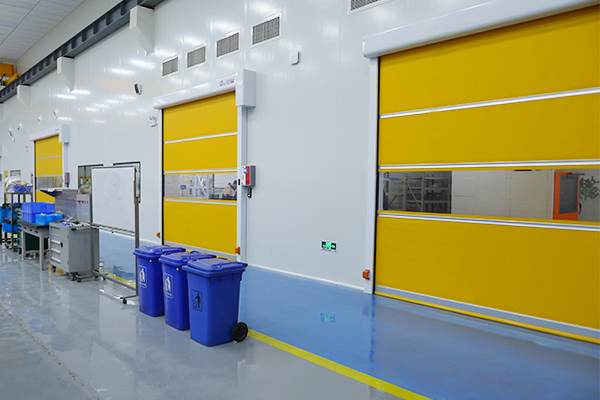
How High-Speed Roll-Up Doors Solve Food Workshop Problems
1. How Do High-Speed Roll-Up Doors Reduce Dust in Food Workshops?
A high-speed roll-up door can open and close quickly, usually at a speed of around 0.8–1.5 m/s, depending on the door model and application.
Because the door remains open for a much shorter time, the amount of external air entering the workshop is greatly reduced. This helps limit dust, particles, and airborne pollutants.
In addition, good sealing performance helps maintain a stable positive pressure environment inside the workshop, preventing external contaminants from entering the clean production area.For food factories with strict hygiene requirements, this makes dust-proof high-speed roll-up doors an effective solution.
2. Can High-Speed Roll-Up Doors Prevent Insects?
Yes. High-speed roll-up doors can help reduce insect intrusion in two key ways.
First, the door closes quickly after people or forklifts pass through, reducing the time insects have to enter the workshop.
Second, the door is designed with tight side sealing and bottom sealing structures, which help block mosquitoes, flies, and other insects from entering through gaps.
In some food processing environments, high-speed doors can also be used together with air shower systems or buffer rooms to further improve hygiene control.This makes them suitable as pest control doors for food production areas.
3. How Do High-Speed Doors Help with Temperature Control and Energy Saving?
Because high-speed roll-up doors open and close quickly, they can significantly reduce the loss of cold air, warm air, or conditioned air.
For cold chain food processing, dairy production, refrigerated packaging, and constant-temperature workshops, this helps maintain a more stable production environment.
In high-frequency areas where doors may open more than 500 times per day, reducing each opening cycle by even one second can lower the exchange of hot and cold air. This helps reduce the operating load of refrigeration and air-conditioning systems.
In real projects, energy consumption may often be reduced by around 10%–20%, depending on door usage frequency, workshop layout, and environmental conditions.Therefore, energy-saving high-speed roll-up doors are not only hygiene equipment but also part of a long-term cost optimization strategy.
4. How Do High-Speed Roll-Up Doors Improve Passage Efficiency?
High-speed roll-up doors can be equipped with radar sensors, ground loop detectors, pull cords, push buttons, or access control systems.
When forklifts, carts, or workers approach the door, the system can open automatically and close immediately after passage.
This reduces manual operation, waiting time, and traffic congestion. It also improves the safety and efficiency of personnel and logistics flow.For food factories with high daily traffic, automatic industrial fast doors can help optimize production rhythm and reduce unnecessary delays.
Traditional Doors vs. High-Speed Roll-Up Doors
| Item | Traditional Door | High-Speed Roll-Up Door |
| Opening Speed | Slow | Fast |
| Sealing Performance | General | High |
| Pest Prevention | Weak | Strong |
| Energy Consumption | High | Low |
| Automation | Limited or none | Supported |
| Suitable for High-Frequency Use | Limited | Yes |
| Temperature Control | Poor | Better |
| Dust Prevention | Limited | Strong |
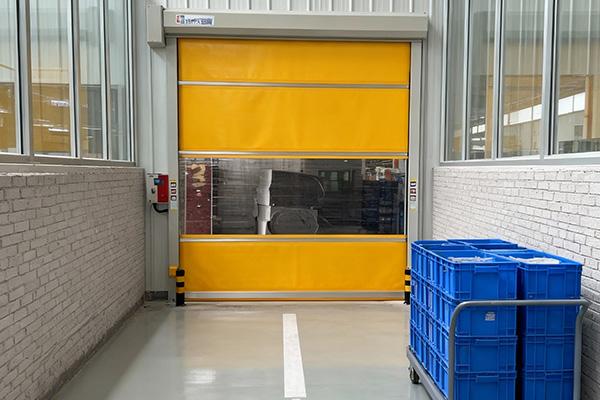
Application Case: High-Speed Roll-Up Doors in a Food Processing Workshop
A frozen food manufacturer in East China, with an annual production capacity of about 20,000 tons, upgraded its clean workshop system in 2024. The company mainly supplied products to supermarket channels and had strict requirements for hygiene and temperature control.Before the upgrade, the factory used ordinary roller shutter doors between the workshop and the external buffer area.
Problems Before the Upgrade
The original doors required around 8–12 seconds to open.
The doors opened more than 500 times per day, especially during peak forklift traffic.
Flying insect monitoring points frequently exceeded control limits in summer.
The refrigerated processing area had large temperature fluctuations, around ±2.5°C to ±3°C.
The air-conditioning and refrigeration systems operated under high load for long periods.During a third-party food safety audit based on HACCP principles, the entrance area was identified as a potential cross-contamination risk point.
Door Upgrade Solution
The company replaced the original doors at three major logistics passages with industrial high-speed roll-up doors.
The new door system included:
- Opening speed of about 1.2 m/s
- Closing speed of about 0.8 m/s
- Double-side sealing brushes
- Bottom airbag sealing structure
- Radar and ground loop dual-sensor automatic opening system
- Linkage with the workshop positive pressure system
This solution was designed not only as a door replacement but also as part of the workshop environmental control system.
Results After Three Months of Operation
1. Cleaner Workshop Environment
The average door opening time was reduced to around 2–3 seconds, greatly reducing external air entry.
According to internal monitoring data, the concentration of suspended particles in the workshop decreased by more than 30%.
2. Improved Pest Control
Because the door opening time was shortened and the sealing structure was improved, data from insect traps showed a reduction of around 70%.
Summer pest complaints were almost eliminated.
3. More Stable Temperature Control
The temperature fluctuation in the refrigerated processing area was reduced from around ±3°C to within ±1°C.
This better met the temperature stability requirements of cold chain food processing.
4. Lower Energy Consumption
The refrigeration system load decreased, and overall energy consumption was reduced by around 12%–18%, based on the company’s internal energy reports.
5. Higher Logistics Efficiency
The automatic sensing system reduced manual operation. Forklift waiting time for each passage was reduced by about 60%, while overall logistics efficiency improved by around 25%–30%.
Project Summary
In later customer factory inspections and third-party audits, the upgraded entrance system was recognized for its improved sealing control and air isolation design.This case shows that a high-speed roll-up door is not just a door upgrade. It is part of a complete food workshop environmental control solution.
Conclusion
For food processing companies, workshop environmental control is not only a compliance requirement. It is also an important part of product quality, brand reputation, and long-term competitiveness.
By installing high-speed roll-up doors for food processing workshops, manufacturers can reduce dust, prevent insects, stabilize temperature, improve logistics efficiency, and lower energy costs.
If you are looking for a reliable food processing workshop door solution, a customized high-speed roll-up door system can help your facility improve hygiene control, production efficiency, and food safety performance.Contact us today to get a customized high-speed roll-up door solution for your food processing workshop.
FAQ: High-Speed Roll-Up Doors for Food Processing Workshops
1. Are high-speed roll-up doors required in food processing workshops?
They are not always mandatory. However, in high-cleanliness, high-frequency, temperature-controlled, or pest-sensitive areas, high-speed roll-up doors offer clear advantages over traditional doors.
2. Can high-speed roll-up doors prevent insects?
Yes. Their fast opening and closing speed, combined with strong sealing structures, can effectively reduce the probability of insects entering food production areas.
3. Are high-speed roll-up doors suitable for cold storage areas?
Yes. They are especially suitable for cold chain environments, refrigerated processing areas, and workshops that require stable temperature control.
4. Do high-speed roll-up doors comply with food industry requirements?
When properly designed and installed, high-speed roll-up doors can meet the needs of food factories for hygiene control, isolation, dust prevention, pest control, and environmental stability. The final solution should be designed according to the specific workshop layout and production process.
5. What type of high-speed door is best for food factories?
For most food processing workshops, PVC high-speed roll-up doors with good sealing performance, automatic sensors, and easy-to-clean materials are commonly used. For refrigerated or cold chain areas, insulated high-speed doors may be more suitable.


