
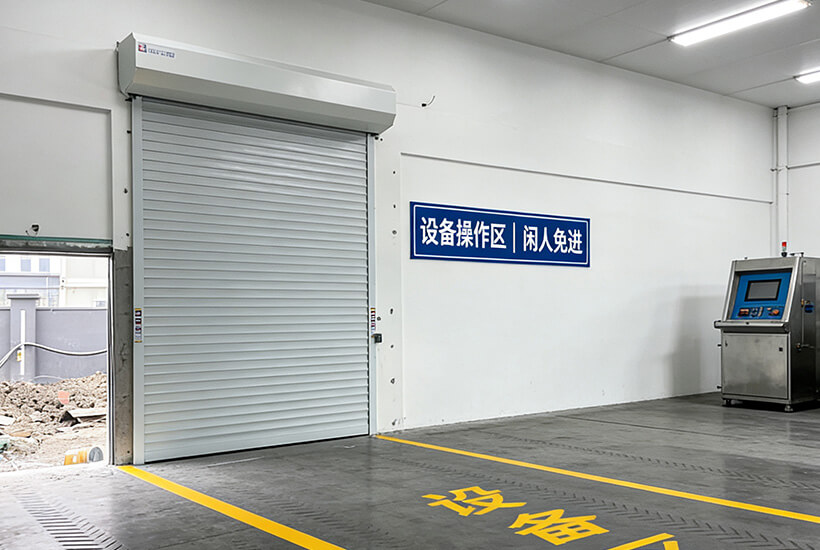
In today’s fast-paced industrial landscape, efficiency, security, and durability are paramount when it comes to choosing the right doors for your business. Whether you’re operating a warehouse, manufacturing plant, or distribution center, the type of door you install plays a crucial role in ensuring smooth operations and safeguarding assets. Industrial steel roll-up doors have become a go-to solution for businesses looking to balance functionality with security.
In this comprehensive guide, we’ll explore the essential features, benefits, and applications of industrial steel roll-up doors. From their unmatched durability to their energy-efficient design, you’ll discover why these doors are the preferred choice across various industries. Whether you’re in the market for a new installation or seeking to upgrade your current system, this article will provide you with the key insights needed to make an informed decision.
Stay with us as we break down what makes industrial steel rolling doors stand out, and how they can streamline your business operations while providing top-notch protection.
Contents
- 1 Why Choose Industrial Steel Roll-Up Doors? (Key Benefits)
- 2 Types of Rolling Steel Doors
- 3 Market Trends & Innovations for 2025
- 4 Installation and Maintenance of Roll-Up Doors
- 5 Conclusion
- 6 Frequently Asked Questions about Roll-Up Doors
- 6.1 What is a industrial roll up door, and how does it differ from a traditional garage door?
- 6.2 Are steel roll and gauge steel important when choosing commercial roll up doors?
- 6.3 Can roll up doors be insulated for self storage or temperature-controlled spaces?
- 6.4 What wind load and safety features should I consider for commercial roll-up and wind-rated doors?
- 6.5 How do coiling doors and rolling service doors impact maintenance and door repair needs?
- 6.6 Which door models and custom rolling door options are available for commercial use?
- 6.7 Are commercial roll up doors affordable and what affects pricing?
- 6.8 How do I choose between a service door, security doors, or a commercial overhead door for my facility?
Why Choose Industrial Steel Roll-Up Doors? (Key Benefits)
Durability and Security Features
- Heavy-Duty Construction: These doors are made from commercial-grade steel slats (typically 18-gauge to 24-gauge). This robust construction creates a formidable barrier against forced entry, vandalism, and impact from daily operations.
- Weather Resistance: With a carefully discerned wind load rating, industrial roll-up doors are made to withstand extreme winds during storms. This improves and fortifies the structural integrity of the overall building, as well as protects the contents inside.
Superior Space Optimization
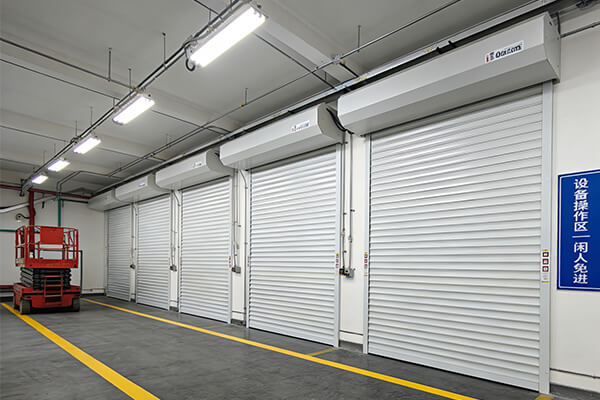
- Vertical Coiling Mechanism: Unlike sectional doors, which slide horizontally, industrial rolling doors coil upward into a compact drum above the opening.
- Maximize Overhead Clearance: This design frees up critical ceiling space, allowing for the unobstructed installation of fire sprinkler systems, HVAC ducting, and lighting. It also prevents interference with tall machinery or forklifts operating near the doorway.
Energy Efficiency through Insulation
- High Thermal Efficiency: Foamed-in-place insulation is positioned between the steel slats of our insulated models. This is why these doors have superior R-values making them critical for cold storage and temperature-controlled distribution centers.
- Reduced Utility Bills: Insulated roll-up doors reduce the amount of heat transfer and infiltration which lightens the load of the heating and cooling systems. This leads to significant cost savings because the systems are not in operation as often.
Types of Rolling Steel Doors
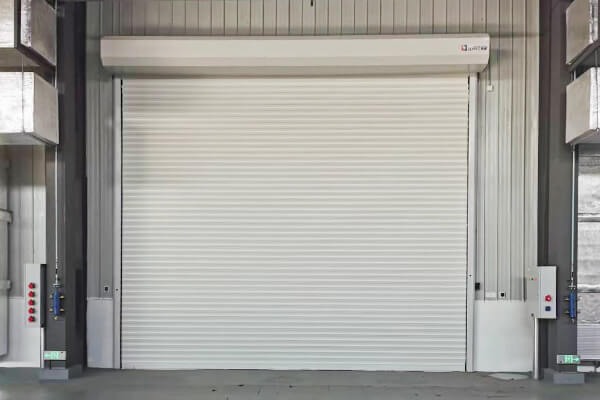
Selecting the correct door type is critical for operational efficiency and compliance. Below are the primary categories of industrial steel roll-up doors, tailored to specific facility requirements.
Rolling Shutter Doors
These are the industry standards for general security and heavy-duty protection.
- Best For: Warehouses, loading bays, and distribution centers requiring robust physical security.
- Key Features: Constructed from galvanized steel slats, these doors offer a solid barrier against intrusion and weather. They are designed for durability and low-maintenance operation in high-traffic environments.
Insulated Roll-Up Doors
Designed to minimize energy loss, these doors feature foamed-in-place insulation within the steel slats.
- Best For: Cold storage facilities, manufacturing plants, and noise-sensitive areas.
- Key Features: These doors provide excellent thermal efficiency (U-value/R-value), helping maintain internal temperatures and significantly reducing heating or cooling costs. They also offer acoustic insulation, reducing noise pollution between working zones.
High-Speed Roll-Up Doors
Modern logistics demand speed. These doors are engineered for rapid open/close cycles to optimize workflow.
- Best For: High-traffic logistics hubs and environments requiring strict climate control.
- Key Features: With opening speeds exceeding 1.5m/s, these doors minimize air exchange between zones. This rapid action prevents heat loss, reduces the ingress of dust or contaminants, and ensures forklifts can move without delay.
Fire-Rated Rolling Doors
These safety-critical doors are engineered to prevent the spread of fire and smoke, facilitating safe evacuation and protecting assets.
- Best For: Firewalls, lift lobbies, and hazardous storage areas requiring compartmentalisation.
- Key Features: Made to meet rigorous safety standards (such as NFPA or EN 1634), these doors feature auto-closing mechanisms triggered by heat or smoke alarms. They carry certified fire resistance ratings (e.g., 60 to 240 minutes) to contain hazards effectively.
Perforated Shutters & Security Grilles
A balance between security and openness, allowing for “see-through” protection.
- Best For: Retail shopfronts, underground car parks, and industrial zones requiring ventilation.
- Key Features: These options provide a secure physical barrier while maintaining visibility and airflow. They are essential for areas that require security patrols to inspect the premises visually without opening the facility, or where building codes require smoke ventilation.
Industrial Roll-Up Doors Comparison Table
| Feature | Rolling Shutter | Insulated Door | High-Speed Roller Door | Fire-Rated Door | Security Grille |
| Best For | Security | Climate | Traffic | Safety | Display |
| Material | Steel/Alum | Steel+Foam | Fabric/PVC | Steel | Alum/Steel |
| Speed | Standard | Standard | Rapid | Standard | Standard |
| Thermal | Low | High | Low/Med | Varies | None |
| Fire Rate | No | No | No | Yes | No |
| Sealing | Basic | Air-Tight | Good | Fire Seal | Open |
| Cost | Low | Medium | High | High | Medium |
Market Trends & Innovations for 2025
Automatic Induction Activation (Smart Entry Systems)
- Radar Sensing:
- Technology: Uses microwave or infrared radar to detect moving objects within a programmable zone.
- Innovation: Modern sensors can distinguish between pedestrians and vehicles. The door can open partially for a person or fully for a forklift, reducing air exchange by up to 40%.
- Geomagnetic Induction:
- Technology: Buried ground loops or floor-mounted sensors that detect disturbances in the magnetic field caused by large metal objects (like forklifts or trucks).
- Benefit: Prevents “false opens” caused by passing foot traffic or birds, ensuring the door only opens for industrial equipment.
- Access Control Integration:
- Biometric & Face Recognition: High-security facilities are adopting touchless facial scanning or fingerprint readers for authorized entry.
- Keypad/Password: Encrypted, weather-resistant keypads for manual override or specific personnel access.
- Smartphone & App Control:
- Remote Monitoring: Facility managers can check the “Open/Close” status of any door globally via an app.
- Virtual Keys: Grant temporary digital access keys to delivery drivers or maintenance crews that expire after a set time.
Advanced Automation and Safety Features
- Predictive Safety:
- New motors utilize torque-monitoring algorithms. If the motor detects even slight resistance (indicating an obstruction not caught by visual sensors), it stops/reverses before physical contact is made, preventing damage to goods or injury.
- Touchless Opening Sensors:
- Wave-to-Open: Infrared switches allow workers to open doors by simply waving a hand within 6 inches of the sensor, critical for hygiene in food processing or pharmaceutical plants.
- High-Speed Auto-Reversing Edges:
- Wireless Edge Technology: Older coiled cords are being replaced by wireless signals. If the bottom rubber seal touches an object, the signal is instant, reversing the door at speeds up to 1.5 m/s to prevent collision.
Customization & Aesthetics
Hi visibility mixed-use (retail/warehouse) industrial zones are a major and growing trend.
- Durability: Polyester powder coatings are now available in a new Super Durable formulation with twice the resistance to UV fading and chalking over standard paint.
- Branding: Instead of the standard grey or white, companies are now matching the color of their doors to their branding palette (e.g., Amazon Blue or DHL Yellow).
Installation and Maintenance of Roll-Up Doors
Professional Installation vs. DIY
While DIY projects are popular, industrial steel roll-up doors involve high-tension mechanics that require certified professionals.
- Precision Calibration: The counterbalance system (torsion springs) must be adjusted to align with the weight of the door curtain. Incorrect calibration will cause the motor to overwork and fail early.
- Guide Alignment: Misaligned guide tracks can cause the door to bind or jam.
- Safety Compliance: Certified installers ensure that all safety devices, such as brakes and anti-drop mechanisms, are properly engaged.
Essential Maintenance Checklist for Longevity
1 Step: Visual Inspection
- Curtain & Slats
- Tracks (Guides)
- Weather Seals
2 Step: Lubrication
- Where to Lubricate
- Where NOT to Lubricate
3 Step: Balance Test
- Procedure: Disengage the motor (switch to manual mode), lift the door to waist height, and release it.
- Pass: The door stays in place, supported by the springs.
- Fail: If the door slams shut or shoots up, the springs are not properly adjusted and require immediate professional attention.
Conclusion
From my perspective, industrial steel roll-up doors are no longer just a physical barrier—they are a critical asset for facility efficiency and security. By investing in modern, insulated, and smart-enabled rolling doors, I have seen businesses significantly reduce energy costs, streamline logistics, and fortify their assets against theft and weather. As we head into 2026, I strongly recommend prioritizing automation and predictive maintenance to future-proof your operations. Don’t wait for a breakdown to upgrade; contact our team today to find the perfect solution for your facility.
Frequently Asked Questions about Roll-Up Doors
What is a industrial roll up door, and how does it differ from a traditional garage door?
A roll up door, often called a rolling sheet or coiling door, consists of interlocking slats (slat doors) that roll around a drum above the opening. Unlike sectional overhead doors that use hinged panels, roll-up garage and commercial roll-up doors save ceiling space and are ideal for loading dock, parking garages, and commercial and industrial applications where overhead door systems must be compact and durable.
Are steel roll and gauge steel important when choosing commercial roll up doors?
Yes. Gauge steel (thickness of the steel) determines durability, security, and resistance to dents. Commercial roll up doors and heavy-duty coiling doors typically use thicker gauge steel or multi-layer construction for high-performance, commercial usage. Choosing the correct gauge helps meet commercial needs, rated doors requirements, and offers extra security for rolling service doors and commercial garage doors.
Can roll up doors be insulated for self storage or temperature-controlled spaces?
Insulated rolling doors and insulated service doors are available for self storage, warehouses, and climate-sensitive commercial applications. Insulation improves energy efficiency, reduces condensation, and helps maintain interior temperatures. For commercial roll up doors used in loading dock and parking garages, insulated rolling door options can meet performance doors criteria and offer improved comfort and protection for stored goods.
What wind load and safety features should I consider for commercial roll-up and wind-rated doors?
Wind load ratings are critical for locations with stringent building codes or high wind exposure. Commercial roll-up doors and rolling garage doors can be engineered to specific wind load requirements with reinforced slats, guides, and stronger drums. Look for tested rated doors and manufacturers who offer wind load certification to ensure compliance and safety for commercial applications.
How do coiling doors and rolling service doors impact maintenance and door repair needs?
Coiling doors and rolling service doors are low-maintenance compared with complex sectional systems, but they still require periodic inspections, lubrication of springs and drums, and professional door repair for damaged slats or bent guides. Regular maintenance reduces downtime and extends the life of the door—especially important for commercial and industrial doors in frequent-use environments.
Which door models and custom rolling door options are available for commercial use?
Door models range from standard rolling sheet doors and counter doors to high-performance, insulated, and fire-rated rolling fire doors. Manufacturers offer custom rolling door sizes, finishes, and special features for commercial use such as vision slats, rubber bottom seals, high-cycle springs, and chain hoist or motorized operation to match commercial applications and business-specific needs.
Are commercial roll up doors affordable and what affects pricing?
Commercial roll up doors are available at affordable prices for standard rolling sheet doors, but cost varies with material (gauge steel), insulation, wind load certification, fire ratings, and special features for commercial and residential hybrid projects. Installation complexity, door sizes, customization, and required hardware also influence overall price; sourcing from reputable door manufacturers reduces long-term door repair and replacement costs.
How do I choose between a service door, security doors, or a commercial overhead door for my facility?
Select based on function: service doors and access doors are for personnel access, security doors and steel garage options focus on protection, and commercial overhead doors or commercial roll up doors handle vehicle and equipment access. Consider frequency of use, security needs, insulation, compliance with building codes, and whether you need rolling sheet doors for tight overhead clearance or high-performance doors for demanding commercial applications.


