
Contents
- 1 Introduction
- 2 Major Environmental Crises for Conveyor Wall Openings
- 3 Core Decryption: Seamless Integration Logic Between Speed Roll Up Doors and WMS/WCS
- 4 Conveyor Opening Protection Solutions
- 5 Case Study: Noise and Dust Reduction Retrofit at a Top E-commerce Sorting Center
- 6 Conclusion & Integration Advice
- 7 FAQ on Automated Line Door Integration
- 7.1 Q1: What industrial communication protocols do the door control systems support?
- 7.2 Q2: Conveyor openings are often small with cramped installation spaces. Will the rapid door motor interfere with other equipment?
- 7.3 Q3: How does the rapid door react if the assembly line triggers an Emergency Stop (E-stop)?
Introduction
In highly automated e-commerce hubs and pharmaceutical sorting centers, kilometers of conveyor belts often pass through different physical zones. If these conveyor wall openings remain permanently open, they lead to severe dust cross-contamination, machine noise diffusion, and cold air loss in temperature-controlled areas. However, many automation engineers hesitate to install physical doors, fearing they might cause parcel jams and reduce the overall line throughput. In reality, speed roll up doors designed specifically for assembly lines have long broken this bottleneck. This article will deeply analyze how these high-speed doors achieve “handshake integration” with WMS/WCS systems via precise PLC signals, perfectly realizing environmental isolation without ever disrupting parcel flow.
Major Environmental Crises for Conveyor Wall Openings
In modern facilities complying with EHS (Environment, Health, and Safety) and GMP standards, conveyor wall openings are the “biggest funnels” for environmental control failure:
1. Noise Pollution
The continuous roar of sorters, rollers, and motors (often reaching 80-90 decibels) penetrates unhindered through open holes into adjacent office or manual review areas, severely threatening employees’ hearing health and focus.
2. Cross-Contamination
In food or pharmaceutical secondary packaging workshops, cardboard scraps, particulates, and dust from the warehousing area are drawn directly into high-cleanliness zones by the airflow generated by the moving belts, leading to product contamination.
3. Energy Loss
Open holes act like exhaust fans. In fresh cold chains or constant-temperature warehouses (e.g., 20°C cool storage), the temperature difference causes massive cold air loss, causing the HVAC refrigeration system’s load and electricity bills to skyrocket.
Core Decryption: Seamless Integration Logic Between Speed Roll Up Doors and WMS/WCS
To seal the environment without hindering conveying speeds of over 2 meters per second, dedicated assembly line rapid doors employ extremely hardcore automation control mechanisms:
1. Millisecond PLC Handshake: Achieving True Zero-Wait
- Technical Analysis: Abandoning traditional independent photoelectric sensors, the door’s control box is wired directly into the sorting line’s main PLC. When the WCS (Warehouse Control System) detects a parcel approaching the opening, it calculates the time delay and sends an “open” digital signal in advance.
- Core Function: The door fully opens the moment before the parcel arrives and drops instantly upon receiving the “close” signal after passage. This algorithm-based “handshake protocol” achieves non-decelerated parcel transit.
2. High-Frequency Compact Motors: Matching Ultra-Fast Conveyors
- Technical Analysis: Parcel passing frequency on automated sorting lines is extremely high, potentially exceeding 5,000 open/close cycles daily, which easily overheats standard door motors. Therefore, conveyor-dedicated rapid doors use servo brake motors specifically designed for compact sizes.
- Core Function: Achieves ultra-fast opening/closing speeds of 1.5 m/s – 2.0 m/s, perfectly matching the rhythm of high-speed belt conveyors, and supports 24/7 high-frequency continuous operation without overheating.
3. Light Curtain Anti-Jamming Safety: Never Crushing Parcels
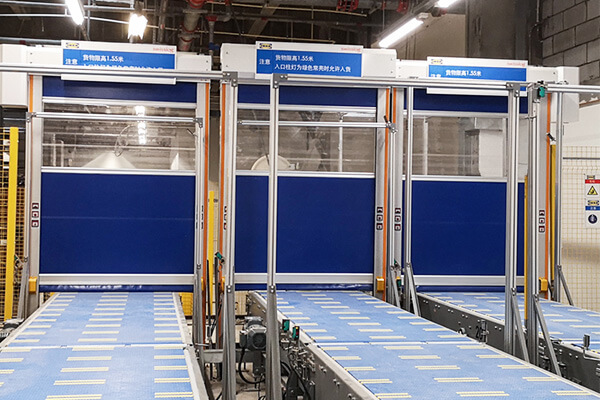
- Technical Analysis: Infrared safety light curtains or anti-crush bottom edges come standard on both sides of the conveyor opening.
- Core Function: If the sorting line experiences an abnormal halt, leaving a high-value parcel directly beneath the doorway, the light curtain instantly detects the obstacle. The door remains open or automatically rebounds upon contact, strictly preventing any severe “door crushing goods” accidents.
Conveyor Opening Protection Solutions
During production line design, engineering directors typically face a choice among these three solutions:
| Dimension | Open Hole | Hanging PVC Strip Curtains | Integrated Speed Roll Up Doors |
| Isolation: Noise/Dust | Zero isolation | Poor, leaks air and sound through gaps. | Excellent, tightly blocks >15dB noise. |
| Parcel Jam Risk | No jams | Very high, often snags bags causing rollovers. | Zero jams, pre-opens via system control. |
| Impact on Throughput | No impact | Slightly reduces, parcels face resistance pushing curtains. | No impact, supports 2m/s non-decelerated transit. |
| Automation Integration | N/A | N/A | Perfect WCS/PLC integration, outputs error signals. |
Case Study: Noise and Dust Reduction Retrofit at a Top E-commerce Sorting Center
- Background: In a massive international e-commerce hub, kilometers of conveyors passed from the storage zone into the manual packing zone. Originally, cheap PVC strip curtains were hung over the openings for environmental isolation. However, in practice, the curtains frequently snagged flimsy polymailers, causing parcels to roll over and pile up. Furthermore, the curtains failed to block the 85-decibel machine noise, leading to frequent complaints from manual review staff.
- Solution: The automation retrofit team removed all strip curtains and installed compact speed roll up doors at 12 conveyor wall openings, supporting the Profinet communication protocol and wired into the line’s main PLC.
- Measurable Results: Post-retrofit, downtime caused by parcel jams instantly dropped to 0. Environmental noise in the manual packing area plummeted by 15 decibels, vastly improving the workspace. Most importantly, during peak promotions like Double 11, the assembly line maintained full-load throughput; the millisecond door integration didn’t slow the logistics rhythm at all.
Conclusion & Integration Advice
The soul of an automated sorting line lies in “ultimate transit efficiency,” while workshop environmental control relies on “absolute physical isolation.” These two seem contradictory but can blend perfectly in the face of intelligent hardware.
Abandon those traditional plastic strip curtains that easily snag goods and leak sound and dust! We strongly advise system integrators and engineering heads to incorporate communication-protocol-supported speed roll up doors as standard automation peripheral nodes into their WCS planning from the very early stages of production line design. It is not just a door; it is an intelligent hub that ensures logistics flow and elevates the facility’s EHS compliance levels.
FAQ on Automated Line Door Integration
Q1: What industrial communication protocols do the door control systems support?
Professional industrial door control boxes come standard with rich I/O interfaces and support common industrial protocols like Modbus RTU, Profinet, and Ethernet/IP. This allows the door to act as a standard automation node, seamlessly integrating directly into mainstream PLC systems like Siemens, Mitsubishi, or Beckhoff.
Q2: Conveyor openings are often small with cramped installation spaces. Will the rapid door motor interfere with other equipment?
No. Compact rapid doors designed specifically for conveyor lines utilize an extremely tight aluminum frame structure. The motors support top-mount, side-mount, or even flush-mount installations to maximize spatial savings, ensuring they never interfere with nearby cable trays, barcode scanners, or pneumatic sorting arms.
Q3: How does the rapid door react if the assembly line triggers an Emergency Stop (E-stop)?
The door is deeply tied to the line’s PLC. Upon receiving a line E-stop signal, the door reacts based on pre-set logic: typically, it is programmed to “force roll-up and remain open.” This allows operators to quickly inspect parcel conditions on both sides of the opening and manually clear faults until the E-stop is reset.


