
Contents
- 1 Introduction
- 2 The Classic Cleanroom Dilemma: Pressure Control vs. Emergency Escape
- 3 Fatal Misconception: Why Speed Roll Up Doors with Emergency Release Cannot Replace Fire Doors?
- 4 Optimal Engineering Solutions: Balancing Efficient Logistics and Life Safety
- 5 Speed Roll Up Doors vs. Certified Fire Doors
- 6 Case Study: Why a CDMO Factory Smashed Walls Right Before Inspection?
- 7 Conclusion
- 8 FAQ for Fire Safety Inspections
Introduction
In the design of pharmaceutical facilities, an inherent contradiction exists: GMP regulations require cleanrooms to be highly sealed to maintain pressure differentials and prevent contamination, while fire safety codes (such as NFPA 101 Life Safety Code) demand that escape routes remain unobstructed at all times. Many engineers mistakenly believe that as long as speed roll up doors are equipped with “automatic power-off roll-up (UPS)” or “manual release levers,” they can serve as compliant fire escape doors. This is a highly dangerous industry myth! This article will analyze from the foundational fire codes why rapid doors must never solely replace certified fire doors, and provide the correct engineering solutions that balance both cleanroom integrity and fire safety.
The Classic Cleanroom Dilemma: Pressure Control vs. Emergency Escape
In modern biopharmaceutical plants, preventing cross-contamination is the core mission. Rapidly opening and closing doors effectively cut off air convection, making them standard for logistics aisles.
However, EHS (Environment, Health, and Safety) standards are equally stringent: any physical barrier that hinders personnel from quickly pushing a door open and exiting during a state of panic (e.g., power outages, heavy smoke) is strictly prohibited by law. How to balance these two needs is the primary focus of facility auditors.
Fatal Misconception: Why Speed Roll Up Doors with Emergency Release Cannot Replace Fire Doors?
1. Lack of Passive Fire Protection
Code Requirement: Compliant fire doors must possess a Fire Resistance Rating of 60, 90, or even 120 minutes for integrity and insulation to confine the fire within specific fire zones.
Rapid Door Flaw: Most rapid door curtain materials (like PVC or PU) rapidly melt and emit toxic smoke when exposed to open flames and extreme heat. They cannot serve as a physical barrier to stop fire spread.
2. Fails Panic Hardware Standards
Code Requirement: International life safety codes explicitly state that escape doors must open with a single push (requiring a Panic Bar) without the use of keys, special tools, or complex motions.
Rapid Door Flaw: Even if equipped with a manual release lever, requiring panicked personnel to locate and forcefully pull a specific lever in thick smoke completely contradicts human escape instincts.
3. Risk of Extreme Mechanical/Electrical Failure
While a backup UPS is great for routine power outages, under the extreme heat of a fire, the door’s control motherboard, sensors, or motors are highly prone to short-circuiting, melting, and jamming, turning the door into an impassable wall.
Optimal Engineering Solutions: Balancing Efficient Logistics and Life Safety
To successfully pass EHS and fire design reviews, pharmaceutical engineering typically adopts the following two compliant strategies:
Physical Separation
This is the most standard and widely used approach. Install speed roll up doors in the main aisle strictly for high-frequency AGV and material traffic; on the adjacent wall, install a normally-closed solid steel fire door equipped with a panic bar, strictly reserved for emergency personnel escape.
Non-Fire Rated Partitions
If the doorway itself is not a fire zone boundary (merely an internal partition between cleanrooms of the same grade), a “Breakaway Escape Panel” can be installed on the adjacent wall as an auxiliary escape route during emergencies.
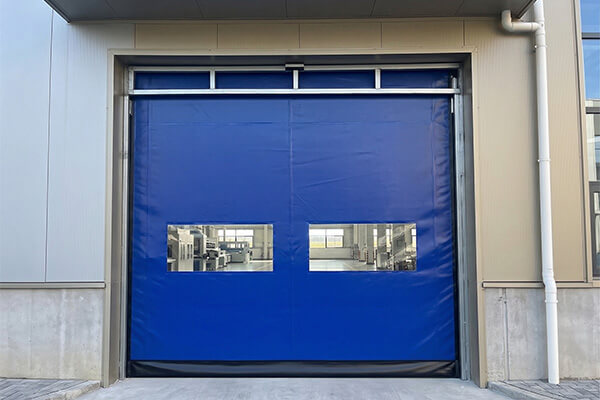
Speed Roll Up Doors vs. Certified Fire Doors
| Dimension | Speed Roll Up Doors | Certified Solid Fire Doors | Compliance Impact |
| Core Function | High-frequency logistics, dynamic pressure control. | Blocking fire spread, ensuring life escape. | Functions must never be mixed; separate physically. |
| Fire Rating | None; melts upon direct flame. | 60 / 90 / 120 minutes ratings. | Fire zone boundaries mandate fire-rated doors. |
| Escape Mechanism | Manual lever or UPS pop-up – non-compliant. | Panic Bar – opens with a simple push. | Escape must align with human panic instincts. |
| Fire Inspection | Fails inspection as the sole escape exit. | 100% meets NFPA and local fire codes. | Non-compliant design risks severe shutdown penalties. |
Case Study: Why a CDMO Factory Smashed Walls Right Before Inspection?
- Background: A newly built CDMO facility installed only speed roll up doors with UPS power in all cleanroom corridors to pursue ultimate aesthetics and material flow efficiency.
- Inspection Crisis: During the joint fire inspection on the eve of production, the auditor issued a red flag, pointing out that the rapid doors failed NFPA 101 “panic hardware” requirements, citing a massive life safety hazard.
- Solution: The plant was forced to halt and delay operations. They urgently hired a team to smash the cleanroom sandwich panels next to the rapid doors to install 15 normally-closed solid fire escape doors with Panic Bars. This rework cost the factory nearly a month of capacity and hundreds of thousands in modification costs.
Conclusion
In pharmaceutical engineering construction, efficiency and cleanliness are certainly important, but they must never supersede life safety.
Clarifying the functional boundaries of doors is crucial: let speed roll up doors handle what they do best—high-frequency logistics and dynamic pressure control; and let authoritative certified solid fire doors protect your employees’ escape routes. We strongly recommend that engineering teams bring door suppliers and EHS fire consultants to the same table during the initial blueprint planning phase to avoid fatal reworks later on.
FAQ for Fire Safety Inspections
Q1: If my speed roll up doors use “Flame Retardant” curtains, do they count as fire doors?
Absolutely not. “Flame Retardant” simply means the material self-extinguishes and is hard to ignite; “Fire Resistance” means the door structure can withstand extreme heat for a specified time, blocking fire and heat spread. Flame-retardant rapid doors still fail fire partition inspections.
Q2: Do fire departments allow rapid doors to link with the Fire Alarm System (FAS)?
Allowed and mandatory. In standard compliant designs, when a fire alarm triggers, the FAS forces the rapid door’s standard power off, and uses internal UPS or counterweights to forcefully roll the door up and keep it open. This is only to prevent the door from blocking the aisle; the door itself still lacks fire separation and legal escape exit qualifications.


