
Contents
- 1 Introduction
- 2 The Hidden Dangers in High-Traffic Logistics Hubs
- 3 How Do Infrared Safety Sensors Work on a Fast Roll Up Door?
- 4 Safety Photocells vs. Light Curtains: What’s the Difference?
- 5 3 Reasons Why Infrared Sensors Are a Non-Negotiable Investment
- 6 Integrating Sensors with Automated Warehouses (AGVs)
- 7 Real-World Case Study: Zero Accidents at a Global Cold Chain Facility
- 8 FAQ
Introduction
In any busy logistics center or manufacturing plant, efficiency is money. However, safety is the ultimate veto power. According to industry data, forklift and pedestrian collisions at warehouse doorways cause millions of dollars in damages and severe downtime every year. When you install a fast roll up door to improve traffic flow, its operating speed—often exceeding 1.5 meters per second—means that traditional mechanical safety bottom edges may not react fast enough during a high-speed descent.
The ultimate solution to achieving a “zero-accident” warehouse is the integration of non-contact barriers: Infrared Photoelectric Sensors and Safety Light Curtains.
The Hidden Dangers in High-Traffic Logistics Hubs
Modern warehouses are complex environments where forklifts, Automated Guided Vehicles (AGVs), and pedestrian workers operate in close proximity. Doorway zones are notorious hazard hotspots due to natural blind spots and the speed differential between fast-moving vehicles and descending doors. Without an advanced electronic eye continuously monitoring this threshold, the risk of a fast roll up door striking a worker or an expensive loaded pallet increases dramatically.
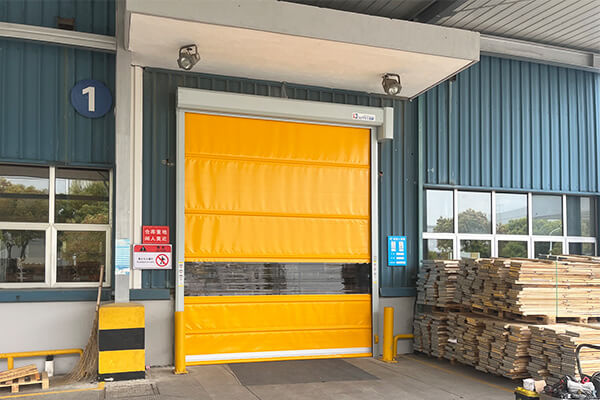
How Do Infrared Safety Sensors Work on a Fast Roll Up Door?
Infrared safety sensors project invisible light beams across the door opening, creating a “virtual wall”. If an object, person, or forklift breaks this beam while the fast roll up door is closing, the control box instantly receives a signal. Within milliseconds, the motor halts the downward movement and reverses the door to the fully open position.
Safety Photocells vs. Light Curtains: What’s the Difference?
To meet different EHS standards, facilities usually choose between single-point photocells and full-height light curtains. Here is a quick comparison:
| Feature | Single-Point Photocells | Safety Light Curtains |
| Coverage | A single horizontal line, typically installed 30-50 cm above the floor. | A large vertical grid, covering up to 2 meters in height. |
| Best For | Standard warehouses with basic protection needs and low pedestrian traffic. | Complex logistics hubs with mixed traffic (AGVs, forklifts) and high-value pallets. |
| Security Level | Basic | Absolute Safety |
3 Reasons Why Infrared Sensors Are a Non-Negotiable Investment
1. Absolute Protection for Personnel
Life safety is priceless. Relying solely on a mechanical bottom edge means the door must physically hit a worker’s hard hat or shoulder to stop. Non-contact infrared sensors ensure the door reverses before making any physical contact, aligning perfectly with strict OSHA compliance for industrial environments.
2. Safeguarding High-Value Goods
Imagine a fast roll up door crashing down on a pallet of precision electronics or sensitive pharmaceuticals. The financial loss of the damaged goods far exceeds the cost of the door itself. Light curtains provide top-to-bottom protection for loads of varying heights.
3. Preventing Door Damage and Costly Downtime
By detecting forklifts early, infrared sensors prevent the heavy forks from piercing the door curtain. This protects your equipment investment and ensures continuous 24/7 operations without costly maintenance breaks.
Integrating Sensors with Automated Warehouses (AGVs)
In Industry 4.0 applications, a fast roll up door doesn’t just work in isolation. Modern infrared safety systems communicate directly with the Warehouse Management System (WMS) and AGVs. If a sensor detects an obstruction, it can halt the descending door and simultaneously send a “stop” signal to an approaching AGV, preventing system-wide jams and ensuring smooth automated material handling.
Real-World Case Study: Zero Accidents at a Global Cold Chain Facility
Client Background: A major European cold chain logistics center processing over 5,000 pallets daily.
The Challenge: They experienced frequent door-to-forklift collisions, causing thermal leaks (loss of -18°C temperature) and high repair bills. Their old doors relied on basic pressure sensors.
The Solution: We upgraded their facility with our premium fast roll up doors equipped with 2-meter-high Safety Light Curtains.
The Results:
- Accidents Reduced: 100% reduction in door-related collisions over 12 months.
- ROI Achieved: Maintenance costs dropped by $15,000 annually, paying off the sensor upgrades within just 4 months.
“The cost of one accident far exceeds the investment in a premium light curtain system. It’s a fundamental requirement for modern warehousing.” — Technical Director, SEPPES
Conclusion
Safety sensors are not just optional accessories; they are the backbone of corporate responsibility and operational efficiency. Choosing the right configuration for your fast roll up door protects your most valuable assets: your people and your products.
Are you unsure if your current doorway security meets modern standards? Contact our industrial door experts today for a free safety assessment or request a quote for a customized door system equipped with advanced light curtains.
FAQ
Q1: Can I upgrade my existing fast roll up door with safety light curtains?
A1: Yes. Most high-quality fast roll up doors with PLC control panels can be retrofitted with light curtains. Our engineers can guide you through the compatibility assessment.
Q2: Do infrared sensors work in dusty or cold warehouse environments?
A2: Industrial-grade infrared sensors and light curtains come with high IP ratings (e.g., IP65 or IP67), making them resistant to dust and moisture. For cold storage, specialized heated sensors are used to prevent frost interference.
Q3: Are safety light curtains required by law?
A3: While specific regulations vary by country, upgrading to non-contact sensors ensures compliance with strict workplace safety standards like OSHA (US) and EN 13241-1 (Europe).


